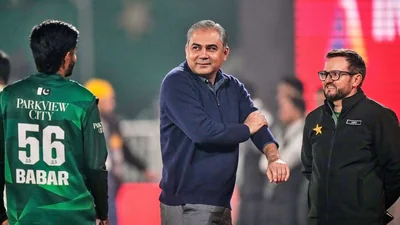
Mushtaq Ahmed PCB coaching has become a talking point after the former Pakistan spinner admitted that he feels hesitant about taking up a coaching position with the national team. His comments come at a difficult moment for Pakistan Cricket, with the Pakistan Cricket Board facing renewed criticism over major changes made during the ongoing England Test tour.
Mushtaq’s position is notable because his hesitation does not appear to come from a lack of desire to work with Pakistan. Instead, he pointed toward uncertainty surrounding coaching jobs, decision-making and the possibility of being removed abruptly. For a former international cricketer who says he wants to help Pakistan’s players improve, that uncertainty represents a significant barrier.
Why Mushtaq Ahmed Is Hesitant About a Pakistan Coaching Role
Mushtaq Ahmed has made it clear that coaching Pakistan remains something he would genuinely like to do. He believes he could help international players regain confidence and build a stronger team environment.
However, the former spinner identified job security and institutional stability as major concerns. His comments suggest that experienced former players may think twice before accepting national coaching responsibilities if they believe short-term results or emotional decisions could quickly end their tenure.
That issue goes beyond one potential appointment. Coaching a national side requires months of planning, player development and tactical preparation. If coaches are constantly worried about being removed, it can become difficult to establish a consistent philosophy.
Mushtaq’s comments therefore highlight a wider question for Pakistan cricket: can the PCB create an environment where coaches are given enough time to implement their plans?
PCB’s Mid-Tour Changes Sparked Fresh Debate
The controversy intensified after the PCB made major changes during Pakistan’s England tour. Seven players were sent back to Pakistan following defeats in the opening two Tests, while changes were also made to the coaching staff.
Among the players reportedly sent home were Mohammad Rizwan, Imam-ul-Haq and Salman Ali Agha. The coaching structure also changed, with Sarfaraz Ahmed and Umar Gul replaced during the tour by Mike Hesson and Ashley Noffke.
For Mushtaq, the timing was particularly difficult to understand. He argued that major decisions involving players and coaches should generally be handled with greater calm, particularly while a Test series is still underway.
His criticism is not simply about whether individual players or coaches deserved to remain in their positions. Instead, it focuses on the process and timing of the decisions.
Why Mid-Series Coaching Changes Can Be Difficult
Test cricket places enormous importance on preparation and continuity. Players spend weeks preparing for specific opponents, while coaches develop plans around pitch conditions, opposition weaknesses and individual player roles.
Changing several members of the setup in the middle of a tour can therefore create disruption at a particularly sensitive stage.
A new coaching team may have different ideas about selection, batting positions, bowling workloads and fielding strategies. Players then have to adapt while simultaneously trying to perform in international matches.
There can be situations where an immediate change is justified. Poor results, serious disagreements or wider problems can force boards to act quickly. But Mushtaq’s argument is that such decisions should be supported by a clear rationale rather than appearing emotional or reactive.
Mushtaq Ahmed’s International Experience Adds Weight to His View
Mushtaq Ahmed is not commenting as an outsider unfamiliar with international cricket. The former leg-spinner played 52 Tests and 144 ODIs for Pakistan, giving him extensive experience of the pressures surrounding the national team.
His playing career also means he understands the relationship between players, coaches and administrators from multiple perspectives.
For former players considering coaching roles, the environment created by a national board can be just as important as salary, responsibilities or the prestige of the position.
A coach needs authority to make decisions, support from administrators and enough time to evaluate whether those decisions are working. Without those conditions, even an experienced coach can struggle to build a stable team.
The Bigger Problem: Continuity in Pakistan Cricket
The latest dispute has revived a familiar conversation around Pakistan cricket: how much stability should coaches and captains receive?
International cricket rarely produces immediate results from every strategic change. A young player may need several matches to adapt to Test cricket. A new bowling combination may require time to develop. Even a successful team can experience short-term defeats without necessarily needing a complete overhaul.
This is where continuity becomes important.
If every disappointing series leads to significant changes, the next coaching group inherits a team that may already be undergoing another transition. Over time, this can create a cycle in which Pakistan repeatedly changes direction without allowing one long-term plan to mature.
Mushtaq’s comments effectively question whether that cycle can be broken.
Mohsin Naqvi and the PCB Face a Leadership Challenge
The debate also places attention on PCB chairman Mohsin Naqvi and the board’s approach to cricket management.
For any cricket administrator, balancing immediate results with long-term development is difficult. A national team represents a country’s sporting ambitions, meaning defeats can quickly produce public pressure.
However, strong administration requires decisions to be based on clearly defined objectives. If coaches and players believe their positions can change suddenly after a small run of poor results, uncertainty can spread through the dressing room.
The PCB therefore faces a broader leadership challenge: demonstrating that selection and coaching decisions are part of a coherent strategy rather than isolated reactions to individual results.
Why Former Players May Be Reluctant to Return
Pakistan has a large pool of former international cricketers with valuable knowledge. Many understand local cricket culture, player development and the unique pressures surrounding the national side.
Yet former players may be reluctant to accept coaching positions if they believe the role carries substantial professional risk without corresponding institutional support.
Mushtaq’s comments are important in this context. He did not reject the idea of coaching Pakistan. In fact, he expressed enthusiasm about helping the team. His concern was whether the system would provide enough stability for him to do the job effectively.
That distinction matters.
The challenge for the PCB is not simply finding a famous former cricketer to join the coaching staff. It is creating conditions that make experienced candidates willing to commit to the role for the long term.
What Mushtaq Could Bring to Pakistan’s Team
Mushtaq has experience as both an international player and a coach, giving him an understanding of technical development as well as the psychological side of elite cricket.
His stated objective would be to improve player confidence and create a unit capable of challenging stronger opposition. That approach could be particularly valuable for a Pakistan side attempting to develop greater consistency in Test cricket.
Spin bowling is another area where Mushtaq’s expertise could be useful. As a former high-level leg-spinner, he understands the technical and tactical demands involved in developing attacking spin options.
But expertise alone cannot guarantee success. Any coach needs a stable structure around them, clear selection policies and support from the board.
Pakistan’s England Test Series Now Has Added Pressure
Pakistan’s third and final Test against England is scheduled to begin on September 9 in Birmingham. After losing the opening two matches, Pakistan enters the final Test with the series already beyond its reach.
The immediate objective will be to avoid a clean sweep and finish the tour with a stronger performance.
But the match also carries significance beyond the result. With major personnel changes already made, the new coaching setup will be under scrutiny from the beginning.
Players returning to the field will have to adjust quickly to new expectations, while the coaching staff will have limited time to establish its influence during the tour.
Criticism From Former England Figures Highlights Wider Concerns
The PCB’s decisions have also attracted criticism from prominent cricket figures, including Michael Atherton, Nasser Hussain and Jason Gillespie.
The fact that the changes have generated discussion beyond Pakistan demonstrates how unusual mid-tour restructuring can appear in international cricket.
Criticism does not automatically mean that every PCB decision was incorrect. Cricket boards sometimes have information that is unavailable to the public. But when major decisions are made during a tour, transparency becomes especially important.
Clear communication can help explain why changes were necessary and what the board expects to achieve from them.
Stability Could Be the Real Test for the PCB
The central issue raised by Mushtaq Ahmed is ultimately bigger than one coaching appointment.
Pakistan cricket needs a system in which coaches can plan beyond the next match, players understand their roles and administrators maintain clear performance standards. That does not mean coaches should never be replaced. Accountability remains essential at international level.
The key is distinguishing between necessary accountability and constant instability.
A strong cricket structure should be capable of making difficult decisions without creating the impression that every setback could trigger another major reset.
What This Means for Pakistan Cricket’s Future
Mushtaq Ahmed’s comments provide an interesting measure of how former Pakistan cricketers view the national setup. His willingness to serve Pakistan remains clear, but so does his concern about the environment in which coaches operate.
If the PCB wants to attract experienced former players, it may need to focus not only on who joins the coaching staff but also on how the system supports them after they arrive.
The immediate focus will be the final Test against England. The longer-term question, however, is whether Pakistan can establish enough continuity to build a team rather than repeatedly rebuild one.
For Mushtaq, the door to coaching Pakistan appears open. Whether he, or other experienced former players, feels confident enough to walk through it may depend on how the PCB addresses the very instability he has highlighted.
For breaking news and live news updates, like us on Facebook or follow us on Twitter and Instagram. Read more on Latest Cricket on thefoxdaily.com.






COMMENTS 0