
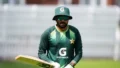
Shaheen Afridi Test comeback hopes have received a boost after the Pakistan fast bowler reaffirmed his commitment to red-ball cricket ahead of the President’s Trophy. Afridi is set to represent KRL when the domestic first-class competition begins on Saturday, marking his first first-class appearance in Pakistan in seven years.
The left-arm seamer has not been part of Pakistan’s recent Test squads for tours of the West Indies and England. His absence has coincided with questions over his place in the Test setup and perceptions that his workload and priorities have shifted toward limited-overs cricket.
Afridi has now made his position clear: red-ball cricket remains his first priority. His return to domestic four-day cricket gives him an opportunity to address both his match fitness and his bowling rhythm while making a fresh case for selection.
Shaheen Afridi returns to first-class cricket after seven years
Afridi’s return to Pakistan’s first-class competition carries an interesting piece of history. He last played a first-class match in Pakistan for KRL in 2017, when he announced himself in spectacular fashion as a teenager.
At just 17, Afridi produced figures of 8 for 39 on his first-class debut. That performance immediately highlighted the potential of a bowler who would later become one of Pakistan’s most recognisable fast-bowling figures.
Seven years later, he is returning to the same level of cricket for a very different reason. This time, the objective is not simply to announce his arrival but to rebuild the foundations required for sustained success in Test Cricket.
International cricket has kept Afridi extremely busy since his breakthrough. Playing across Tests, ODIs and T20Is has limited the amount of domestic red-ball cricket he has been able to play.
His upcoming President’s Trophy campaign therefore offers something international cricket cannot always provide: extended spells, longer periods on the field and the opportunity to work through bowling plans without the pressure of a short-format game.
Why red-ball cricket remains important to Afridi
Afridi has stressed that his love for red-ball cricket has never disappeared. The lack of regular first-class appearances has largely been a consequence of his international schedule rather than a rejection of the format.
For a fast bowler, first-class cricket can be especially valuable because it forces the player to think beyond individual deliveries. Bowlers have to build spells, manage energy, understand how a batter is responding and maintain discipline over long periods.
Afridi’s comments suggest that he sees the President’s Trophy as an opportunity to return to those fundamentals.
His plan is straightforward: bowl in domestic cricket with the same principles he has used successfully in Test cricket, while using longer spells to sharpen his line and length.
Can domestic cricket help Shaheen regain his Test place?
Pakistan’s recent Test selections have placed greater emphasis on medium-fast options, while Afridi’s position in the red-ball attack has become less secure.
His previous Test performances provide part of the explanation. After an explosive beginning to his Test career, his effectiveness declined, particularly following the knee problems that disrupted his progress.
The source material notes that Afridi’s most recent 27 Test wickets have come at an average of more than 40. That represents a substantial difference from the standards he established earlier in his career and helps explain why Pakistan’s selectors have looked for alternatives.
The President’s Trophy could therefore become an important evaluation point. Strong performances would not automatically guarantee selection, but they could demonstrate that Afridi is regaining the control, pace and endurance expected from a Test fast bowler.
The importance of bowling rhythm for a fast bowler
Fast bowling is heavily dependent on rhythm. A bowler can possess pace and skill but still struggle if the run-up, release point and overall movement are not synchronised.
First-class cricket provides the chance to rebuild that rhythm gradually.
Instead of bowling only a short number of overs in a T20 match, Afridi can potentially operate through multiple spells and learn how his body responds across a longer period. That is particularly relevant for a player who has experienced injury problems during his career.
The challenge will be to find the right balance between intensity and workload. The goal is not simply to produce one spectacular spell but to demonstrate consistency across an entire first-class match.
What Afridi can learn from his brother Riaz
Afridi has also highlighted the influence of his elder brother Riaz Afridi, who has extensive first-class experience.
That experience has shaped Shaheen’s understanding of the longer format. One of the key lessons is that spending more time on the field can help a bowler develop confidence while naturally refining line and length.
That principle is particularly relevant to Afridi’s current situation. He does not need to rediscover how to bowl a fast delivery. Instead, he needs sustained opportunities to repeat the right actions and build consistency.
Domestic cricket can provide exactly that environment.
England series exposed Pakistan’s pace concerns
Pakistan’s recent Test performances in England have also highlighted why a bowler of Afridi’s ability could be valuable if he returns to his best.
The Pakistan attack lacked the pace and variety that England were able to produce. The contrast was particularly noticeable during the recent Test series, when England’s fast bowlers repeatedly created pressure with movement, aggression and sustained intensity.
That does not mean Afridi would automatically solve Pakistan’s bowling problems. His selection will depend on form, fitness and tactical requirements. However, a fully firing left-arm quick would give Pakistan a different dimension from a predominantly medium-fast attack.
Afridi’s left-arm angle is itself an important tactical weapon. Combined with genuine pace and the ability to move the new ball, it can create different problems for right- and left-handed batters.
Why the President’s Trophy could be a turning point
The President’s Trophy arrives at an important stage of Afridi’s career.
He remains captain of Pakistan’s ODI team and recently enjoyed a productive Champions Cup campaign. Afridi finished as the tournament’s leading wicket-taker and helped Pakistan Gold win the competition after taking 7 for 36 in the final.
That performance shows that his bowling ability remains capable of producing major results in limited-overs cricket. The next challenge is translating that momentum into the longer format.
The President’s Trophy can serve as the bridge between those two worlds.
| Area | Why it matters for Afridi |
|---|---|
| First-class cricket | Provides extended spells and longer periods on the field |
| Bowling rhythm | Allows him to repeat his action and sharpen consistency |
| Fitness | Tests his ability to handle the demands of longer cricket |
| Line and length | Extended spells encourage greater discipline |
| Test selection | Strong domestic performances can strengthen his case |
Afridi’s recent Champions Cup success provides confidence
There is already evidence that Afridi can make an impact when he is in rhythm.
His Champions Cup campaign was one of the strongest recent indicators of his form. He finished as the competition’s leading wicket-taker and played a major role in Pakistan Gold’s title-winning campaign.
The final was the clearest example. Afridi claimed 7 wickets for 36 runs, producing the type of match-defining spell that Pakistan would hope to see from him in international cricket.
The challenge now is different. One-day cricket rewards short, high-intensity spells, while Test cricket requires a bowler to repeat that quality over significantly longer periods.
That is why his first-class return matters even after a successful Champions Cup.
Pakistan’s upcoming schedule creates a major opportunity
Afridi’s domestic red-ball campaign comes before a demanding international schedule.
He is expected to lead Pakistan in a home tri-series involving England and Sri Lanka in the ODI format. After that, Pakistan have two home Test assignments, against Sri Lanka and New Zealand.
Those Test series could provide Afridi with a realistic route back into the national side if his domestic performances are strong enough.
The timing could hardly be more useful. Instead of returning directly to Test cricket after a lengthy red-ball gap, Afridi has the chance to build himself back through domestic matches first.
That pathway could also give Pakistan’s selectors more evidence before making a decision.
What Afridi must prove before a Test recall
Getting back into Pakistan’s Test squad will require more than a single impressive spell.
First, Afridi must demonstrate that he can maintain a strong pace and accurate line over long spells. Test cricket places a different physical demand on fast bowlers, particularly when conditions do not offer immediate assistance.
Second, he needs to show that his body can handle repeated workloads. His injury history means fitness will naturally remain part of the selection discussion.
Third, consistency will be crucial. Pakistan need a bowler who can create pressure even when wickets are not arriving quickly.
Finally, Afridi must convince the selectors that he can provide greater impact than the alternatives currently being used in the Test side.
Red-ball cricket could also protect Afridi’s long-term career
Regular first-class cricket is not only about selection. It can also help an international fast bowler maintain important technical habits.
Short-format cricket often encourages variations, changes of pace and attacking plans designed for immediate results. Test cricket requires a different mindset, with greater emphasis on patience and sustained pressure.
Returning to domestic red-ball cricket can help Afridi reconnect with that approach.
It could also provide an opportunity to manage his workload in a controlled environment. Rather than immediately being asked to deliver at international level, he can build up through domestic competition and learn how his body responds.
Could Afridi return to Pakistan’s Test attack?
The door is clearly not closed.
Afridi has publicly stated that he wants to regain his Test place, and his decision to play the President’s Trophy demonstrates a willingness to take the domestic route toward that goal.
Whether he returns will ultimately depend on what happens on the field.
If he produces consistent spells, maintains his pace, stays fit and takes wickets, the selectors will have a strong reason to reconsider his position. If his domestic performances remain below the required standard, Pakistan may continue with the bowlers already preferred by the management.
That makes the President’s Trophy more than a routine domestic assignment for Afridi. It is effectively an audition for the next stage of his Test career.
Final Verdict
Shaheen Shah Afridi’s return to first-class cricket represents an important step in his attempt to rebuild his Test career. The left-arm seamer has made it clear that red-ball cricket remains his first priority, and playing for KRL gives him the opportunity to demonstrate that commitment on the field.
The bigger challenge will be turning that commitment into consistent performances. Afridi’s recent Test numbers have declined from the exceptional standards of his early career, while injury and limited red-ball opportunities have complicated his progress.
His Champions Cup success provides an encouraging starting point, but four-day cricket will test him differently. Long spells, sustained pace, fitness, discipline and repeatability will all matter.
With home Test series against Sri Lanka and New Zealand coming later in the season, Afridi has a realistic window to push his name back into Pakistan’s plans. The path is clear: perform strongly in domestic cricket, stay healthy and prove that the explosive Test bowler Pakistan once relied upon is ready to return.
For breaking news and live news updates, like us on Facebook or follow us on Twitter and Instagram. Read more on Latest Cricket on thefoxdaily.com.





COMMENTS 0