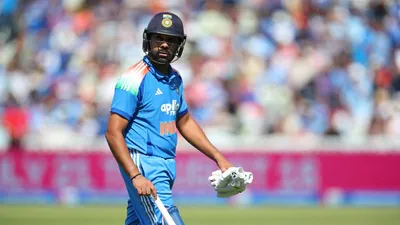
Few debates in sport are as emotionally charged as the battle between proven greatness and future potential.
Every generation eventually reaches a crossroads where legendary players begin competing not only against opponents but also against time itself. Indian cricket now finds itself confronting that reality with Rohit Sharma.
Recent discussions surrounding Rohit’s future have extended far beyond a single ODI series against England. They have evolved into a broader conversation about India’s long-term strategy, succession planning, and the difficult choices that every successful sporting nation must eventually make.
While speculation about retirement continues to dominate headlines, the deeper issue is whether Rohit Sharma remains part of India’s blueprint for the 2027 ODI World Cup or whether Indian cricket has already begun preparing for life after one of its most influential white-ball batters.
The answer carries implications not just for Rohit but for the future direction of Indian cricket itself.
The Rohit Sharma Question Is Bigger Than Retirement
Discussions about Rohit Sharma often become polarized.
One side points to his extraordinary achievements, arguing that players of his caliber deserve patience and trust. The other side focuses on current performances, insisting that selection should be based solely on present output rather than past accomplishments.
In reality, both arguments contain elements of truth.
Rohit’s status as one of the greatest ODI batters in cricket history is beyond dispute. Equally undeniable is the fact that international sport rewards current performance, not historical achievements.
This creates a dilemma that selectors must navigate carefully.
Understanding Rohit Sharma’s ODI Legacy
Before assessing the future, it is important to appreciate the scale of what Rohit has already achieved.
Few players have shaped ODI batting as dramatically as he has.
| Achievement | Why It Matters |
|---|---|
| Three ODI Double Centuries | Most by any player in ODI history |
| Five World Cup Centuries in 2019 | One of the greatest World Cup campaigns ever |
| Over 11,000 ODI Runs | Among cricket’s elite run-scorers |
| Champions Trophy Success | Key contributor in major ICC tournaments |
| Revolutionized Opening Batting | Combined aggression with consistency |
These achievements guarantee Rohit’s place among cricket’s all-time greats regardless of what happens next.
The challenge facing selectors is not evaluating his career. It is determining whether his future contribution justifies a place in India’s next World Cup plans.
The Reality of Being a One-Format Cricketer
One factor often overlooked in discussions about Rohit’s recent performances is his unique position within modern international cricket.
Since stepping away from other formats, Rohit has effectively become a specialist ODI player.
This presents challenges that younger multi-format players rarely encounter.
Unlike cricketers who regularly move between Tests, T20Is, franchise leagues, and ODIs, a specialist ODI batter often experiences lengthy gaps between international appearances.
Maintaining rhythm, timing, and competitive sharpness becomes significantly more difficult.
While franchise cricket helps, the demands of ODI cricket remain unique.
This context does not excuse poor performances, but it does help explain why consistency becomes harder to sustain as opportunities become less frequent.
Why Age Matters Even for Great Players
Age alone should never determine selection.
Elite athletes continue to challenge conventional expectations across multiple sports.
However, age inevitably changes how performance is evaluated.
A temporary slump from a 24-year-old is viewed as part of development. A similar slump from a 39-year-old invites questions about decline.
This is not unfairness. It is simply the reality of professional sport.
Selectors must evaluate whether a player’s current level can be maintained over the next 12 to 18 months rather than merely over the next series.
That assessment becomes particularly important when planning for a major tournament like the ODI World Cup.
The Yashasvi Jaiswal Factor
No discussion about Rohit Sharma’s future is complete without examining the rise of Yashasvi Jaiswal.
The talented left-hander represents exactly the kind of player selectors typically prioritize when planning for the future.
Young, aggressive, adaptable, and capable of becoming a long-term solution at the top of the order, Jaiswal embodies India’s next generation.
His emergence has inevitably increased pressure on senior players.
Cricket history shows that transitions rarely occur because legends suddenly stop performing. More often, they happen because exceptional young players force their way into contention.
That appears to be the situation India currently faces.
The 2027 World Cup Timeline Creates Urgency
If the next ODI World Cup were only a few months away, the argument for retaining Rohit would likely be stronger.
Experience often becomes invaluable during major tournaments.
However, the tournament remains approximately 15 months away.
This timeline changes the equation considerably.
Selectors must ask several critical questions:
- Who will form India’s opening partnership in 2027?
- How much preparation time do younger players need?
- Can India afford to delay transition planning?
- Will current veterans still be operating at peak level?
- What combination provides the highest long-term upside?
These questions extend beyond Rohit and apply to every senior player approaching the final stages of an international career.
A Lesson from Previous Indian Cricket Transitions
Indian cricket has experienced similar moments before.
Transitions involving legendary players are rarely smooth.
Whether it was Sachin Tendulkar, Rahul Dravid, VVS Laxman, Virender Sehwag, or more recently players like Shikhar Dhawan, every era eventually reaches a point where difficult decisions become unavoidable.
The challenge is balancing respect for past achievements with the practical demands of future success.
History suggests that delaying transitions often creates more problems than solving them.
At the same time, moving on too quickly can deprive younger players of valuable mentorship and experience.
Finding the right balance is one of the hardest jobs in cricket administration.
The Hidden Side of Selection: Team Building vs Individual Careers
One aspect frequently overlooked in public debate is that selectors are not tasked with managing individual careers.
Their responsibility is to build the strongest possible team.
This distinction matters.
From an individual perspective, Rohit may still believe he has unfinished business and enough quality to compete at the highest level.
From a team-building perspective, selectors must evaluate whether investing those opportunities in younger players would better serve India’s long-term objectives.
These perspectives are not necessarily aligned.
That tension often defines major sporting transitions.
Has ODI Cricket Changed Beyond Rohit’s Strengths?
Modern ODI cricket is evolving rapidly.
The format increasingly rewards:
- Explosive starts.
- Dynamic fielding.
- Exceptional fitness.
- Positional flexibility.
- Fast running between wickets.
Rohit remains an outstanding batter capable of changing matches.
However, selection decisions now involve evaluating complete contributions rather than batting alone.
Teams increasingly seek players who can influence multiple phases of a game.
This broader evaluation framework naturally affects senior players more than emerging talents.
A Contrarian View: Why Writing Off Rohit Could Be Premature
While many analysts believe India’s future lies elsewhere, there is also a compelling argument for caution.
Elite performers often produce their best cricket when challenged.
Rohit has repeatedly demonstrated an ability to respond when doubts emerge.
His World Cup record, leadership experience, and ability to deliver in high-pressure matches remain significant assets.
Cricket history is filled with examples of veterans being written off too early only to produce remarkable late-career revivals.
That possibility cannot be completely dismissed.
Selectors therefore face a delicate balancing act between preparing for the future and avoiding premature decisions.
The Most Likely Scenario for Rohit Sharma
The most realistic outcome may not involve an immediate retirement or an automatic World Cup selection.
Instead, Rohit appears likely to enter a phase where every series becomes an evaluation.
Future selection decisions will probably depend on:
- Consistent run-scoring.
- Fitness levels.
- Team combination requirements.
- Performance of younger alternatives.
- India’s evolving World Cup strategy.
In many ways, Rohit’s international future now rests less on reputation and more on tangible output.
That is often how sporting careers enter their final chapters.
Prediction: India’s World Cup Squad Will Reflect a New Era
Looking ahead to 2027, India’s ODI squad is likely to feature a stronger emphasis on youth than recent editions.
The combination of emerging talent and evolving tactical demands suggests selectors will gradually move toward a younger core.
Whether Rohit remains part of that group depends largely on his ability to outperform direct competitors over the next year.
The window remains open, but it is undoubtedly narrower than before.
Conclusion: The Debate Is No Longer About the Past
Rohit Sharma’s place in cricket history is secure.
Nothing that happens over the next year will diminish his achievements, records, or influence on Indian cricket.
The real debate is no longer about what he has accomplished. It is about what India needs next.
As the countdown to the 2027 ODI World Cup continues, selectors must make a difficult decision between continuity and transition, experience and potential, legacy and future planning.
Rohit may still have memorable innings left to play. He may even force his way back into India’s long-term plans through sheer weight of performance.
But for the first time in his ODI career, the conversation is being driven less by what he has done and more by what comes after him.
That is the reality every sporting great eventually faces—and Indian cricket now stands at that crossroads with one of its finest ever white-ball cricketers.
For breaking news and live news updates, like us on Facebook or follow us on Twitter and Instagram. Read more on Latest Sports on thefoxdaily.com.






COMMENTS 0