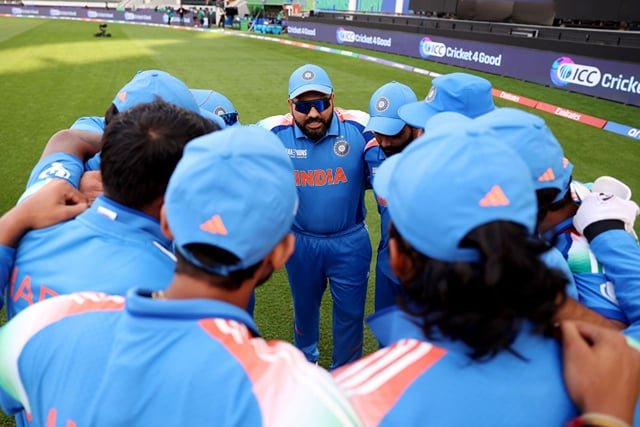
Rohit Sharma once again showed his sharp cricketing awareness during the first ODI between India and West Indies at the Greenfield International Stadium in Thiruvananthapuram on Sunday, September 27, 2026.
While Shubman Gill led India on the field, former captain Rohit Sharma was heard giving a brief but useful piece of advice to veteran all-rounder Ravindra Jadeja. The exchange was picked up by the stump microphone and quickly became one of the talking points from the match.
Jadeja had been introduced into the attack during the ninth over after West Indies made a strong start with the bat. However, the left-arm spinner conceded 16 runs in his first over. Seeing that the faster deliveries were coming onto the bat nicely, Rohit suggested that Jadeja reduce his pace through the air.
“Jaddu, thoda dheere daal,” Rohit was heard saying. He then explained that bowling faster was allowing the ball to come onto the bat comfortably.
What Did Rohit Sharma Tell Ravindra Jadeja?
The short conversation provided an interesting glimpse into Rohit Sharma’s role around the Indian team despite no longer being the ODI captain.
Rohit advised Jadeja to slow down his deliveries because the pitch appeared to be offering conditions in which quicker bowling could make stroke-making easier for the batters.
The advice was particularly relevant because West Indies had already established considerable momentum by the time Jadeja entered the attack. Openers John Campbell and Justin Greaves put together a 135-run partnership, putting pressure on the Indian bowlers during the early stages of the innings.
Jadeja’s first over went for 16 runs, prompting Rohit to communicate the adjustment from the boundary. Rather than suggesting a major change to Jadeja’s bowling style, the advice was a simple tactical tweak: take some pace off the ball.
Such moments are often valuable in ODI cricket, where small changes in pace, length and trajectory can influence how easily batters can attack a bowler.
West Indies Make Strong Start Against India
West Indies won the early battle after India won the toss and elected to field first in Thiruvananthapuram.
John Campbell and Justin Greaves gave the visitors an excellent platform by adding 135 runs for the opening wicket. Their partnership meant India had to work hard to create the first breakthrough.
Jadeja was brought into the attack during the ninth over as India looked for a way to slow down the scoring rate. However, his opening over proved expensive, with the West Indies batters finding ways to attack the spinner.
Rohit’s intervention came during this phase of the innings. His message to Jadeja was straightforward: reduce the pace and avoid giving the batters a ball that was too easy to hit.
The moment also highlighted the experience available around India’s current leadership group. Shubman Gill was captaining the side, while experienced players such as Rohit and Jadeja remained important voices within the team.
Ravindra Jadeja Returns to ODI Cricket
The match marked Ravindra Jadeja’s return to India’s ODI setup after an eight-month absence.
The veteran all-rounder had missed India’s away series against England as well as the home series against Afghanistan before making his comeback against West Indies.
His return carries significance for India’s preparations because Jadeja remains an experienced option who can contribute with both bat and ball. His ability to bowl economically, bat in the middle and lower order, and contribute in the field has made him a long-standing part of India’s white-ball plans.
However, his first ODI outing after the extended break was not particularly productive with the ball. Jadeja completed his full quota of 10 overs but finished without a wicket and conceded 54 runs.
That gave him bowling figures of 0/54 in 10 overs in the first ODI.
Jadeja Misses Out on a Milestone
Although Jadeja could not take a wicket on his return, the match still carried statistical significance for him.
He entered the contest tied with West Indies legend Courtney Walsh for wickets in ODIs between India and West Indies. Both bowlers had 44 wickets in matches involving the two sides.
Jadeja has collected his 44 wickets against West Indies across 33 ODI matches, while Walsh reached the same tally in 38 games.
With just one wicket required to move ahead of Walsh, Jadeja had an opportunity to take sole possession of the record during the first ODI. However, he finished the game wicketless and therefore remained level with the former West Indies fast bowler.
| Bowler | Wickets vs Opponent | Matches |
|---|---|---|
| Ravindra Jadeja | 44 | 33 |
| Courtney Walsh | 44 | 38 |
Jadeja will therefore have another opportunity to move ahead of Walsh later in the ODI series.
Kuldeep Yadav Leads India’s Bowling Attack
While Jadeja struggled to make an impact, fellow left-arm spinner Kuldeep Yadav emerged as India’s standout bowler.
Kuldeep provided India with the breakthrough they desperately needed when he dismissed John Campbell in the 20th over. Campbell had scored 62 runs from 60 deliveries before his innings came to an end.
The wicket broke the 135-run opening partnership and gave India an opening in the middle overs.
Kuldeep then continued to trouble the West Indies batting lineup. He dismissed Shai Hope for 12 off 11 balls before removing Justin Greaves, who had produced an impressive century.
Greaves scored 101 runs from 108 deliveries and played a major role in West Indies’ strong first-half performance. Kuldeep eventually brought his innings to an end.
The spinner then added another wicket by dismissing Jewel Andrew for a duck, completing an excellent spell.
Kuldeep finished with 4/40 from 10 overs, making him India’s most successful bowler in the innings.
Why Rohit’s Advice Was Important
The exchange between Rohit and Jadeja may have lasted only a few seconds, but it underlined one of the key tactical elements of ODI spin bowling: variation in pace.
Spinners do not always need to turn the ball sharply to create pressure. Changes in speed, flight and length can force batters to alter their timing. When a pitch allows a fast delivery to reach the batter quickly, taking pace off can make attacking shots more difficult.
That appears to have been the thinking behind Rohit’s advice to Jadeja.
His comment also demonstrated the value of experience during a match. Even though Rohit was not the captain for this game, he has spent years leading India’s ODI side and understands the tactical demands of the format.
For a player returning to international ODI cricket after several months away, having experienced teammates communicating tactical observations can also be useful during a difficult spell.
Shubman Gill Leads India in the ODI Series
The first ODI also represented another important stage in Shubman Gill’s development as India’s ODI captain.
Gill won the toss and chose to field, meaning India’s bowlers were tasked with controlling a West Indies batting lineup that started aggressively.
The presence of experienced players such as Rohit Sharma, Ravindra Jadeja and other senior members of the squad gives Gill additional leadership experience around him as he continues to establish himself in the role.
For India, the series is also part of the broader preparation for the next phase of ODI cricket. Performances from senior players returning to the format will therefore be closely watched.
Jadeja’s Comeback Has More Than One Dimension
Judging Jadeja’s comeback only by his bowling figures would not provide the complete picture of his return.
The all-rounder has historically provided India with value across multiple areas. His bowling can help control the middle overs, while his batting gives the team additional depth. His fielding remains another important part of his overall contribution.
Against West Indies, however, the immediate challenge with the ball was controlling the scoring rate after the visitors’ openers had established a strong platform.
Rohit’s advice therefore focused on a specific problem rather than Jadeja’s overall ability. The suggestion to bowl slower was an attempt to make the conditions and the pace of the pitch work more effectively for the spinner.
India vs West Indies 1st ODI: Key Takeaways
- Rohit Sharma advised Ravindra Jadeja to bowl slower after the spinner conceded 16 runs in his opening over.
- West Indies openers John Campbell and Justin Greaves added 135 runs for the first wicket.
- Jadeja returned to ODI cricket after an eight-month absence.
- Jadeja finished with 0/54 from his 10 overs and remained level with Courtney Walsh on 44 ODI wickets against the opposition.
- Kuldeep Yadav was India’s standout bowler, taking 4/40 from his 10 overs.
- Justin Greaves scored 101 from 108 deliveries for West Indies.
- John Campbell made 62 before Kuldeep ended the opening partnership.
What This Means for India’s Bowling Plans
The first ODI provided India with contrasting results from their two frontline left-arm spinners.
Kuldeep’s four-wicket spell demonstrated his ability to break partnerships and attack the middle order, while Jadeja’s expensive spell showed why variations in pace and trajectory can become important when batters are able to score freely.
It is also too early to draw broad conclusions from one match. Jadeja has returned after a lengthy gap, and the conditions, opposition and match situation can all influence a bowler’s figures.
For India, the bigger objective will be finding the right balance between attacking for wickets and controlling the run rate as the ODI series progresses.
Final Verdict
Rohit Sharma’s stump-mic exchange with Ravindra Jadeja offered a fascinating glimpse into the tactical conversations happening around India’s new ODI leadership group. His simple instruction to slow the ball down came after Jadeja’s expensive opening over and reflected the need to adapt to how the West Indies batters were playing.
Jadeja ultimately finished without a wicket, while Kuldeep Yadav delivered the major breakthrough for India with figures of 4/40. Still, Jadeja’s return to ODI cricket remains an important storyline, particularly with the veteran all-rounder only one wicket away from moving clear of Courtney Walsh in the wicket tally between India and West Indies.
The stump-mic moment may have been brief, but it captured one of the defining elements of high-level ODI cricket: experienced players constantly assessing conditions and making small tactical adjustments in real time.
For breaking news and live news updates, like us on Facebook or follow us on Twitter and Instagram. Read more on Latest Cricket on thefoxdaily.com.






COMMENTS 0