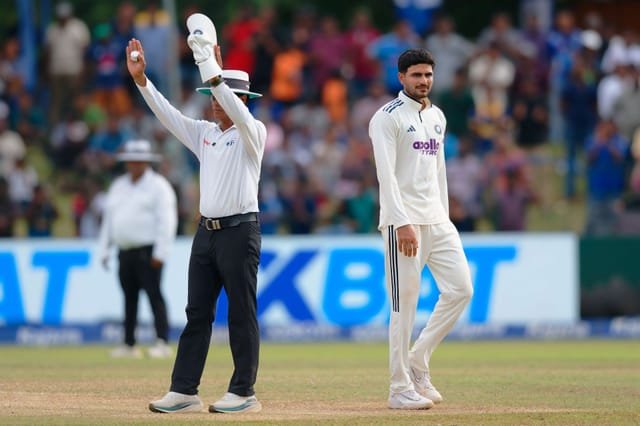
Shubman Gill’s follow-on decision in the second Test against Sri Lanka has come under scrutiny after india failed to complete a victory in Colombo, but former India opener Kris Srikkanth has strongly defended the captain’s tactical choice.
India dominated large portions of the Test after declaring their first innings at 503/9. Sri Lanka were then dismissed for 290, leaving Gill with a straightforward tactical decision: enforce the follow-on and immediately put the hosts back under pressure, or send his own batters back to the crease and potentially reduce the time available to take 10 wickets.
Gill chose the aggressive option. Sri Lanka were forced to bat again and slipped to 229/6 by the end of Day 4. Yet the final day produced a dramatic change in momentum as Sonal Dinusha and Sri Lanka’s lower order resisted the Indian attack for the entire day, eventually taking the hosts to 429/9.
With the match running out of time, the teams shook hands on a draw. India nevertheless won the two-Test series 1-0.
Why Kris Srikkanth backed Gill’s decision
Srikkanth argued that India’s decision should be judged according to the circumstances that existed when Gill made it rather than solely by the final result.
The biggest factor was the weather. With rain threatening to reduce the amount of cricket available, India needed to maximize the number of overs they could bowl at Sri Lanka.
“India had no other choice because of the rainy conditions. I agree with the follow-on decision.”
Srikkanth’s argument is based on a simple Test-match principle: when a team needs 10 wickets but time is running out, giving the opposition another innings can be more valuable than adding runs to an already substantial total.
India had already scored 503 runs. Sri Lanka had been dismissed for 290. From India’s perspective, another batting innings would have consumed valuable time that could instead be spent attacking the Sri Lankan batting order.
What was India’s position when the follow-on was enforced?
India entered the decision with a commanding advantage.
| Innings | Score | Key situation |
|---|---|---|
| India first innings | 503/9 declared | India built a huge platform before declaring |
| Sri Lanka first innings | 290 all out | India secured a 213-run lead |
| Sri Lanka second innings | 429/9 declared | Lower-order resistance secured a draw |
| Match result | Draw | India won the two-Test series 1-0 |
Once Sri Lanka were dismissed for 290, India had a 213-run lead. That was a substantial advantage, but the match situation was unusual because the clock and weather were as important as the scoreboard.
Gill therefore had to balance two competing priorities: protect his bowlers from excessive workload or maximize the time available to take wickets.
Why batting again was not necessarily the safer option
The criticism of the follow-on decision largely comes from the outcome. Sri Lanka survived, so it is easy to argue that India should have batted again and created an even larger target.
But that approach had an obvious drawback.
If India had batted for another 20 or 30 overs, Sri Lanka’s second innings would have started later. Even if India added another 100 or 150 runs, the hosts would still have had less time to lose all 10 wickets.
In a conventional Test match, that extra batting time might make sense. In a rain-affected contest, however, the equation changes.
India did not need to prove that Sri Lanka could not chase an enormous target. They needed to dismiss Sri Lanka twice within the available playing time.
That is why Srikkanth’s defence focuses heavily on the weather rather than the eventual result.
The one argument against Gill: protecting the bowlers
Srikkanth did identify one legitimate reason why India could have avoided enforcing the follow-on: giving their bowlers additional rest.
India’s bowlers had already worked hard during the first Sri Lankan innings. By choosing to enforce the follow-on, Gill effectively committed his bowling attack to another long spell of work.
India bowled 89.4 overs during Sri Lanka’s first innings and then had to bowl for another 154 overs during the second innings.
That workload became particularly relevant on the final day.
Sri Lanka’s resistance meant India’s bowlers spent three consecutive days on the field trying to finish the match. The longer the second innings continued, the more difficult it became to maintain the intensity needed to produce breakthroughs.
In hindsight, this was the biggest tactical cost of the follow-on.
Why the final day changed the entire narrative
At the end of Day 4, India’s decision appeared to be working.
Sri Lanka were 229/6 and still faced a significant deficit. India had successfully created the situation every captain wants after enforcing the follow-on: the opposition was under pressure and only four wickets remained.
But Test cricket rarely follows a script.
Sri Lanka’s lower order produced the resistance India could not break. Sonal Dinusha continued his remarkable contribution, while support from the tail ensured that the hosts survived long enough to take the match beyond India’s reach.
The critical point was not simply the number of runs Sri Lanka scored. It was the amount of time they consumed.
Every defensive partnership made an Indian victory less likely because the match had a fixed ending point. Unlike a chase, India could not simply continue bowling until the final wicket fell.
Sonal Dinusha became the difference-maker
The draw would not have been possible without Dinusha’s extraordinary resistance.
After contributing significantly earlier in the match, the Sri Lankan batter again stood between India and victory during the second innings. His unbeaten 133 formed the backbone of the resistance.
What made his performance especially valuable was not merely the century itself but the time it consumed.
In a Test match where India had to take 10 wickets before the clock ran out, every partnership had tactical value. Sri Lanka’s lower order understood that survival was effectively their route to victory in the context of the match result.
They did not need to attack India. They needed to remain at the crease.
Follow-on history makes the result unusual
India have traditionally enjoyed enormous success after enforcing the follow-on.
Before the Colombo draw, India had won all eight Tests against Sri Lanka in which they had enforced the follow-on.
The Colombo match therefore broke a highly favorable pattern.
More broadly, it was only the 13th occasion in India’s Test history when the team failed to win after enforcing the follow-on. The previous such instance mentioned in the report came against Australia in Sydney in 2019.
That historical context explains why Gill’s decision has attracted so much discussion.
It was not a routine tactical choice that happened to fail. It was an aggressive decision that had historically produced strong results for India, particularly against Sri Lanka.
Gill’s decision should be judged on process, not just result
This is perhaps the most important lesson from the Colombo Test.
Captaincy decisions in Test cricket should not be evaluated solely through the final scorecard.
A captain makes a decision based on the information available at a particular moment. Gill knew India had a 213-run first-innings lead. He knew weather could limit playing time. He knew Sri Lanka had already been bowled out for 290.
His objective was therefore logical: maximize India’s opportunity to take 10 wickets.
The fact that Sri Lanka eventually survived does not automatically make the original decision incorrect.
At the same time, the result exposes the risk involved. Gill’s decision left India’s bowlers with a huge workload, and once Sri Lanka’s resistance continued into the final day, India had no alternative route to victory.
Comparison: batting again versus enforcing the follow-on
| Option | Potential advantage | Main risk |
|---|---|---|
| Enforce follow-on | Maximum time available to take 10 wickets | Heavy workload for bowlers |
| Bat again | More rest for bowlers and larger overall lead | Less time available to dismiss Sri Lanka |
| Short second innings | Some rest while adding runs | Could consume crucial overs without guaranteeing victory |
The comparison shows why there was no completely risk-free option.
Gill’s choice prioritized time. An alternative strategy would have prioritized player recovery and scoreboard pressure.
Given the weather concerns, Srikkanth believes prioritizing time was the more sensible choice.
The WTC equation made the decision even more understandable
India’s World Test Championship ambitions also mattered.
Every Test result has consequences in the WTC standings, particularly for a team trying to remain in contention for the final.
A victory in Colombo would have strengthened India’s position considerably compared with a draw. That meant Gill had little incentive to settle for a conservative approach once Sri Lanka were bowled out for 290.
India needed wickets, not simply runs.
From that perspective, enforcing the follow-on was consistent with an aggressive attempt to secure the maximum possible result.
What India can learn from the Colombo draw
The biggest lesson may not be about whether to enforce the follow-on. It is about managing the bowling attack after making that decision.
Once Sri Lanka began resisting, India needed fresh ideas and sustained pressure. Long spells, field changes and the use of different bowling combinations became increasingly important.
The final day also demonstrated the importance of having multiple wicket-taking options in conditions where batters can become comfortable.
India’s bowlers were not simply trying to contain Sri Lanka. They needed breakthroughs at regular intervals.
That distinction matters because defensive bowling can allow a tailender or lower-order batter to survive, while an attacking strategy always carries the possibility of conceding runs.
Was Shubman Gill’s follow-on decision wrong?
Based on the match circumstances described by Srikkanth, the decision was defensible.
The weather reduced the available time, India already had a large first-innings lead, and batting again would have consumed overs that could have been used to take wickets.
The decision ultimately failed because Sri Lanka produced an exceptional defensive effort, not because the logic behind the decision was inherently flawed.
However, the match also showed that enforcing the follow-on carries a hidden cost: the bowling attack can become exhausted if the opposition refuses to collapse.
So the fairest assessment is that Gill made an aggressive and understandable decision, but India could not execute the final stage of the plan.
Why the draw matters for India’s future
India still won the series 1-0, so the Colombo result did not erase their overall success against Sri Lanka.
But the missed victory could become important in the larger WTC race.
When teams are competing for a limited number of places in a championship final, dropped opportunities can become increasingly expensive. A dominant position that produces only a draw can therefore feel like a defeat even when the team remains unbeaten.
For Gill, the bigger challenge will be ensuring that the Colombo experience improves his decision-making rather than making him unnecessarily cautious in future Tests.
Conclusion
Shubman Gill’s follow-on decision may have failed to produce the desired victory, but Kris Srikkanth’s defence highlights why the call was reasonable in the circumstances.
India had scored 503/9 before dismissing Sri Lanka for 290. With rain threatening and limited time available, sending Sri Lanka back in immediately gave India the maximum possible opportunity to take 10 wickets.
The gamble nearly worked. Sri Lanka were reduced to 229/6 before Sonal Dinusha and the lower order mounted a remarkable resistance and finished on 429/9.
The main criticism is therefore not that Gill misunderstood the match situation, but that India’s bowlers could not finish the job after being asked to operate for an extended period.
Colombo ultimately offered a useful reminder about Test captaincy: sometimes the correct tactical decision can still produce the wrong result. Gill’s next challenge is to learn from the workload and execution issues while retaining the attacking mindset that made the follow-on decision logical in the first place.
For breaking news and live news updates, like us on Facebook or follow us on Twitter and Instagram. Read more on Latest Cricket on thefoxdaily.com.






COMMENTS 0