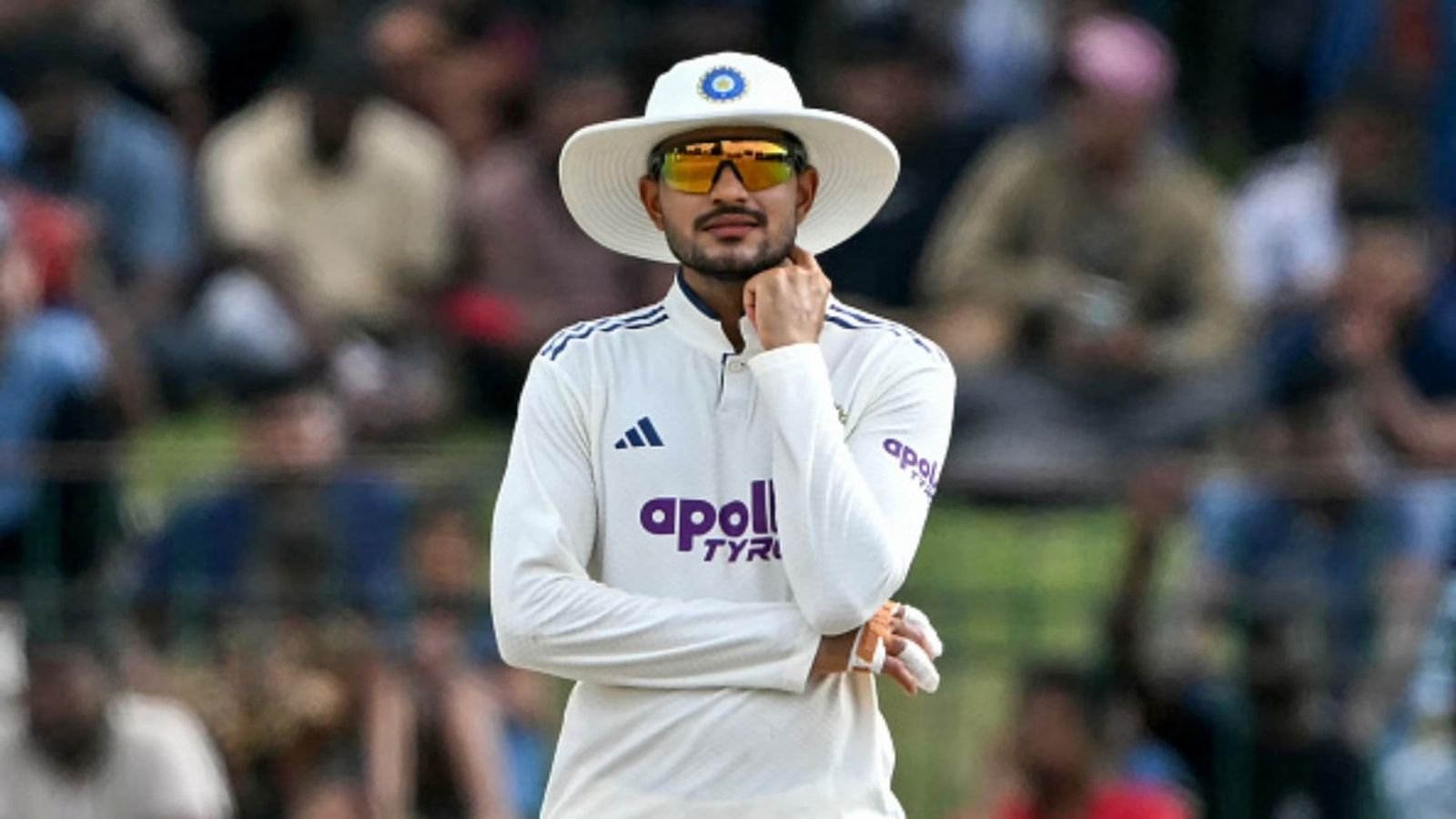
Shubman Gill’s unwanted captaincy record became one of the defining talking points after india failed to beat Sri Lanka in the Colombo Test despite enforcing the follow-on. India entered the final stages of the match in a dominant position, but Sri Lanka’s determined second-innings resistance denied the visitors a series-clinching victory.
India had declared their first innings at 503/9 after major contributions from Devdutt Padikkal and Dhruv Jurel. Sri Lanka were subsequently dismissed for 290, giving Gill the opportunity to enforce the follow-on and attempt to finish the match without setting up another chase.
The decision appeared logical at the time. India had a substantial advantage, Sri Lanka had already been bowled out, and the visitors had enough time to attack again. Instead, the second innings developed into a marathon of survival.
Sonal Dinusha emerged as the central figure in Sri Lanka’s resistance. After making a century in the first innings, he produced an unbeaten 133 in the second, receiving crucial support from the lower order. With only 17 overs remaining and Sri Lanka 216 runs ahead, the possibility of an Indian victory disappeared and both teams eventually accepted a draw.
The result meant India still won the two-Test series 1-0, but Gill entered the record books in an unwanted way. According to the supplied match record, he became the first India captain whose team failed to win a Test after enforcing the follow-on.
What is Shubman Gill’s unwanted record?
The record is directly connected to India’s history of enforcing the follow-on in Test cricket.
India had previously enforced the follow-on on eight occasions before Gill made the decision in Colombo. Each of those earlier instances reportedly ended with an Indian victory.
The first came under Kapil Dev at Cuttack in 1987. Later, Mohammad Azharuddin, MS Dhoni, Virat Kohli and Rohit Sharma also enforced the follow-on during their captaincy tenures.
All of those previous decisions were followed by victories. Gill’s Colombo Test therefore created a statistical first: India enforced the follow-on but could not complete the win.
The record should not automatically be interpreted as proof that Gill made the wrong tactical decision. The decision to enforce the follow-on was made from a position of considerable strength. The more interesting question is why India could not convert that advantage once Sri Lanka were sent back to bat.
Why the follow-on decision made sense at the time
The follow-on exists to allow a team with a sufficiently large first-innings advantage to make the opposition bat again immediately. The strategic objective is straightforward: maintain pressure, remove the need for another innings and create more time to take 20 wickets.
India had every reason to consider that option.
Their first innings had produced 503/9 declared, while Sri Lanka had been bowled out for only 290. That left India with a significant advantage and an opportunity to put Sri Lanka back under pressure.
There was also a practical consideration. By enforcing the follow-on, India avoided spending additional time batting. That preserved whatever remaining match time was available for their bowlers to take the required wickets.
On paper, it was an aggressive attempt to maximize India’s chances of winning.
The problem was that Sri Lanka did not respond according to the expected script.
Devdutt Padikkal and Dhruv Jurel put India in control
India’s commanding position was built on a substantial first innings.
Devdutt Padikkal scored 117, while Dhruv Jurel added 115. Their centuries helped India reach 503/9 before Gill declared.
The importance of those performances goes beyond their individual milestones. The centuries gave India the numerical advantage required to put Sri Lanka under immediate pressure.
A first-innings total above 500 also allowed Gill to think aggressively about the match situation rather than simply protecting against defeat.
Once Sri Lanka were bowled out for 290, the follow-on became a natural tactical option.
Sri Lanka’s second innings changed everything
The second innings completely altered the complexion of the match.
Instead of collapsing again, Sri Lanka produced the kind of resistance that can frustrate even a dominant bowling attack. Sonal Dinusha was at the centre of it, remaining unbeaten on 133.
His innings was especially valuable because he had already demonstrated his ability to occupy the crease during the first innings. Producing another century-level contribution in the second innings transformed him from a successful batter into the principal reason India could not finish the match.
Dinusha’s innings was not an isolated effort. Sri Lanka’s lower order played an equally important role by refusing to give India the quick wickets they needed.
The lower order delivered the crucial resistance
Keshara Nuwantha, Prabath Jayasuriya, Lahiru Kumara and Asitha Fernando all contributed to the survival effort.
Collectively, Sri Lanka’s lower order faced 292 deliveries, an extraordinary amount of time at the crease given the pressure India were applying.
This is where the Colombo Test became less about traditional batting dominance and more about time management.
India did not necessarily need to bowl Sri Lanka out quickly from a purely statistical perspective. They needed to take wickets quickly enough to leave themselves sufficient time to force a result.
Every defensive over reduced India’s remaining opportunity. Every partnership increased the pressure on the Indian attack. By the time Sri Lanka reached a 216-run lead with only 17 overs remaining, the match had effectively escaped India’s control.
How Sonal Dinusha turned the match around
Dinusha’s unbeaten 133 deserves special attention because of the context in which it was scored.
Scoring a century once in a Test is difficult. Repeating the achievement in the second innings against a team that has enforced the follow-on requires a different type of temperament.
Dinusha did not simply accumulate runs. He remained at the crease long enough to consume the resource India needed most: time.
That is the unique tactical dimension of his innings.
When a team enforces the follow-on, the opposition’s goal is often to survive long enough to make the result impossible. Runs matter, but occupying the crease can be equally valuable.
Dinusha and Sri Lanka’s lower order understood that requirement perfectly.
India’s bowlers faced a different challenge in the second innings
India’s bowling attack entered the second innings with an obvious objective: take wickets quickly.
But a team trying to force a result cannot rely solely on containment. Bowlers must attack, and attacking fields can create scoring opportunities for batters willing to absorb pressure and wait for loose deliveries.
The longer Sri Lanka survived, the more difficult the equation became.
India also had to manage the physical demands of a long Test match. Their bowlers had already spent time on the field during Sri Lanka’s first innings, and another extended bowling effort increased the workload.
That is one reason enforcing the follow-on is always a calculated risk. A team receives additional time to bowl, but it also asks its bowlers to return to the field without the recovery period that comes from batting.
Gill’s record compared with previous India captains
India’s history of enforcing the follow-on makes Gill’s result unusual.
| India captain | Follow-on outcome | Result |
|---|---|---|
| Kapil Dev | Enforced follow-on at Cuttack in 1987 | India won |
| Mohammad Azharuddin | Enforced follow-on | India won |
| MS Dhoni | Enforced follow-on | India won |
| Virat Kohli | Enforced follow-on | India won |
| Rohit Sharma | Enforced follow-on | India won |
| Shubman Gill | Enforced follow-on in Colombo | Draw |
The table puts the unusual nature of Gill’s record into perspective. Previous India captains who made the same tactical call were able to complete the victory.
Gill therefore becomes the first Indian captain to experience the other possible outcome: a draw after enforcing the follow-on.
Does the record mean Gill made a tactical mistake?
Not necessarily.
It is easy to judge a captain’s decision using the final result, but Test cricket decisions should be evaluated according to the information available when they were made.
India had a huge first-innings total and had already bowled Sri Lanka out. Enforcing the follow-on maximized the amount of time available for India to take the remaining wickets.
The unexpected variable was Sri Lanka’s resistance.
Had India taken several early wickets in the second innings, the same decision would probably have been celebrated as an aggressive captaincy move. Because Sri Lanka survived, the record now looks far less favorable.
That is the nature of Test captaincy. Tactical decisions often carry risks that become visible only after the opposition responds.
The hidden lesson from the Colombo draw
The biggest lesson from the match may not be about the follow-on at all. It may be about India’s ability to close out Tests.
India had enough control to declare above 500, dismiss Sri Lanka for 290 and force them to bat again. Yet they still could not take the final wickets in time.
That sequence shows how difficult it is to translate statistical dominance into a Test victory.
A team can control almost every major phase of a match and still lose the opportunity to win because of one extended partnership.
In Colombo, that partnership was effectively Sri Lanka’s collective lower-order resistance around Dinusha.
Why the draw matters despite India winning the series
India still completed the two-Test series with a 1-0 victory, so the result cannot be classified as a series failure.
However, the draw represents a missed opportunity.
India entered the contest needing strong results as part of their World Test Championship campaign. Winning the Colombo Test would have strengthened their position and provided a more convincing conclusion to the series.
Instead, the visitors leave with a victory from the series but also questions about their ability to finish matches when they have established a dominant position.
That distinction is particularly important in the WTC because draws can have a significant effect on a team’s points percentage. A team that dominates large portions of a Test but cannot complete the victory may eventually pay for those missed opportunities.
What Gill can learn from the Colombo experience
Gill’s captaincy career is still developing, and the Colombo Test provides valuable experience regardless of the unwanted record.
The match demonstrated the importance of reading the opposition’s second-innings response quickly. Once Sri Lanka began resisting, India needed to find alternative ways to generate breakthroughs.
It also highlighted the importance of bowling resources. When a captain enforces the follow-on, the condition and freshness of the attack become crucial.
Future situations may require Gill to balance the desire for an outright victory against the physical condition of his bowlers and the amount of time remaining.
There is no universal answer. The correct decision depends on the match situation, pitch, weather, bowling resources and opposition batting strength.
Could this unwanted record define Gill’s captaincy?
It is far too early to suggest that it will.
Captaincy records are built over years, not one Test. Gill has already shown an appetite for aggressive decisions, and the follow-on call itself demonstrated that he was willing to pursue victory rather than simply settle for control.
The more meaningful measure will be how he responds.
If India repeatedly struggle to close out matches from dominant positions, questions about their tactical execution will become more significant. If this remains an isolated incident, it will eventually become an unusual statistical footnote in Gill’s captaincy career.
In that sense, the Colombo draw could be useful. It gives Gill a real example of how quickly a Test can change even after one team appears firmly in command.
Conclusion: Gill’s unwanted record tells only half the story
Shubman Gill’s unwanted captaincy record came after India enforced the follow-on against Sri Lanka but could not complete victory in the Colombo Test. The result ended India’s perfect record of winning every previous Test in which an Indian captain had enforced the follow-on.
Yet the statistic should not obscure the bigger story. India had taken an enormous step toward victory by scoring 503/9 declared and dismissing Sri Lanka for 290. Gill’s decision to enforce the follow-on was an aggressive attempt to use the remaining time to secure a win.
Sri Lanka simply produced an extraordinary response. Sonal Dinusha’s unbeaten 133 and the lower order’s willingness to absorb 292 deliveries frustrated India’s attack until only 17 overs remained.
India ultimately secured a 1-0 series victory, but the Colombo draw exposed an important weakness: dominating a Test is not the same as finishing it.
For Gill, the record will remain an unwanted entry in the history books. But the bigger test of his captaincy will be what he learns from it. His next challenge is to ensure that when India create another position of overwhelming advantage, they have the tactical flexibility and bowling execution needed to turn control into victory.
For breaking news and live news updates, like us on Facebook or follow us on Twitter and Instagram. Read more on Latest Cricket on thefoxdaily.com.






COMMENTS 0