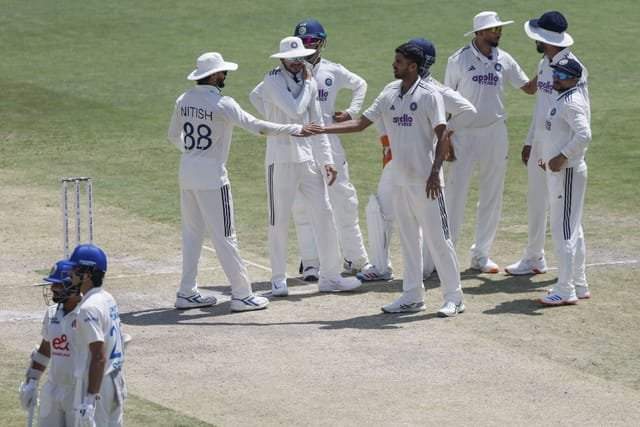
In the aftermath of India’s historic innings-and-300-run victory over afghanistan in the one-off Test at New Chandigarh, the conversation about individual performances quickly turned to a player whose contributions to the win were perhaps the least celebrated relative to their actual significance. Washington Sundar scored an unbeaten 52 off 68 deliveries in India’s only innings and finished with five wickets across Afghanistan’s two innings combined, making him one of the most impactful performers across all three phases of a match that ended inside three days.
Sunil Gavaskar, one of the most respected voices in cricket commentary, used the platform of Star Sports’ ‘Follow the Blues’ to deliver an assessment of Washington Sundar that went beyond praising a single performance and addressed something more fundamental: why the Gujarat Titans star is exactly the kind of cricketer that captains at every level covet and that Test teams can be built around.
Gavaskar’s Assessment: A Player Every Captain Would Want
When asked whether Washington had proved his status as a crucial component of India’s Test lineup, Gavaskar’s answer moved beyond a simple yes. He articulated specifically what it is about Washington’s skill set that makes him so valuable:
“I think you want somebody like a Washington Sundar in your team because he can bat at any order. You can give him the new ball, and he will bowl with the new ball. If you want him to bowl a tight line, he will do that for you. He is such a team player, and every captain would love to have Washington Sundar in his team.”
The key phrase is “he can bat at any order.” That sentence carries more weight than it might initially appear to. In Test cricket, a player’s position in the batting order is usually fixed and reflects a fairly narrow range of what they can be asked to do. An opener faces the new ball. A number three absorbs pressure and builds innings. A lower-order batter provides quick runs without expectation of long resistance. Players who can perform credibly across multiple positions in a batting lineup are genuinely rare, because the technical and mental demands of each position are different.
Gavaskar is saying that Washington can meet those different demands. He can be used flexibly without significant cost to the team’s batting structure. And that flexibility, combined with his bowling utility, gives a captain options that most players do not offer.
The Complete Performance Against Afghanistan: What the Numbers Say
Washington’s contribution to India’s innings-and-300-run victory was spread across all three disciplines and reflected the full breadth of what Gavaskar was describing.
With the bat, he walked in during India’s first innings at a moment when the hosts were already in a commanding position, and produced an unbeaten 52 off 68 deliveries that demonstrated both composure and technical quality. The innings was not an emergency cameo of swinging sixes. It was a calibrated, confident contribution from a lower-order batter who understood his role within the context of a declaration innings and executed it with five fours and a six across an extended stay at the crease.
Gavaskar’s specific observation about the conditions adds important context here. The pitch in New Chandigarh was, by his description, not easy to bat on. Scoring a half-century on a surface that is already showing wear and assisting spin is a different achievement from accumulating runs on a flat track, and Washington’s 52 should be evaluated accordingly.
With the ball, Washington took 1/21 in 6.4 overs in Afghanistan’s first innings and then became India’s most successful bowler in the second innings, returning 4/36 in 11 overs as the visitors were bowled out for 112. His second-innings figures were the foundation on which the match was brought to its conclusion, providing the consistent wicket-taking threat that complemented Manav Suthar’s debut brilliance and Kuldeep Yadav’s final two-wicket burst.
| Phase | Contribution | Figures | Significance |
|---|---|---|---|
| Batting (1st innings) | Unbeaten 52 off 68 balls | 5 fours, 1 six | Scored on a pitch Gavaskar described as “not very easy to bat on” |
| Bowling (1st innings) | Support bowler role | 1/21 in 6.4 overs | Tight economy, complemented Suthar’s 6-wicket spell |
| Bowling (2nd innings) | Lead wicket-taker | 4/36 in 11 overs | India’s most successful bowler in the second innings |
| Overall match | 52 runs + 5 wickets | All-round across all 3 disciplines | Critical to India’s record-breaking innings win |
Not a New Discovery: Gavaskar’s Reminder About Washington’s Batting Pedigree
One of the most valuable aspects of Gavaskar’s commentary was his reminder that Washington Sundar’s batting quality is not a recent development or a surprise. He reached back into the record books to contextualize the unbeaten 52 within a longer career narrative that has consistently demonstrated this player’s capability with the bat when given the opportunity to express it.
“We have all known how good a batter he is. In fact, in 2021, when England were here, he got two 90s, although he didn’t get a hundred. So we all knew that he could bat.”
The 2021 England series reference is significant. Washington scored 85 and 96 not out in that series, coming in at number eight and producing innings that substantially shaped match outcomes in circumstances considerably more challenging than India’s declaration innings against Afghanistan. The fact that he did not convert either of those innings into centuries is almost irrelevant given the context: a spinner batting at number eight, against England’s attack in Test conditions, scoring two 90-plus innings in the same series, is demonstrating something genuinely exceptional.
Gavaskar also referenced the rear-guard action Washington played alongside Ravindra Jadeja, which produced his first Test century. That innings, in a pressurized situation designed to test the nerves of experienced batters, was further confirmation of a player who performs better when the game demands more of him, not less.
“Last year, he did that rear-guard action with Ravindra Jadeja in saving the game for India, where he got his first hundred. So everybody knows about his batting, and again over here, on a pitch which was not really very easy to bat on, he got a very good half-century.”
This is Gavaskar’s broader point rendered explicit: Washington’s batting is not contingent on favorable conditions or limited bowling attacks. He has demonstrated it against quality opposition, on difficult pitches, in high-pressure situations. The Afghanistan match adds to that record rather than constituting it entirely.
Washington Sundar’s Test Career in Context: What 18 Matches Have Told Us
The statistical picture of Washington Sundar’s Test career at this stage of the Afghanistan match is worth examining in full, because it tells a story that the headline performers in any given match can sometimes obscure.
Across 18 Test matches, Washington has accumulated 937 runs at an average of 44.61 and taken 41 wickets at an average of 30.34. Those are not the numbers of a specialist batter who occasionally bowls, or a specialist bowler who can hold a bat. They are the numbers of a genuine Test all-rounder, a player who contributes meaningfully with both disciplines and whose combined contribution to a match exceeds what either skillset alone could provide.
A batting average of 44.61 would be respectable for many specialist batters in India’s top seven. A bowling average of 30.34 across 41 Test wickets is the kind of number that reflects consistent wicket-taking ability rather than a collection of favorable match-ups. The combination of both, sustained across 18 Test appearances, is exactly the evidence base that Gavaskar is drawing on when he says every captain would want Washington in their team.
The Gujarat Titans Connection: Why Club Form and Test Form Are Telling the Same Story
Washington Sundar’s prominence in this conversation comes against the backdrop of his role with the Gujarat Titans in the IPL, where he has established himself as one of the most reliable all-round performers in franchise cricket. His IPL form and his Test performances are not separate stories. They reflect the same underlying qualities: the ability to adapt his bowling to whatever a situation demands, the composure to bat under pressure, and the physical and mental conditioning to perform across formats without the kind of breakdown that afflicts players who are pushed too hard across multiple demands.
Gavaskar’s point that a captain can give Washington the new ball, ask him to bowl a tight line, or move him up or down the batting order and receive competent performance in any of those roles is a statement about character as much as skill. Players with that kind of flexibility are not manufactured by ability alone. They are produced by a combination of natural talent and the willingness to work on every dimension of their game rather than settling for excellence in one area at the expense of others.
What India’s Test Selection Should Take From This Performance
The one-off Test against Afghanistan was not a high-stakes examination of India’s Test capabilities in the way that a series against England or Australia would be. Afghanistan are a developing Test nation, and the margin of India’s victory reflects the gap between the two sides rather than anything revelatory about India’s specific quality.
But individual performances within such a match can still carry genuine information. Washington Sundar’s contribution in New Chandigarh confirmed what his broader career record suggests: that he is currently operating at the level of one of India’s most complete and flexible Test assets. A bowling all-rounder who can bat to 50 in difficult conditions, take wickets with the new ball, and bowl economically in a supporting role is not just useful. He is the kind of player that allows a captain to make tactical decisions that a less versatile lineup cannot support.
Gavaskar has been watching Test cricket for fifty years. When he says every captain would love to have a player in their team, it is not a polite compliment. It is a specific, experienced judgment that the Indian selectors would do well to continue acting on.
Conclusion: A Performance That Confirms What the Record Already Said
Washington Sundar’s performance in the IND vs AFG 2026 Test was not a revelation. It was a confirmation. His unbeaten 52, his five wickets across two innings, his adaptability with both ball and bat in conditions that challenged every batter on the field: all of this was consistent with a player who has been quietly building one of the most impressive all-round Test records in Indian Cricket over the past several years.
Sunil Gavaskar’s assessment provides the appropriate frame for understanding that record. This is a player who can bat at any order, bowl with the new ball or in support, maintain economy or take wickets depending on what the team requires. In the language of Test cricket, that makes Washington Sundar something genuinely valuable: a captain’s cricketer who makes every tactical option more available and every match situation more manageable.
The one-off Test against Afghanistan is over. India won by an innings and 300 runs. Washington Sundar contributed across every phase. The Gujarat Titans star, and the Indian Test team, move forward with one more data point confirming exactly the same story.
For breaking news and live news updates, like us on Facebook or follow us on Twitter and Instagram. Read more on Latest Sports on thefoxdaily.com.






COMMENTS 0