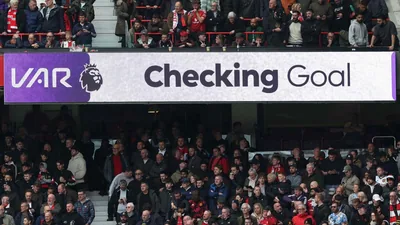
UEFA Clear Line VAR overhaul is set to change how video assistant referees are used across European football from the 2026-27 season. The new initiative aims to reduce lengthy reviews and prevent marginal incidents from dominating matches, while ensuring that VAR remains focused on clear and obvious errors.
UEFA has introduced Clear Line, a public library containing around 150 real-match VAR examples. Each case explains the principles used by referees and video officials when assessing incidents that could influence the outcome of a game.
The initiative comes amid growing frustration among supporters, players and coaches over lengthy VAR interventions. UEFA wants to create a clearer distinction between an obvious mistake that needs correcting and a subjective decision that should remain with the referee on the field.
What is UEFA’s Clear Line VAR project?
Clear Line is designed to provide greater transparency around the circumstances in which VAR should intervene. Instead of treating every potentially controversial incident as an opportunity for an extensive replay review, UEFA wants officials to concentrate on match-changing mistakes supported by clear evidence.
The library covers the main areas where VAR intervention is permitted. These include goals and attacking-phase offences, penalty incidents, straight red cards, factual decisions and cases involving mistaken identity.
By making real examples publicly available, UEFA is also giving clubs, players, coaches, journalists and supporters an opportunity to understand how the governing body expects VAR protocols to be applied.
UEFA wants to stop ‘microscopic’ VAR reviews
One of the biggest objectives of the UEFA VAR overhaul is to prevent officials from becoming overly dependent on freeze-frames and extreme slow-motion footage.
Roberto Rosetti, UEFA’s managing director of refereeing, acknowledged the dissatisfaction surrounding VAR and stressed the importance of preserving the natural flow of football.
His argument is that football cannot be judged entirely through isolated images. A freeze-frame can make a challenge appear more serious than it was during the actual movement of play, which is why context and normal-speed footage remain important.
UEFA therefore wants referees to avoid spending excessive amounts of time examining tiny details that do not clearly demonstrate an error.
Referees will remain at the centre of decision-making
The new approach is based on a simple principle: VAR should support referees rather than replace them.
When VAR was introduced, its primary purpose was to correct major mistakes and serious incidents that officials had clearly missed. UEFA believes that the technology has gradually expanded into areas involving marginal contact and subjective interpretations.
Under the revised approach, referees will continue to make authoritative decisions on the field unless VAR identifies a clear reason for intervention.
This could reduce the number of situations in which an official is repeatedly sent to the pitchside monitor to reconsider a decision that was fundamentally subjective.
New replay process for on-field reviews
UEFA is also introducing a more structured process for referees who are asked to review an incident at the pitchside monitor.
The referee will initially be shown a freeze-frame highlighting the relevant point of contact. This will then be followed by footage played at half speed before the official sees the incident at normal speed.
The sequence is intended to provide both detail and context. The freeze-frame can identify exactly where contact occurred, while normal-speed footage allows the referee to judge the overall intensity and nature of the incident.
This is particularly important in challenges where a single still image could give a misleading impression of what happened.
UEFA concerned about lengthy VAR interruptions
Another major issue addressed by Clear Line is the amount of time consumed by VAR checks.
UEFA believes that extremely long reviews can damage the credibility of the system and disrupt the rhythm of matches. Rosetti has indicated that reviews lasting more than around 90 seconds can become problematic from the perspective of supporters and the flow of football.
The objective is therefore not simply to make VAR more accurate but also to make its use more efficient. Shorter interventions should allow matches to maintain their natural pace while still correcting genuine refereeing errors.
Handball remains one of VAR’s biggest challenges
Handball decisions are expected to remain one of the most difficult areas for consistent VAR interpretation.
Similar incidents can produce different decisions across domestic competitions in England, Spain, Italy, Germany and France, as well as UEFA tournaments. The differences often arise because handball decisions involve elements of interpretation rather than purely objective facts.
Clear Line aims to reduce those inconsistencies by providing referees with approved examples and principles that can be applied across UEFA competitions.
However, UEFA does not expect complete uniformity. Subjective decisions will always contain an element of judgement, and the new system is designed to improve consistency rather than eliminate interpretation altogether.
Clear Line will be available to fans and clubs
UEFA’s project is not limited to refereeing officials. The public nature of the Clear Line library means that supporters and other members of the football community can examine the same types of incidents used to explain VAR decision-making.
Players, coaches, clubs and journalists will also be able to compare controversial moments with UEFA’s approved examples. This could help create a common understanding of why certain incidents trigger VAR intervention while others do not.
Greater transparency could also help reduce confusion when supporters see different decisions in apparently similar situations.
How the UEFA VAR changes could affect Champions League matches
The new approach will apply across UEFA competitions, including the Champions League, Europa League and Conference League.
For Europe’s biggest clubs, the change could mean fewer lengthy stoppages during crucial knockout matches. Decisions will still be reviewed when the evidence points to a clear and obvious error, but marginal incidents should be less likely to trigger extended examinations.
This could be particularly significant in high-pressure Champions League matches, where a lengthy VAR review can dramatically alter the atmosphere inside a stadium and interrupt the momentum of a team.
Clear Line does not change football’s laws
Importantly, UEFA’s new project does not introduce a new set of football laws. Instead, it changes the emphasis placed on the existing VAR protocol.
The governing body’s message is that video technology should be used selectively and responsibly. VAR should intervene when there is compelling evidence of a serious mistake rather than encouraging officials to search endlessly for technical infringements.
That represents a significant philosophical shift in the way UEFA wants technology to be integrated into football.
What the UEFA VAR overhaul means for football
The Clear Line initiative could represent an important step in the evolution of VAR. Rather than abandoning video technology, UEFA is attempting to make it less intrusive while preserving its ability to correct major errors.
The biggest change could be the renewed emphasis on the referee’s authority. Officials will be encouraged to make decisions based on what they see on the pitch, with VAR acting as a safety net rather than a second referee constantly examining every detail.
If the approach works as intended, European football could see shorter reviews, fewer interruptions and greater consistency without losing the benefits of video assistance.
Ultimately, UEFA’s message is straightforward: technology should help football rather than overwhelm it. The Clear Line project is an attempt to ensure that VAR remains a tool for correcting clear mistakes while keeping the referee, the flow of the game and the context of football at the centre of decision-making.
For breaking news and live news updates, like us on Facebook or follow us on Twitter and Instagram. Read more on Latest Football on thefoxdaily.com.






COMMENTS 0