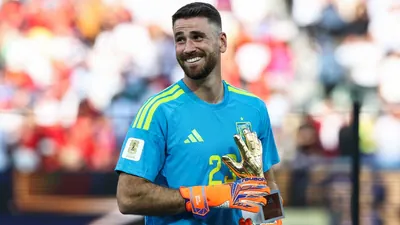
When Spain defeated argentina 1-0 after extra time to win the FIFA World Cup 2026, much of the attention naturally focused on the attacking stars, tactical brilliance, and the historic achievement of lifting football’s biggest prize. Yet one of the most important figures behind Spain’s triumph was a player who rarely appeared in highlight reels.
Unai Simón, Spain’s first-choice goalkeeper, completed one of the most remarkable World Cup campaigns ever produced by a goalkeeper. His statistics were extraordinary, his influence immense, and his style unlike that of many modern goalkeepers who gain recognition through spectacular saves.
Instead, Simón became the silent guardian of Spain’s championship run—preventing danger before it even became visible.
Why Unai Simón Was the Perfect Goalkeeper for Spain’s World Cup System
Traditional goalkeeper evaluations often revolve around saves, reflexes, and dramatic moments. While those qualities remain important, elite football increasingly demands much more from modern goalkeepers.
Today’s top teams expect their goalkeeper to function as:
- An additional defender.
- A playmaker during buildup.
- A sweeper behind a high defensive line.
- A tactical organizer.
- A pressure-resistant passer.
Few players embodied those responsibilities better than Simón during the World Cup.
Spain’s tactical philosophy under Luis de la Fuente relied on aggressive pressing, possession dominance, and a defensive line positioned high up the pitch. Such an approach creates enormous risks if the goalkeeper cannot cover space behind defenders.
Simón’s intelligence and positioning made that system possible.
Unai Simón’s Historic World Cup 2026 Numbers
The statistics from Spain’s victorious campaign reveal just how dominant their defensive structure became.
| Statistic | Unai Simón (World Cup 2026) |
|---|---|
| Matches Played | 8 |
| Clean Sheets | 7 |
| Goals Conceded | Lowest Ever by a World Cup Champion |
| Consecutive Minutes Without Conceding | 650 |
| Sweeper Interventions | 22 |
| Aerial Claims | 8 |
| Golden Glove Award | Winner |
The most impressive number may be the 650 consecutive minutes without conceding a goal, surpassing one of football’s most famous World Cup records.
While records often depend on circumstances, sustaining that level of defensive excellence across an entire tournament requires exceptional concentration, organization, and tactical understanding.
The Goalkeeper Who Rarely Needed to Make Saves
One of the biggest paradoxes of Simón’s tournament is that he was not among the busiest goalkeepers.
In fact, several goalkeepers eliminated during earlier stages recorded significantly more saves than the Spaniard.
At first glance, some critics might interpret this as evidence that Spain’s defenders deserved most of the credit.
The reality is more complex.
Modern goalkeeping is increasingly measured by the ability to eliminate threats before they result in shots.
Rather than reacting to danger, Simón specialized in preventing danger altogether.
This distinction is crucial.
A spectacular save usually occurs because a defensive structure has already been breached. Preventing that situation from developing in the first place is often even more valuable.
The Evolution of the Sweeper-Keeper Role
To understand Simón’s impact, it is important to understand the modern sweeper-keeper role.
The position has evolved dramatically over the past two decades.
Goalkeepers were once expected to remain near their goal line and focus primarily on shot-stopping.
Today, elite teams ask them to operate almost like an additional outfield player.
Key responsibilities include:
- Intercepting through balls.
- Covering space behind defenders.
- Initiating attacks.
- Supporting possession play.
- Managing transitions.
Simón excelled in every area.
His 22 sweeper interventions led all goalkeepers at the tournament, demonstrating how frequently he left his penalty area to neutralize attacking opportunities.
How Spain Built the Best Defensive Unit of the Tournament
While Simón deserves immense credit, Spain’s defensive success was ultimately a collective achievement.
The team’s structure functioned like a synchronized machine.
High Press from the Front
Spain’s attackers aggressively pressured opponents immediately after losing possession, reducing the time available to launch dangerous attacks.
Midfield Control
Rodri provided exceptional defensive balance, screening the backline and disrupting opposition transitions before they could develop.
Elite Central Defending
The partnership between Pau Cubarsí and Aymeric Laporte combined youthful composure with veteran experience.
Goalkeeper Support
Behind them all stood Simón, acting as the final layer of protection whenever opponents attempted to bypass Spain’s defensive structure.
The result was one of the most efficient defensive systems ever seen at a World Cup.
The France Match Explained Why Simón Is Special
The semi-final against France provided perhaps the clearest example of why Spain trusted Simón so completely.
Facing players such as Kylian Mbappé creates a tactical dilemma.
Most teams respond by dropping deeper to reduce the risk of balls played behind the defense.
Spain refused to compromise.
Their confidence stemmed largely from Simón’s ability to anticipate danger.
Repeatedly, he moved aggressively off his line to intercept passes before France’s forwards could exploit their pace advantage.
These interventions rarely generate viral clips, but they fundamentally alter matches.
Without such actions, defenders are forced to retreat deeper, changing an entire team’s tactical identity.
The World Cup Final Moment That Defined His Tournament
The final against Argentina produced another illustration of Simón’s elite decision-making.
Within minutes of kickoff, he identified a developing threat and sprinted far outside his penalty area to clear a dangerous ball before Lionel Messi could reach it.
Many goalkeepers hesitate in those situations.
Hesitation often results in one-on-one opportunities.
Simón’s willingness to trust his instincts prevented a potentially game-changing moment before it materialized.
That single action encapsulated his entire tournament philosophy.
He was not merely reacting to football matches; he was actively shaping them.
Spain’s Expected Goals Dominance Reveals the Full Story
Expected Goals (xG) has become one of football’s most useful analytical tools because it measures the quality of chances rather than simply counting shots.
Spain’s defensive numbers throughout the tournament were extraordinary.
| Opponent | Expected Goals (xG) |
|---|---|
| Cape Verde | 0.30 |
| Saudi Arabia | 0.14 |
| Uruguay | 0.20 |
| Austria | 0.32 |
| Portugal | 0.58 |
| Belgium | 0.38 |
| France | 0.30 |
| Argentina | 0.13 |
These numbers reveal that opponents consistently struggled to create meaningful scoring opportunities.
While defenders and midfielders deserve praise, the confidence provided by Simón’s positioning and anticipation played a major role in enabling Spain’s aggressive approach.
Why Luis de la Fuente Never Considered Replacing Him
Before the tournament, some observers questioned whether Spain had stronger alternatives.
After all, Spain possessed several goalkeepers enjoying outstanding club seasons.
Yet Luis de la Fuente never appeared uncertain about his choice.
The trust between coach and goalkeeper had been built over many years.
Having worked together through Spain’s youth teams and senior setup, the coach understood exactly what Simón offered.
More importantly, he trusted him in the specific tactical role Spain required.
Football history repeatedly shows that coaches value reliability and tactical suitability as much as raw talent.
Simón provided both.
The Difference Between Club Football and International Football
One overlooked aspect of Simón’s success is the dramatic contrast between his club and international environments.
At Athletic Bilbao, he often faces significantly more defensive pressure.
Matches frequently require:
- More shot-stopping.
- Greater aerial work.
- Repeated defensive interventions.
- Higher save volumes.
Spain’s dominance creates a completely different challenge.
Goalkeepers may spend long periods without meaningful involvement before suddenly needing to make a critical decision.
Maintaining concentration under those circumstances requires exceptional mental discipline.
Simón mastered that challenge throughout the tournament.
What Future Goalkeepers Can Learn from Unai Simón
Perhaps the most important lesson from Simón’s World Cup campaign is that goalkeeping excellence extends beyond saves.
Young goalkeepers often focus exclusively on reflexes and diving techniques.
Modern football increasingly rewards:
- Positioning.
- Game intelligence.
- Decision-making.
- Distribution.
- Communication.
- Anticipation.
Simón’s Golden Glove victory demonstrated that preventing opportunities can be just as valuable as stopping them.
Legacy of a Historic Tournament
Spain’s World Cup triumph will be remembered for its tactical brilliance, defensive discipline, and championship mentality.
At the center of that success stood a goalkeeper who rarely demanded attention.
Unai Simón did not dominate headlines through spectacular acrobatics or dramatic penalty shootouts. Instead, he delivered something arguably more impressive: complete control.
By combining elite positioning, fearless anticipation, calm distribution, and unwavering concentration, he helped Spain produce one of the greatest defensive performances ever witnessed at a FIFA World Cup.
His Golden Glove award was not simply recognition for clean sheets. It was recognition for redefining what elite goalkeeping looks like in modern football.
Conclusion
Unai Simón’s FIFA World Cup 2026 campaign will likely be studied by coaches and goalkeepers for years to come. While many champions are remembered for goals, assists, or spectacular saves, Simón built his legacy through anticipation, intelligence, and tactical excellence.
His record-breaking clean-sheet run, Golden Glove triumph, and crucial role in Spain’s defensive dominance proved that the best goalkeepers do not always make the most saves—they simply make sure those saves are never needed.
As football continues evolving, Simón’s tournament may ultimately be remembered as one of the defining examples of modern goalkeeping perfection.
For breaking news and live news updates, like us on Facebook or follow us on Twitter and Instagram. Read more on Latest Sports on thefoxdaily.com.






COMMENTS 0