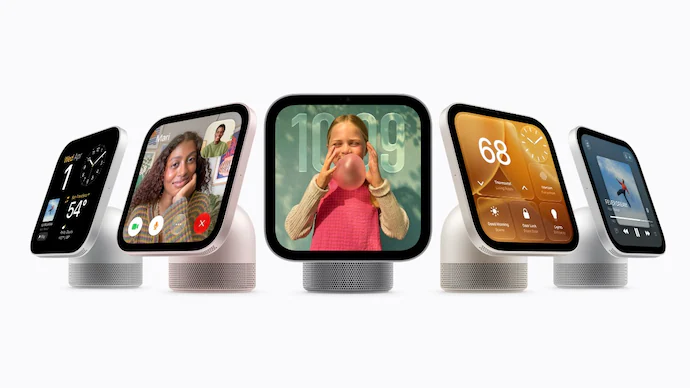
Apple is reportedly developing a premium Smart Home display with a motorised robotic arm that can rotate to face whoever is speaking. The futuristic device could represent a significant expansion of the company’s ambitions in the smart home market, combining a large display, voice recognition and robotic movement in a single product.
According to Bloomberg’s Mark Gurman, the device is being developed under the internal codename J595. Unlike a conventional smart display that remains fixed in one position, the proposed product is expected to move its screen automatically in response to voices in the room. This could make video calls, smart home controls and other interactive features more convenient for users moving around their homes.
Apple is reportedly targeting a launch between 2027 and 2028. Although the company has not confirmed the device’s final name, specifications or price, earlier reports have suggested that it could be positioned as a high-end addition to Apple’s smart home lineup, potentially costing around $1,000.
Apple’s Robotic Smart Display Could Change How People Use Home Devices
Most smart displays are designed to provide information and respond to commands from a stationary position. Their screens can show video calls, calendars, weather updates and smart home controls, but users may need to adjust their position or move the device to maintain a comfortable viewing angle.
Apple’s reported robotic display could approach this problem differently. By mounting the screen on a motorised arm, the company could allow the device to adjust its orientation automatically rather than requiring users to reposition it manually.
The concept could be particularly useful in rooms where people frequently move around, such as kitchens, living rooms and shared family spaces. Instead of interacting with a fixed screen, users could potentially speak to the device from different positions and have it turn towards them.
However, the product remains a reported development project. Its final capabilities will depend on Apple’s hardware design, voice recognition technology and software implementation.
What Is Apple’s J595 Robotic Display?
J595 is the reported internal codename for Apple’s upcoming robotic smart home device. Bloomberg’s Mark Gurman has described a product built around a display attached to a motorised arm capable of rotating through a full 360 degrees.
The device is expected to be a more advanced version of Apple’s reported HomeView smart display, with a larger screen and additional mechanical capabilities. While the standard HomeView model is described as having a fixed 7-inch display, the robotic version is expected to feature a 9-inch screen.
The difference would extend beyond screen size. The motorised arm could allow the display to change its position in response to activity in the room, making it a more interactive home device than a conventional stationary screen.
Apple has not publicly confirmed the J595 codename or the reported specifications. Details about its processor, camera system, sensors, battery or power requirements, and supported applications also remain unconfirmed.
How the Robotic Arm Could Follow Your Voice
The reported device’s most distinctive feature is its ability to turn towards the person speaking. Using voice recognition and other sensing capabilities, it could identify the direction of a voice and adjust the screen’s position accordingly.
For example, someone preparing food in the kitchen could ask the device a question without needing to stand directly in front of it. The display could rotate towards the speaker, making the screen easier to see while the person continues cooking.
The same mechanism could be useful during video calls. If a family member walks from one side of a room to another, the display could potentially move to maintain a better viewing angle. This might reduce the need to remain seated or stationary in front of the screen throughout a conversation.
Such a feature could also make hands-free interaction more natural. Rather than treating voice commands as isolated instructions, the device could respond to where a person is speaking from and adjust its physical orientation to suit the interaction.
Nevertheless, important technical details remain unknown. Apple has not confirmed how the device would distinguish between multiple speakers, whether it could track a person visually, or how reliably it would follow someone moving around a room. The reported ability to rotate towards a speaker should not be interpreted as confirmation that the display will continuously track every movement.
Why a Moving Display Could Be Useful for Video Calls
Video calling is one of the clearest potential use cases for a robotic smart display. Fixed screens can become inconvenient when people move around during conversations, particularly when several family members are participating from the same room.
A screen that adjusts its position could make conversations feel less restrictive. Someone could move around a kitchen or living room while remaining closer to the centre of the display’s viewing angle, depending on how Apple’s tracking and movement systems ultimately work.
The larger reported 9-inch screen could also provide more space for video, interface elements and smart home controls than a smaller display. However, screen size alone would not determine the quality of the experience. Camera performance, microphone sensitivity, speaker quality and the responsiveness of the robotic arm would all influence how useful the product becomes.
Movement could also introduce new considerations. A motorised display would need to operate quietly, respond smoothly and avoid unnecessary movements that distract users. Its software would have to balance responsiveness with privacy and predictable behaviour inside a shared home.
Apple’s Robotic Smart Display Launch Timeline
Apple is reportedly aiming to launch the robotic display sometime between 2027 and 2028. That timeline suggests the device is still a future product rather than something consumers should expect to buy in the immediate term.
Apple has not announced an official release date, opened pre-orders or confirmed that the product will reach the market on the reported schedule. Development timelines can change, particularly when a device combines new mechanical hardware with complex software features.
The reported launch window also leaves several questions unanswered, including when Apple might reveal the product, which countries could receive it first and whether the company would introduce additional versions.
For consumers considering a smart home upgrade, it is therefore too early to make purchasing decisions based on an assumed release date. The final product announcement will be needed to establish its availability and capabilities.
Expected Price: Could Apple’s Robotic Display Cost $1,000?
The robotic display is expected to sit above Apple’s standard smart home display in the product lineup. While the reported price of the standard HomeView is $299, previous reports have suggested that the more advanced robotic model could cost approximately $1,000.
That figure is an estimate from earlier reporting, not an official Apple price. The company has not confirmed the final cost, and the price could change before launch.
A price near $1,000 would put the device in a substantially more expensive category than many conventional smart displays. Its value would depend on whether buyers consider the moving screen, premium hardware and broader smart home integration worth the additional cost.
The reported price could also make the device a more specialised product. Consumers who primarily want voice-controlled music, timers, weather updates or basic smart home functions may find it difficult to justify paying significantly more for robotic movement.
By contrast, households that frequently use video calls or want a central display for interacting with smart home systems could see more potential value in the concept. Even then, the final decision would depend on real-world performance and the features available at launch.
What Could Apple Call Its New Robotic Home Device?
Apple has not confirmed the product’s official name. Previous reports have suggested that the company has considered names such as HomeView Pro, HomeView Max and HomeView 360.
These names would communicate different aspects of the reported product. The Pro label could position it as a premium device, Max could emphasise its larger display or expanded capabilities, while 360 could draw attention to the screen’s reported rotational movement.
However, these are reported naming possibilities rather than confirmed branding decisions. Apple could choose a different name before the product is announced.
Apple Wants a Bigger Role in the Smart Home Market
The robotic display could be part of Apple’s broader effort to strengthen its presence in the smart home market, where Google Nest and Amazon Echo products have established positions.
Smart displays and voice assistants can act as central points for managing connected devices, making video calls, checking information and controlling entertainment. A more advanced display could give Apple another way to bring its services and hardware into everyday home routines.
The challenge is that smart home customers often consider more than hardware design. Compatibility with lights, cameras, thermostats, speakers and other connected products can determine whether a platform is convenient enough to use as the centre of a home.
Apple would need to ensure that the robotic display works reliably with its own ecosystem and offers a compelling experience for the tasks people perform most often. A moving screen could help differentiate the product, but it would not automatically solve broader questions about compatibility, software flexibility or application support.
Apple’s Siri Challenges Could Affect the Device
The reported development of the robotic display comes amid wider questions about Apple’s smart home software and artificial intelligence capabilities.
According to earlier reporting cited in coverage of Apple’s smart home plans, the launch of the standard HomeView was delayed by roughly two years amid software difficulties involving the company’s AI-powered Siri. Those reports described finished devices waiting in warehouses while the software was being addressed.
If similar software dependencies affect the robotic model, Apple’s ability to deliver a polished experience could be just as important as its mechanical engineering. The device would need to recognise commands, interpret interactions and coordinate its display movement without introducing unnecessary delays or confusing behaviour.
A robotic arm adds another layer of complexity to the experience. Voice recognition would need to work consistently in noisy environments, while the movement system would need to respond appropriately when several people are speaking or when the intended user is unclear.
These are potential engineering challenges, not confirmation that the upcoming device is experiencing the same problems. Apple has not publicly detailed the project’s development status.
Missing Apps and Software Flexibility Remain Concerns
Hardware alone may not be enough to persuade consumers to adopt Apple’s smart home display. The software available on the device will influence how useful it becomes over time.
Reports about the current HomeView describe a platform that relies heavily on a connected iPhone and lacks a dedicated app store. Major entertainment services, including YouTube and Netflix, have also been cited as missing from the platform.
If those limitations persist, they could reduce the appeal of a premium display for people who want to watch videos, access a wide range of services or customise their smart home experience. Consumers who already use Google Nest or Amazon Echo devices may be reluctant to switch if Apple’s alternative offers fewer of the functions they depend on.
Apple could address some of these concerns by expanding supported applications, improving integration with third-party services or providing more flexibility through future software updates. However, the company has not confirmed what applications or software features the robotic display will support.
It is also unclear whether the reported device will have a dedicated app marketplace, support streaming services such as YouTube and Netflix, or operate independently of an iPhone for a wider range of tasks.
Privacy and Reliability Will Be Important for a Moving Smart Display
A device that reacts to voices and changes its physical position introduces considerations beyond those associated with a stationary screen. Consumers will want to understand how it detects speakers, when its microphones are active and whether any visual sensing technology is used.
Apple has not confirmed the robotic display’s complete sensor configuration or privacy controls. Details about microphone settings, camera permissions, local processing and the handling of voice data will therefore be important when the company eventually provides official specifications.
Mechanical reliability will also matter. A motorised arm introduces moving components that must function consistently over repeated use. The device would need to manage movement safely around people, pets, furniture and other objects, although Apple has not disclosed how the reported product would handle obstacles or movement restrictions.
These considerations could influence whether buyers view the device as a practical household assistant or an expensive novelty. A successful product would need to demonstrate that its moving display makes common tasks easier without creating additional complications.
Can Apple’s Robotic Display Compete With Google Nest and Amazon Echo?
Apple’s reported product would enter a market in which customers already have access to smart speakers, displays and connected-home platforms from established competitors.
Google Nest and Amazon Echo devices offer consumers ways to use voice assistants, access information and manage compatible smart home products. Apple’s proposed approach could stand apart through its combination of a larger display and a motorised arm that responds to a speaker’s position.
However, competition will depend on the overall experience rather than the novelty of robotic movement. Pricing, voice assistant performance, third-party compatibility, entertainment options and integration with existing devices could all influence consumer adoption.
The reported price of around $1,000 could be a particular hurdle if buyers can meet most of their needs with less expensive alternatives. Apple would need to show that the display’s additional capabilities deliver practical benefits beyond simply moving the screen around a room.
For now, the device remains an indication of Apple’s reported smart home ambitions rather than a confirmed commercial product. Its eventual competitiveness will be clearer once Apple reveals its features, pricing and software support.
What We Know About Apple’s Robotic Smart Display So Far
- Internal codename: The device is reportedly being developed under the codename J595.
- Display: It is expected to feature a 9-inch screen, compared with the reported 7-inch display on the standard HomeView.
- Robotic movement: A motorised arm could rotate through 360 degrees and turn the screen towards the person speaking.
- Expected launch: Earlier reporting points to a possible release between 2027 and 2028.
- Potential price: Previous reports have suggested a price of around $1,000, although Apple has not confirmed it.
- Possible names: HomeView Pro, HomeView Max and HomeView 360 have reportedly been considered.
- Unconfirmed details: The final name, price, specifications, supported apps, privacy controls and launch date have not been officially announced.
What Apple’s Robotic Smart Display Could Mean for Consumers
Apple’s reported robotic display points towards a smart home experience in which devices adapt their physical position to users rather than remaining fixed in place. If the company can combine reliable voice recognition, smooth movement and useful software, the product could offer a different way to interact with a home assistant.
Its success, however, will depend on more than the robotic arm. A premium price would need to be supported by practical features, strong integration with connected devices and a software experience that meets everyday needs.
With a possible launch not expected until 2027 or 2028, many important details remain uncertain. Until Apple confirms the product and publishes its specifications, the reported device should be viewed as a developing smart home project rather than a guaranteed addition to its retail lineup.
For breaking news and live news updates, like us on Facebook or follow us on Twitter and Instagram. Read more on Latest Technology on thefoxdaily.com.






COMMENTS 0