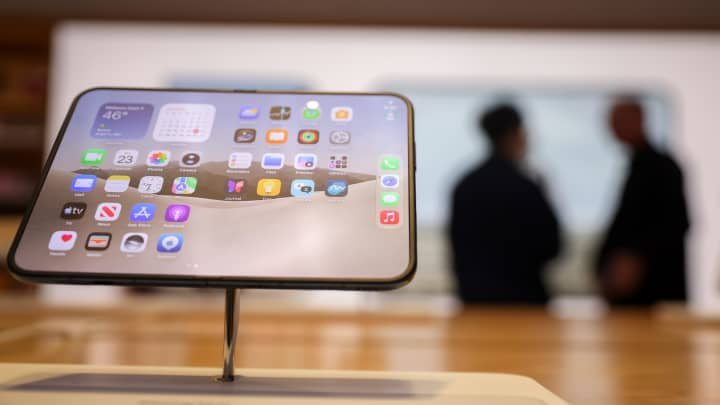
Apple’s first foldable smartphone, the iPhone Duo, is facing early reports of screen failures just days after its launch. Several people claiming to own the $1,999 device have shared images on social media showing cracked inner displays, bright lines across the screen and possible hinge problems.
Some reports describe damage appearing around the same area of the inner display, near the transition between an opening for a cable connecting the phone’s two halves and the central hinge support. Other users have claimed to hear a crunching sound while folding or unfolding the device. A few posts have alleged that the damage occurred without an obvious incident, with some reports describing failures during the initial setup process.
The exact cause of the reported failures has not been established. However, repair specialists at iFixit have suggested that the phone’s complex hinge mechanism could be contributing to the problem. Their teardown identified a central support bar that appeared not to retract properly as the device closed, potentially placing excessive pressure on the delicate inner display.
It remains unclear whether the reports indicate a widespread design problem, a defective production batch or isolated incidents. Apple has acknowledged an issue affecting a small number of units and advised customers experiencing display problems to contact AppleCare for a replacement.
The reports come at an important moment for Apple. The company is entering a foldable smartphone market already served by manufacturers such as Samsung and Huawei. How it investigates the screen failures and handles affected devices could influence consumer confidence in its first-generation foldable phone.
What Is Causing the iPhone Duo Screen Failures?
There is currently no confirmed explanation for why some iPhone Duo owners have reported cracked inner displays. The available accounts vary, and the reports do not establish a single cause or a consistent timeline for the failures.
Some users have claimed that their displays developed cracks during the first setup process, while others have described damage appearing after folding or unfolding the phone. Social media images show bright lines across parts of the inner display, with several reports pointing to a similar area near the hinge assembly.
The location of the reported damage has prompted questions about whether mechanical stress inside the folding mechanism could be affecting the display. iFixit’s teardown offers one possible explanation, but its findings do not establish that the same mechanism caused every reported failure.
iFixit Points to a Possible Hinge Design Problem
iFixit, which is known for dismantling and assessing the repairability of electronic devices, has examined the iPhone Duo’s internal construction and explored possible reasons for the early screen failures.
The repair specialist described the hinge as an intricate mechanism involving interconnected components. Its analysis suggested that part of the assembly might not always move into the correct position as the phone closes, potentially exposing the inner display to excessive mechanical stress.
According to iFixit’s teardown, a central support bar appeared not to retract properly during the closing motion. If the component fails to move as intended, it could place pressure on the display in an area where several structural elements meet.
The curved rails that guide the hinge’s movement were also identified as a possible source of interference. These rails rise above surrounding components as the device folds, and their movement could potentially affect the screen if the mechanism does not operate as designed.
iFixit also highlighted the concentration of structural edges and components around the area where some users have reported damage. When multiple parts meet close to a delicate display assembly, forces acting on that area could become concentrated rather than distributed evenly.
These observations suggest possible mechanical explanations for the reported failures. However, a teardown and a model of the hinge cannot, on their own, prove that a particular component caused the damage in every affected phone. Further investigation would be needed to establish whether the issue stems from component movement, manufacturing variation, a defective batch or another factor.
How the iPhone Duo’s Complex Hinge Works
Foldable smartphones require a hinge that allows the device to open and close repeatedly while protecting a flexible display. Unlike a conventional smartphone, a foldable must accommodate movement between two sections without placing excessive stress on the screen.
Based on Apple’s patents, the iPhone Duo’s hinge incorporates gears, springs and interconnected metal joints. Its waterdrop-style folding design is intended to provide room for the display to bend rather than forcing it into an excessively sharp fold.
Waterdrop-style hinges are also used in other foldable phones. The design helps manage the space occupied by the flexible display as the two halves come together. Apple’s implementation reportedly includes additional engineering features intended to control how the mechanism moves.
The hinge also uses curved guides to direct the movement of its joints as the device opens and closes. These guides are intended to reduce stress on the display by controlling the folding motion and helping the screen follow the mechanism’s path.
Because the display and hinge must work together, the position and movement of internal components are important. If a support or guide does not move as intended, it could potentially create pressure at a vulnerable point. Whether that occurred in the reported iPhone Duo cases remains unconfirmed.
Could the Central Support Bar Be Putting Pressure on the Display?
The central support bar identified in iFixit’s teardown is one of the key components in its proposed explanation for the screen failures. The bar is part of the mechanism that supports the folding assembly as the two halves of the phone move together.
iFixit’s 3D model suggested that the bar was not retracting properly as the phone closed. If the component remains in the wrong position during folding, it could potentially interfere with the display or place pressure on the surrounding layers.
The curved rails that guide the hinge could also contribute to stress if their movement brings them too close to the display or other internal components. The fact that several structural elements converge around the area where damage has been reported makes the assembly a focus of investigation.
However, these are possible explanations rather than confirmed findings about the cause of the failures. The available information does not establish whether the central support bar or curved rails are defective in the affected devices, or whether the same issue is present across the wider product range.
Does the Matte Nano-Texture Display Play a Role?
The iPhone Duo features a matte nano-texture display designed to make the crease associated with a foldable screen less noticeable. The surface treatment scatters reflected light, helping reduce the visibility of the fold line under certain viewing conditions.
The display finish is a separate design feature from the hinge mechanism. The available teardown findings do not establish that the nano-texture treatment caused or contributed to the reported cracking.
Understanding the distinction is important because a visible crease, a bright line caused by display damage and a physical crack are not necessarily the same problem. The reports described by purported owners include bright lines and apparent cracking, but the information provided does not establish that every reported display symptom has an identical cause.
Should Users Avoid Pressing the Centre When Closing the Phone?
Some social media users have advised iPhone Duo owners not to close the device by pressing directly on the centre. The suggestion appears to reflect concerns that pressure applied to the folding area could affect the screen or hinge assembly.
However, the advice has not been established as a confirmed solution to the reported failures. There is no verified evidence in the available information showing that pressing the centre causes the damage or that avoiding this action prevents it.
Until the cause is better understood, users should follow Apple’s handling instructions and avoid applying unnecessary force to the display or hinge. Anyone who notices cracks, bright lines, unusual resistance or abnormal noises should contact AppleCare for guidance rather than attempting to adjust the hinge or repair the device independently.
Apple has specifically advised customers experiencing inner-display problems to contact AppleCare for a replacement. The company has not, in the statement provided, identified a definitive mechanical cause for the failures.
Apple Acknowledges Display Problems in a Small Number of Units
Apple has acknowledged that some iPhone Duo units are experiencing inner-display issues. In an official statement, the company said the response from early users had been positive and highlighted developers’ work to adapt applications to the foldable device’s form factor.
The company also confirmed that it was aware of a problem affecting a small number of units. Apple advised customers experiencing display issues to contact AppleCare for a replacement.
“We are aware of an issue impacting the inner display on a small number of iPhone Duo units. If users experience issues with their iPhone Duo display, they should contact AppleCare for a replacement,” Apple said.
The statement confirms that Apple is aware of reported display problems, but it does not identify their cause or specify whether the issue is linked to a particular component, manufacturing batch or usage condition.
According to a report by 9to5Mac, several affected buyers were able to obtain immediate replacements at Apple Stores. The reports suggest that some customers have received assistance through Apple’s retail support network, although the available information does not establish how every case has been handled.
It is also unclear how frequently the failures are occurring. Apple is likely to have shipped a substantial number of units, but the reports described so far appear to involve a small fraction of purported owners. Without verified sales and failure figures, it is not possible to calculate a reliable defect rate.
iPhone Duo Receives a Repairability Score of 5 Out of 10
Despite investigating the reported screen failures, iFixit has also described the iPhone Duo as the most repairable foldable smartphone it has assessed so far. The device received a repairability score of 5 out of 10, the highest score the organisation has awarded to a foldable phone.
The score provides a separate perspective on the device’s construction. Repairability concerns how practical it is to access and replace components, while durability concerns how well a device withstands use over time. A comparatively high repairability score does not establish that the phone is immune to hardware failures.
Likewise, reports of damaged displays do not automatically mean that every unit has a faulty hinge or that the entire product line is affected. Determining the scale and cause of the problem requires evidence beyond individual social media posts and an examination of the device’s internal design.
The combination of early failure reports and a relatively high repairability assessment highlights two different aspects of the iPhone Duo’s engineering: how its folding mechanism performs during use and how readily the device can be repaired when something goes wrong.
Are the Screen Failures Widespread?
It remains too early to determine whether the iPhone Duo’s reported screen failures are widespread. Some purported owners have posted photographs of damaged displays, and several accounts describe problems around a similar area near the hinge. However, social media reports alone cannot establish the proportion of devices affected.
The available information does not confirm whether the cases involve a defective production batch, a design-related weakness or separate incidents with different causes. Nor does it provide a verified count of damaged devices relative to the total number sold.
Apple’s description of the issue as affecting a small number of units is the company’s stated assessment. Independent failure-rate data would be needed to determine how common the problem is across the entire installed base.
The reports also do not establish whether the issue develops after a particular number of folding cycles or whether some devices are affected from the beginning. Some users have claimed that problems appeared during initial setup, while other accounts describe damage during ordinary folding and unfolding.
These differences make it important to distinguish confirmed product information from individual claims. Photographs and firsthand accounts can help identify patterns, but they do not independently establish the underlying mechanical cause.
What the Early Reports Mean for Apple’s Foldable Market Ambitions
The iPhone Duo launched on Friday, October 23, amid interest in Apple’s entry into the foldable smartphone market. Demand was reported to be strong in cities including Singapore, Shanghai, London and San Francisco.
However, the launch reportedly featured fewer of the long queues and overnight camp-outs associated with some earlier iPhone releases. Reuters attributed part of the situation to sales restrictions, while reports also described demand exceeding supply during the pre-order period.
Apple’s move into foldables is being closely watched because competitors such as Samsung and Huawei have already sold premium foldable phones for years. The iPhone Duo is therefore an important test of whether Apple can attract a wider audience to a category that has remained more specialised than conventional smartphones.
The reported display failures introduce an early challenge for the company. Foldable phones depend on complex mechanical systems and flexible displays, and customers paying a premium price are likely to expect the hinge and screen to remain reliable during normal use.
Francisco Jeronimo, vice president at International Data Corporation (IDC), said the early reports illustrated the engineering challenges involved in foldable devices, even for a company with Apple’s resources and supply-chain capabilities.
“The early reports of inner display failures on the iPhone Duo show that even a company with Apple’s engineering resources and supply chain discipline faces a steep learning curve in foldables,” Jeronimo said in a statement to The Indian Express.
Jeronimo also highlighted the importance of Apple’s response for consumer confidence, particularly given the device’s premium price and the company’s established retail network. He said the company would need to clarify its warranty position as the phone expanded into additional markets.
Can Apple Maintain Its Expected Share of the Foldable Market?
Market forecasts have pointed to substantial ambitions for Apple’s entry into foldable smartphones. According to a forecast by IDC cited in the supplied report, Apple was expected to capture 44% of the foldable market in 2026 by value, while accounting for 31% of Duo units.
The forecast also projected that Apple would become the foldable market leader by both value and units shipped in 2027. These are projections rather than confirmed outcomes, and the early display reports introduce a potential challenge for the company’s efforts to build confidence in the new product category.
Apple’s ability to respond to affected customers may be particularly important because the iPhone Duo is a first-generation device. A prompt replacement process can help customers whose phones develop problems, but it does not by itself establish the root cause or prevent further failures.
The phone’s reported $1,999 starting price also places considerable importance on reliability and after-sales support. Buyers considering a premium foldable may weigh the device’s features against concerns about screen durability, repair costs and the availability of replacements.
Apple’s launch strategy has also included limits on purchases and availability. Pre-order delivery estimates reportedly moved to late January within minutes of orders opening, as demand outpaced supply. The company capped pre-orders at two handsets per customer and limited sales to walk-in shoppers in some markets.
In India, the iPhone Duo was reported to be available only to customers who had ordered online, a distribution approach also described for China, France, Hong Kong and Japan. The supplied report said the phone was scheduled to launch in 28 additional markets on October 30.
What iPhone Duo Owners Should Know
For current owners, the main point is that the cause of the reported display failures remains unconfirmed. iFixit’s teardown has identified possible sources of mechanical stress around the hinge, but these findings do not prove that the same fault is responsible for every reported case.
Users who notice cracks, bright lines across the inner display or unusual hinge behaviour should contact AppleCare and follow the company’s guidance. Apple has advised affected customers to seek a replacement, and some buyers have reportedly received replacements at Apple Stores.
Owners should also avoid assuming that an online suggestion, such as changing how they press the device closed, has been proven to prevent the problem. The available information does not establish that this technique is either the cause of the damage or a reliable fix.
For prospective buyers, the reports are an early warning worth monitoring, but they do not yet establish how common the failures are. A clearer assessment will depend on further investigation, verified information about affected devices and Apple’s explanation of the issue.
Conclusion
The iPhone Duo’s early screen-failure reports have raised questions about the durability of Apple’s first foldable smartphone. Photos shared by purported owners show damage around the inner display, while some users have described unusual noises during folding or unfolding.
iFixit’s teardown points to several possible mechanical causes, including a central support bar that may not retract correctly, curved hinge rails and structural components concentrated near the affected area. These findings offer possible explanations, but no definitive cause has been established.
Apple has acknowledged display issues affecting a small number of units and advised customers to contact AppleCare for replacements. Whether the reports represent isolated failures or a broader hardware problem remains unclear.
As Apple seeks to compete with established foldable-phone manufacturers, its handling of the reported failures will be an important test of customer support and confidence in the category. The next steps will depend on whether the company can identify the cause, clarify its response and demonstrate that the iPhone Duo’s display and hinge can deliver reliable performance over time.
For breaking news and live news updates, like us on Facebook or follow us on Twitter and Instagram. Read more on Latest Technology on thefoxdaily.com.






COMMENTS 0