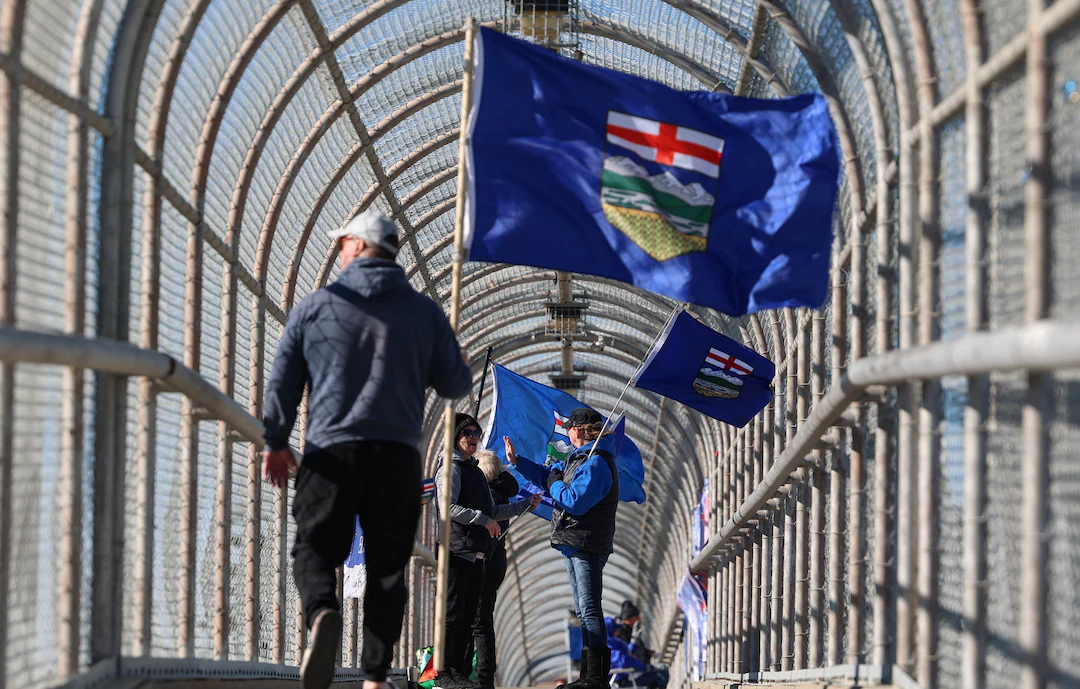
Alberta is voting on whether to separate from Canada, bringing renewed attention to a long-running independence movement in the oil-rich western province. Although public opinion polls suggest that a majority of Albertans want to remain part of Canada, the nonbinding referendum could mark an important moment for a campaign driven by economic grievances, disagreements over energy policy and frustration with the federal government in Ottawa.
The vote, held on Monday, October 19, comes as Canadian Prime Minister Mark Carney faces pressure on several fronts, including US tariffs, President Donald Trump’s repeated suggestions that Canada should become the 51st American state, and growing discontent among some Albertans over the province’s relationship with the federal government.
Separatist campaigners are unlikely to achieve their immediate objective if the expected defeat materialises. However, the debate may continue long after the ballots are counted. A recent Angus Reid poll found that 66% of Albertans intended to vote to remain in Canada, while three in five respondents believed the separatist movement would never disappear.
For Alberta Premier Danielle Smith, the referendum presents a political balancing act. She has urged residents to remain within Canada while responding to pressure from separatists within her own political camp. For Carney, the challenge is to persuade Albertans that their economic interests are better served by remaining part of the federation.
Why Is Alberta Voting on Separation From Canada?
Alberta’s independence debate centres largely on economics, natural resources and the province’s relationship with Ottawa. Unlike Quebec’s separatist movement, which has historically been closely associated with French-language identity and cultural differences, Alberta’s campaign is driven primarily by complaints about federal economic and environmental policies.
Alberta is Canada’s energy heartland and a major producer of oil and gas. Many supporters of independence believe the federal government has restricted the province’s oil industry through environmental regulations and other policy decisions. They also argue that Alberta contributes more to the national economy than it receives in public spending and other benefits.
These grievances have become central to the argument that Alberta should have greater control over its natural resources, economic priorities and political future.
Cory Morgan, founder of the pro-separation advertising organisation Pathway to Independence, argued that Canada’s political and economic system favours central regions and the federal government at the expense of resource-producing provinces.
His argument reflects a broader concern among separatists that Alberta’s economic contribution does not translate into sufficient influence over national policy. Campaigners contend that an independent Alberta could make decisions about energy development, taxation and public spending without facing the same constraints from Ottawa.
However, dissatisfaction with federal policy does not necessarily mean that most Albertans want to establish a separate country. The Angus Reid findings suggest that opposition to the current political arrangement and support for outright independence remain distinct positions for many voters.
Alberta Referendum: What Do the Polls Say?
Public opinion polling indicates that the campaign to keep Alberta within Canada has a substantial advantage heading into the referendum. An Angus Reid poll released on Friday found that 66% of Albertans planned to vote to remain in the country.
The finding suggests that separatists face a significant challenge in persuading voters that independence is preferable to reforming Alberta’s relationship with the federal government.
Yet the same poll revealed a more complicated picture of public opinion. Three in five respondents believed the separatist movement would never come to an end, indicating that many Albertans expect the issue to remain part of provincial politics even if the current referendum produces a defeat for independence supporters.
The distinction matters because the referendum is not simply a test of how many residents want an independent Alberta. It is also a measure of how deeply dissatisfaction with the federal government has become embedded in the province’s political debate.
Among Albertans who said they would vote in favour of separation in a future binding referendum, 60% told pollsters that their motivation was to send a message to the federal government. Only 37% identified the creation of an independent nation as their motivation.
Those figures suggest that at least some support for separatism may reflect political frustration rather than a settled commitment to independence. For these voters, the threat of separation could serve as leverage to demand changes in federal policy.
That distinction could shape the movement’s next phase. If the referendum fails, separatist organisations may continue campaigning for a future vote, or they could redirect their efforts towards pressuring provincial and federal politicians to address Alberta’s economic concerns.
Danielle Smith’s Political Challenge
Alberta Premier Danielle Smith has become a central figure in the debate, even though she has urged voters to remain part of Canada. She is the first Alberta leader to put the question of separation to voters, following months of pressure from a small but vocal group within her governing United Conservative Party.
Her decision to hold the referendum reflects the political difficulty of managing a movement that has gained visibility without necessarily securing majority support for independence.
By allowing the issue to be put to a vote, Smith has given separatists an opportunity to demonstrate the level of public support for their position. At the same time, her calls for Alberta to remain in Canada indicate that she is not advocating an immediate break with the federation.
The referendum therefore serves two political purposes. It allows residents to express their views on Alberta’s constitutional future, while also testing whether separatist sentiment has grown beyond a vocal segment of the provincial electorate.
If the result favours remaining in Canada, Smith could point to the outcome as evidence that most Albertans prefer to address their concerns within the existing political system. However, a strong separatist vote could increase pressure on her government to pursue further negotiations with Ottawa, even if independence itself remains a minority position.
The political consequences may therefore depend not only on the final vote but also on the strength of the separatist showing and how political organisations interpret the result.
What Happens if Albertans Vote for Independence?
The referendum is nonbinding, meaning its result does not automatically separate Alberta from Canada. Instead, it provides a political indication of whether voters support the principle of leaving the federation.
Smith has said that if a majority votes in favour, she would seek a binding referendum on separation. Such an outcome would move the debate into a more consequential phase, but it would not, by itself, establish an independent country.
A binding vote would raise additional political and legal questions, including how a separation process could proceed and what conditions would need to be resolved before independence could become a reality.
Alberta would also need to confront practical questions about the operation of an independent state. These include defence arrangements, currency, border controls and the broader economic relationship with the rest of Canada.
Separatist groups have published transition plans, but key questions about how these systems would function remain unresolved in the material described by the campaign. The existence of such plans does not mean that the province has an agreed or completed roadmap to independence.
Any serious separation proposal would also have to address the interests of residents, businesses and governments affected by a change in Alberta’s constitutional status. Questions involving trade, public services, financial arrangements and the movement of people would become central to the debate.
Consequently, even a majority vote for separation would represent the beginning of a much more complicated political process rather than an immediate exit from Canada.
Why a Defeat May Not End Alberta’s Separatist Movement
The central question surrounding the referendum is whether a defeat would weaken the independence campaign or simply encourage its supporters to prepare for another political contest.
Political scientist Duane Bratt of Mount Royal University in Calgary believes the movement is unlikely to disappear. He has pointed to the connections separatists have built, as well as their ability to organise and mobilise supporters.
That organisational capacity could allow the campaign to remain active even if the referendum fails to secure majority backing.
Separatist movements can persist when their supporters view a vote as one stage in a longer political struggle rather than a final verdict. In Alberta’s case, the underlying disputes concern federal policy, energy development and the distribution of economic benefits across Canada. A referendum result alone may not resolve those disagreements.
For voters who primarily want to send Ottawa a message, a defeat for independence could still be interpreted as a reason to demand political concessions. For committed separatists, meanwhile, the result could become a starting point for efforts to increase support before a future vote.
Bratt has identified two possible directions for the movement after the referendum. Its supporters could concentrate on building backing for another separation vote, or they could split off and establish a dedicated separatist political party with the ambition of becoming a significant force in provincial politics.
Neither outcome is guaranteed. The movement could struggle to expand beyond its existing base, or internal disagreements could weaken its ability to maintain momentum. But the referendum is likely to provide campaigners with new information about their electoral prospects and the arguments that resonate most strongly with residents.
How Mark Carney Is Trying to Keep Alberta in Canada
Prime Minister Mark Carney has made defending Canada’s sovereignty a central political priority. His government is facing pressure from the United States over trade, while President Donald Trump has repeatedly suggested that Canada should become the 51st state.
Against that backdrop, a separatist campaign in Alberta presents an additional challenge for a prime minister seeking to maintain national unity.
Carney, who grew up in Alberta, spent much of the week leading up to the referendum campaigning for the province to remain in Canada. His message has combined appeals to national identity with an argument that the country should not be viewed as a financial transaction between its provinces.
Speaking in Red Deer, Alberta, on Friday, Carney rejected the idea that the country’s future should be judged exclusively through calculations of what individual provinces contribute and receive.
His position directly addresses a key separatist argument: that Alberta would be better off if it could retain greater control over the wealth generated by its resources.
Carney has also taken steps aimed partly at addressing the concerns behind Alberta’s separatist sentiment. He has overturned some environmental policies and supported a proposed oil pipeline that would increase Alberta’s exports to Asian markets.
These moves suggest an effort to demonstrate that Alberta’s priorities can be accommodated within Canada. They also highlight the potential for economic and energy policy to become central to negotiations between the province and the federal government.
However, changing policies does not necessarily guarantee that separatist sentiment will disappear. Some residents may view concessions as evidence that political pressure is working, while others may continue to believe that provincial interests would be better protected through independence.
Alberta’s Economic Grievances Versus National Unity
The referendum exposes a fundamental disagreement over how Canada’s federation should balance national interests with the priorities of individual provinces.
Separatists argue that Alberta’s position as a major energy producer gives it a strong economic case for greater autonomy. In their view, decisions made in Ottawa can impose costs on the province while limiting its ability to develop its natural resources.
Supporters of remaining in Canada counter that the country’s political and economic systems cannot be reduced to a calculation of how much money each province contributes or receives. National institutions, shared infrastructure and the broader economic relationship between provinces form part of the case for remaining within the federation.
The debate is especially significant because Alberta’s concerns are not limited to the constitutional question of independence. They also involve disagreements about environmental policy, energy exports and the degree of influence resource-producing regions should have over federal decisions.
These disputes can persist regardless of the referendum outcome. If most voters reject separation, the result may strengthen the argument for resolving disagreements through negotiations and policy changes. If support for independence proves stronger than expected, federal and provincial leaders could face greater pressure to demonstrate that Alberta’s concerns are being taken seriously.
For Carney, the challenge is to defend national unity without dismissing the economic concerns driving discontent. For Smith, it is to respond to separatist pressure while maintaining her position that Alberta should remain in Canada.
How Alberta’s Vote Differs From Quebec’s Separatist Movement
Alberta’s referendum is notable because it is the first vote on separation from the rest of Canada to be held in a province outside majority French-speaking Quebec.
Quebec’s independence movement has historically been shaped by language, culture and questions about the province’s identity within Canada. Alberta’s campaign, by contrast, has placed greater emphasis on economic grievances and the management of natural resources.
The distinction does not mean that identity and regional political culture are irrelevant in Alberta. Rather, the central argument presented by separatist campaigners focuses on the relationship between the province’s economic contribution and federal decision-making.
This makes the outcome important beyond the immediate question of whether Alberta should become independent. The referendum could also reveal how economic frustration translates into support for constitutional change in a resource-rich province.
It may offer political leaders a clearer indication of whether residents primarily want changes to federal policies or are prepared to consider the more disruptive option of establishing a separate country.
At the same time, comparisons with Quebec should be made cautiously. The two movements have different histories and political foundations, and Alberta’s referendum does not establish that the province is following the same path.
What to Watch After the Alberta Referendum
The immediate focus is on the referendum result, but several developments could determine whether the separatist movement gains or loses momentum in the months ahead.
- The strength of the separatist vote: A clear defeat would reinforce the polling advantage enjoyed by supporters of remaining in Canada. A stronger-than-expected showing for separation could nevertheless encourage campaigners to continue organising.
- Danielle Smith’s response: The premier’s next steps will matter because she must balance her stated preference for remaining in Canada with pressure from separatists within her political base.
- Federal energy policy: Decisions affecting Alberta’s oil and gas industry, environmental rules and proposed export infrastructure could influence whether economic grievances intensify or ease.
- The movement’s political organisation: Separatists may pursue another referendum campaign or explore the creation of a dedicated political party. Their ability to remain united could shape their longer-term influence.
- Public opinion over time: Future polling could indicate whether voters view separation as a realistic political objective or primarily as a way to pressure Ottawa for policy changes.
These factors will help determine whether the referendum becomes a turning point or another chapter in Alberta’s longstanding dispute with the federal government.
Alberta Referendum: Key Facts to Know
- Location: Alberta, a western Canadian province and a major centre of the country’s oil and gas industry.
- Population: Approximately 5 million people.
- Vote: A nonbinding referendum on whether Alberta should separate from Canada.
- Premier: Danielle Smith, who has urged voters to remain in Canada.
- Federal prime minister: Mark Carney, who has campaigned for national unity.
- Polling: An Angus Reid poll released on Friday found that 66% of Albertans planned to vote to remain in Canada.
- Potential next step: Smith has said she would seek a binding referendum if a majority votes in favour of separation.
- Main issue: Economic dissatisfaction, particularly over federal energy and environmental policies, rather than the language and cultural differences that have historically shaped Quebec’s separatist movement.
Conclusion: Alberta’s Separation Debate Is Bigger Than One Vote
Alberta’s referendum is taking place against a backdrop of economic dissatisfaction, political tension and renewed debate over Canada’s national unity. Although polls indicate that remaining in Canada is the preferred option for most Albertans, the vote is unlikely to resolve the grievances that have sustained the separatist movement.
For committed independence supporters, the referendum offers an opportunity to demonstrate their strength and build support for future political action. For other voters, the issue may be less about creating a new country and more about persuading Ottawa to change policies affecting Alberta’s energy industry and economic interests.
The outcome will also test the approaches taken by Smith and Carney. Smith must manage pressure from separatists while advocating that Alberta stay in Canada, while Carney must defend national unity and show that the federal government can respond to regional concerns.
Ultimately, the referendum’s significance may lie less in whether Alberta separates from Canada immediately and more in what the campaign reveals about the province’s relationship with Ottawa. If economic grievances remain unresolved, separatism could continue to influence Alberta’s politics even after voters deliver an expected rejection of independence.
For breaking news and live news updates, like us on Facebook or follow us on Twitter and Instagram. Read more on Latest World on thefoxdaily.com.





COMMENTS 0