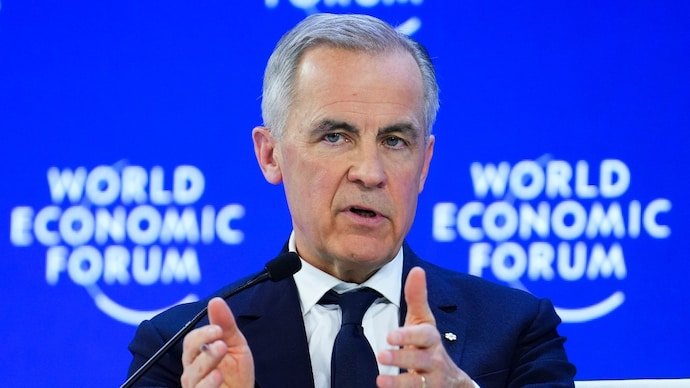
Canadian Prime Minister Mark Carney is taking a direct pitch to global investors as Ottawa attempts to reshape an Economy that has long depended heavily on the United States. With trade tensions between Washington and Ottawa escalating, Canada is looking beyond its southern neighbour for capital, markets and long-term economic partnerships.
About 300 chief executives and senior investment executives are expected at Carney’s Canada Investment Summit in Toronto, representing firms that collectively manage more than USD 120 trillion in assets. The gathering is designed to connect some of the world’s largest pools of capital with Canadian projects in sectors ranging from critical minerals and energy to technology, defence and advanced manufacturing.
The timing is deliberate. For decades, one of Canada’s strongest selling points to international investors has been its immediate access to the enormous US market. That advantage is now facing greater uncertainty as US President Donald Trump pursues tariffs, reshoring policies and measures intended to encourage companies to manufacture and invest inside the United States.
Carney’s response is to argue that Canada should not be viewed merely as an extension of the US economy. Instead, he wants international investors to see Canada as a destination with its own resources, institutions, skilled workforce, trade relationships and long-term investment opportunities.
Carney’s pitch: Canada has more than proximity to the US
Carney has been explicit about the message he wants investors to take away from the summit.
He argues that Canada’s economic proposition goes well beyond its geographic position beside the United States. The country possesses extensive energy and critical mineral resources, a highly educated workforce and a network of trade agreements that provides Canadian businesses with access to roughly 1.5 billion consumers worldwide.
That argument is particularly important now because the traditional North American investment model is being challenged.
A company deciding where to build a factory or establish a supply chain has historically been able to treat Canada and the United States as part of an integrated continental market. That assumption becomes less attractive when tariffs and other trade restrictions make cross-border commerce less predictable.
Carney is therefore trying to change the question investors ask.
Instead of asking whether Canada provides the best route into the US market, Ottawa wants investors to consider whether Canada itself offers a compelling combination of natural resources, human capital, political stability, Infrastructure and access to multiple international markets.
Carney has also emphasised the size and seniority of the summit’s audience as evidence that international investors are willing to examine Canada on its own merits.
Why the US trade relationship has become a vulnerability
The economic relationship between Canada and the United States is unusually deep. Supply chains cross the border repeatedly, particularly in manufacturing, energy, agriculture and industrial production.
That integration has historically been an advantage. Canadian companies can sell into a huge nearby market, while US companies benefit from Canadian resources, labour, production capacity and cross-border supply chains.
But deep integration also creates exposure.
When Washington changes tariff policy or imposes restrictions on Canadian products, the effects can travel quickly through Canadian factories, exporters and investment plans. The uncertainty is particularly important for businesses considering projects that require billions of dollars and operate for decades.
The latest trade dispute has therefore raised a question that goes beyond the immediate value of tariffs: Can Canada continue to depend so heavily on the US market without exposing its long-term economic strategy to policy changes in Washington?
Carney’s investment summit is part of Canada’s attempt to address that vulnerability.
Tariffs have changed the investment calculation
Trade negotiations between Canada and the United States broke down on August 21, after which Washington imposed 50 per cent tariffs on roughly USD 20 billion worth of Canadian goods, according to the supplied account. Canada responded with retaliatory measures.
The dispute subsequently expanded beyond tariffs, with Washington announcing restrictions affecting some Canadian imports and moves to exclude Canadian products from large, long-term US government contracts.
For investors, the significance of these measures is not limited to the immediate financial cost.
Investment decisions depend heavily on predictability. A company constructing a new plant must estimate labour costs, energy prices, tax conditions, access to customers, logistics expenses and regulatory requirements over many years.
If access to a major market can be altered suddenly through tariffs or procurement restrictions, the calculation becomes more complicated.
That uncertainty creates an opening for Canada’s alternative investment pitch. Ottawa is effectively telling investors that while Canada cannot eliminate the risks associated with its largest trading partner, it can offer other advantages that remain within the country’s control.
Carney puts “trust” at the centre of the pitch
One of the strongest themes emerging from Carney’s investor outreach is not a commodity, tax incentive or specific infrastructure project. It is institutional trust.
Carney has contrasted Canada with a more unpredictable international environment by emphasising the country’s commitment to the rule of law and reliability.
He has described trust as an asset that cannot be found on a balance sheet but can nevertheless influence where global capital is deployed.
That is a significant argument for long-term investors.
Large pension funds, sovereign investors and asset managers are not necessarily looking only for the highest short-term return. They also have to assess political risk, regulatory stability, contract enforcement, infrastructure reliability and the likelihood that government policy will remain sufficiently predictable over the life of an investment.
Canada’s institutions can therefore form part of its competitive proposition.
Whether that advantage is enough to compensate for higher costs or other challenges will vary by sector and project. But Carney is making the case that stability itself has economic value, particularly when investors are increasingly dealing with geopolitical fragmentation.
Carney’s background gives him an unusual advantage
The Canadian prime minister is also unusually familiar with the audience he is trying to attract.
Before entering political leadership, Carney spent 13 years at Goldman Sachs and later held senior positions connected with major financial institutions. He led the central banks of Canada and England and subsequently chaired the boards of Bloomberg L.P. and Brookfield Asset Management.
That background gives him direct experience of how major financial institutions assess risk and allocate capital.
It also helps explain the structure of the summit. Rather than simply making a broad political appeal to foreign investors, the Canadian government is attempting to match individual investors with projects that correspond to their investment mandates.
Private meetings are expected to be tailored around investors’ existing portfolios and the types of projects they are prepared to finance.
The objective is not necessarily to announce a large number of deals during the summit itself.
A Canadian official described the event as the country’s largest gathering of investment decision-makers and indicated that the most important results could emerge over the following 12 to 18 months.
That timeline is important. Large infrastructure, energy and industrial projects cannot be negotiated and financed in a few days. Due diligence, regulatory approvals, financing structures and construction planning can take years.
Critical minerals are a major part of Canada’s strategy
Critical minerals are among the sectors where Canada hopes its natural advantages can attract international capital.
Demand for minerals used in batteries, electronics, advanced manufacturing and other strategic technologies has made secure supply chains increasingly important to governments and companies.
Canada has significant natural-resource potential and wants to position itself as a dependable supplier in a global economy that is becoming more concerned about concentrated supply chains.
The opportunity extends beyond simply extracting minerals.
The greater economic prize lies in building more of the value chain domestically, including processing, manufacturing and technology-related activities where feasible. Such investments can create higher-value economic activity while giving Canada a stronger position in emerging industries.
For global investors, the attraction is potentially two-sided: access to Canadian resources and participation in the infrastructure and industrial capacity required to turn those resources into internationally competitive products.
Energy remains another pillar of the investment pitch
Canada’s energy resources are another major component of Carney’s argument.
The country has substantial oil and gas resources as well as opportunities connected with Electricity and other forms of energy infrastructure. For investors, the appeal of Canada’s energy sector depends not only on resource availability but also on infrastructure, export capacity, regulation and long-term demand.
Energy Security has become a more prominent issue globally following supply disruptions, geopolitical conflicts and changes in international trade patterns.
Canada can potentially benefit from those concerns if it can demonstrate that its resources can reach international markets reliably and competitively.
That is particularly relevant to the broader objective of reducing economic concentration around the United States. Diversifying Canadian exports requires more than finding new customers; it requires the infrastructure and commercial relationships necessary to serve those customers at scale.
Technology and advanced manufacturing broaden the agenda
The summit is also focused on sectors that could shape Canada’s economic competitiveness over the longer term, including technology and advanced manufacturing.
This is significant because simply attracting foreign investment into resource extraction would not fundamentally change Canada’s economic exposure.
Ottawa is seeking capital for projects capable of creating broader industrial capacity, technology development and high-skilled employment.
Advanced manufacturing can also provide an important bridge between Canada’s resource advantages and its workforce. Critical minerals, energy and industrial inputs can support manufacturing, while technology can improve productivity and create new export opportunities.
Defence has become another area of growing interest as governments reassess supply chains and national security requirements.
The combination of defence, technology, manufacturing and critical minerals reflects a wider global shift: economic policy and national security are increasingly connected.
Canadian pension funds are part of the capital equation
The investment summit is not only about attracting foreign money into Canada. Canadian institutional investors also have a role to play.
Canada has some of the world’s largest pension investment organisations, which manage substantial pools of long-term capital on behalf of Canadian workers and retirees.
CPP Investments, whose chief executive John Graham is co-hosting the summit, is among the institutions evaluating opportunities in Canada alongside investments elsewhere in the world.
That comparison is important.
Canadian pension funds cannot simply invest domestically because a project is Canadian. Their responsibility is to assess risk and potential returns against opportunities available globally.
For Ottawa, however, creating a stronger pipeline of investable Canadian projects can potentially encourage domestic institutional capital to participate alongside international investors.
That could produce a multiplier effect in which Canadian pension funds, foreign asset managers and corporate investors finance large projects together.
The real test is whether investment follows the rhetoric
The visibility of the summit creates an opportunity for Canada, but attracting investment will ultimately depend on what happens after the speeches and meetings.
Global investors have many choices. Canada’s resources and institutional reputation may make it attractive, but investors still compare expected returns, construction costs, taxation, regulation, labour availability, infrastructure and market access against competing destinations.
The country’s relationship with the United States will remain part of that calculation regardless of Ottawa’s diversification efforts.
Geography cannot be changed. The US will remain Canada’s largest and most important neighbour and a critical economic partner.
Consequently, the goal is unlikely to be a complete separation from the US economy. A more realistic objective is reducing excessive dependence while expanding Canada’s economic options.
That distinction is central to understanding Carney’s strategy.
Europe becomes the next stop in Canada’s diversification drive
Carney’s diplomatic and economic outreach will continue beyond Toronto. He is scheduled to travel to Europe and address the European Parliament as Canada works toward a broader strategic partnership with the European Union.
The European relationship offers Canada another avenue for diversification.
Europe represents a large consumer market, a major source of investment and an important partner in technology, energy, defence and industrial policy. Stronger ties could help Canada reduce the concentration of its international economic relationships while giving European companies additional reasons to invest in Canadian projects.
The timing also reflects a broader geopolitical reality. Countries that traditionally relied heavily on stable global trade are now reconsidering how vulnerable their economies are to political shocks.
Canada is attempting to position itself as one of the places where investors can build long-term projects while maintaining access to multiple international markets.
Canada’s new investment proposition
Carney’s Toronto summit is ultimately an attempt to rewrite Canada’s investment narrative.
For years, Canada’s proximity to the United States was among its biggest commercial advantages. Now, that same proximity has become a source of vulnerability as trade policy in Washington becomes more unpredictable.
Carney’s answer is not to deny Canada’s connection with the United States but to make the Canadian economy less dependent on it.
The pitch combines several assets: critical minerals, energy resources, a highly educated workforce, established institutions, trade agreements, financial expertise and a reputation for political and legal stability.
The presence of hundreds of senior investment executives demonstrates that there is international interest in hearing that argument. But interest is only the first step.
The next test will be whether meetings translate into financing commitments, whether financing turns into construction and whether new projects create durable export capacity outside the traditional US-centred economic model.
That process will take time. As the Canadian government itself expects, the most meaningful outcomes may emerge over the next year or more rather than during the summit itself.
Still, the message from Toronto is clear. Canada wants global capital to see the country as more than America’s neighbour. At a moment when trade tensions are forcing governments and companies to reconsider old assumptions, Ottawa is betting that resources, skilled people, market access and institutional trust can become the foundation of a more diversified Canadian economy.
For breaking news and live news updates, like us on Facebook or follow us on Twitter and Instagram. Read more on Latest World on thefoxdaily.com.





COMMENTS 0