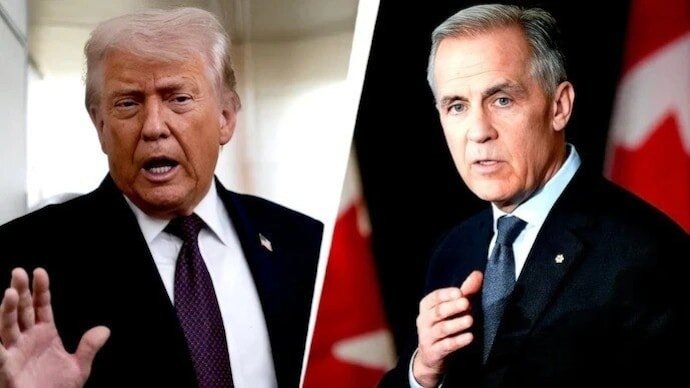
Canada and the United States have failed to reach a trade agreement after three days of negotiations in Washington, setting the stage for another escalation in tensions between two of North America’s largest trading partners. Canadian Prime Minister Mark Carney has suspended the talks and warned that Ottawa will respond to new US tariffs “dollar for dollar” if Washington proceeds with the measures.
The breakdown came shortly before a Friday night deadline, with the United States preparing to impose 50% tariffs on roughly $28 billion worth of Canadian goods. Carney said Canada had made progress during the negotiations but ultimately could not accept an agreement that failed to meet its objectives.
The dispute now moves from the negotiating table to a potential cycle of reciprocal tariffs. Washington says Canada walked away from negotiations despite significant progress, while Ottawa argues that the proposed US measures leave it with little choice but to protect its economy and domestic businesses.
Canada suspends trade negotiations with the US
Carney announced the suspension after three days of intensive discussions between Canadian and US officials. The talks were intended to resolve differences and prevent the latest tariffs from taking effect.
According to Carney, negotiations had produced “important progress,” but the two sides remained too far apart to reach an agreement that Canada considered acceptable.
He directed Canada’s negotiating team to return to Ottawa, effectively ending the latest round of discussions.
The Canadian government’s response also included a clear warning to Washington. Carney said Canada would impose reciprocal tariffs on US goods in response to the new American measures, with the aim of shielding Canadian workers and businesses from the impact.
The phrase “dollar for dollar” is significant because it signals that Ottawa is prepared to match the economic value of the US tariffs rather than simply issue a symbolic response. If implemented, such measures could raise costs for businesses importing goods across the border and increase pressure on both governments to return to negotiations.
Why the US and Canada could not reach a deal
The two sides emerged from the talks with sharply different accounts of what caused the negotiations to fail.
US Trade Representative Jamieson Greer said Canada had walked away from the negotiating table even though Washington believed the discussions were moving toward an agreement.
Greer argued that the United States had offered Canada favorable treatment compared with other major exporters. According to the US account, however, new Canadian demands and changes to earlier commitments disrupted the balance that negotiators had reached.
A senior US official said Ottawa was seeking concessions that Washington was not prepared to grant, particularly in industries considered strategically important to both countries.
Those sectors include automobiles, steel, aluminium and lumber. Each is closely connected to cross-border supply chains, meaning tariffs can affect not only exporters but also manufacturers, suppliers and consumers on both sides of the border.
The disagreement therefore goes beyond a simple dispute over individual products. It involves competing demands over market access, industrial protection and the rules governing one of the world’s most economically integrated bilateral trading relationships.
New 50% tariffs set to take effect
The immediate consequence of the failed talks is the planned introduction of new US tariffs on specified Canadian products.
US Customs and Border Protection issued guidance to importers shortly before the US trade representative’s briefing, stating that the new tariffs would apply after 12:01 a.m.
The measures cover about $28 billion worth of Canadian goods and carry a headline tariff rate of 50%. While the affected products represent a relatively small portion of Canada’s total exports to the United States, the economic significance is larger because the tariffs come on top of existing US duties affecting important Canadian industries.
Canadian steel, lumber and automobiles have already faced tariff-related pressure. The latest measures therefore add another layer of uncertainty for companies whose Business models depend on predictable access to the US market.
For exporters, tariffs can change the economics of a cross-border sale almost immediately. A company may absorb part of the additional cost, pass it to customers, renegotiate contracts or reduce shipments. The ultimate impact depends on the product, the availability of alternative suppliers and how easily companies can adjust their supply chains.
USMCA protections are also being affected
One of the more consequential elements of the latest measures is their application to Canadian goods that would otherwise qualify for preferential treatment under the United States-Mexico-Canada Agreement, or USMCA.
The agreement has been central to North American trade since replacing the North American Free Trade Agreement. Its preferential rules were designed to give qualifying goods from the three participating countries more predictable access to the regional market.
Applying new tariffs to goods eligible for USMCA treatment creates additional uncertainty for companies that have structured their operations around the agreement.
For businesses, the issue is not only the immediate tariff bill. Companies also need to consider whether existing supply chains remain commercially viable if tariffs stay in place for an extended period.
This is particularly important in industries such as automobiles, where components can cross national borders multiple times before a finished vehicle reaches a customer. New costs at one stage can therefore ripple through an entire production network.
Canada prepares for reciprocal tariffs
Carney’s promise of dollar-for-dollar retaliation puts Canada on a collision course with Washington unless the two sides return to negotiations.
Reciprocal tariffs can provide a government with leverage by imposing economic costs on exporters in the other country. But they can also create consequences at home because imported goods become more expensive or businesses face higher input costs.
That makes Canada’s response a balancing act. Ottawa wants to demonstrate that Canadian companies and workers will not be left exposed to unilateral US measures, while also avoiding unnecessary damage to businesses and consumers that rely on American products.
The decision to suspend negotiations rather than continue discussions under the threat of new tariffs also reflects the limits of compromise. Carney indicated that Canada was prepared to negotiate, but not at the cost of accepting terms that Ottawa considered inconsistent with its objectives.
Washington warns against Canadian retaliation
The US administration has also signaled that retaliation could trigger another response.
A senior US official warned that if Canada imposed counter-tariffs, President Donald Trump would be given options to “level out the playing field once again.”
That warning raises the possibility of another round of tariff escalation. If Washington imposes tariffs, Ottawa responds, and Washington then introduces additional measures, companies could face a progressively more uncertain trading environment.
The economic effects of such an escalation would not necessarily be confined to the businesses directly targeted by the original tariffs. Suppliers, distributors and customers could all be affected as companies adjust prices and sourcing decisions.
Why Canada-US trade is particularly sensitive
The United States and Canada share an unusually integrated economic relationship. Companies on both sides of the border depend on access to the neighboring market, while Manufacturing networks connect businesses across industries.
That integration makes tariffs different from a dispute involving distant trading partners. A Canadian company may sell directly to American customers, while also purchasing machinery, components or raw materials from the United States. The same can be true in reverse.
As a result, tariffs can have effects that are more complicated than the value of the goods initially targeted.
For example, a Canadian manufacturer facing a 50% tariff on exports to the US may look for ways to reduce the additional cost. But if the manufacturer depends on American components, moving production or finding replacement suppliers may itself be expensive and time-consuming.
The same dynamic applies to US companies selling products into Canada. Reciprocal Canadian tariffs could make those goods more expensive for Canadian buyers and potentially reduce demand.
Automobiles, steel, aluminium and lumber face particular pressure
The sectors identified during the negotiations are among the areas where tariff policy could have broader industrial consequences.
The automotive sector is especially sensitive because vehicle production depends on complex supply chains. Manufacturers and suppliers often operate across multiple jurisdictions, making it difficult to separate production into completely independent national systems.
Steel and aluminium are similarly important because they serve as inputs for manufacturing, construction and other industries. A tariff imposed on imported metals can affect not only foreign producers but also domestic companies that use those materials.
Lumber carries its own significance because the industry is closely tied to construction and housing markets. Higher costs for imported lumber can potentially affect businesses further down the supply chain.
These effects mean that the dispute is not simply about government revenue from tariffs. The larger question is how the measures influence production costs, investment decisions and the competitiveness of companies operating in North America.
What the tariff dispute means for businesses
Businesses now face a period of uncertainty over how long the new measures could remain in place.
Exporters will need to determine whether they can absorb the added costs or whether they must pass them to customers. Importers may have to reassess contracts, sourcing arrangements and inventory decisions.
Companies with operations on both sides of the border could also face difficult choices about where to manufacture products and how to organize their supply chains.
For smaller businesses, these adjustments can be particularly challenging because they may have fewer suppliers and less negotiating power than multinational corporations.
Large companies, meanwhile, may have more flexibility to redirect production or source components from alternative markets, but major supply-chain changes can still require substantial time and investment.
The broader risk of a prolonged trade confrontation
The immediate dispute is centered on the latest tariffs, but the longer-term concern is the possibility of sustained uncertainty in North American trade.
Businesses make investment decisions based partly on expectations about future market access. Repeated tariff changes can make those decisions more difficult because companies cannot easily determine what their costs will look like months or years ahead.
A prolonged confrontation could therefore influence decisions that extend beyond the products directly covered by the new measures.
At the same time, the economic relationship between Canada and the United States creates an incentive for both governments to eventually find a workable arrangement. Companies and industries on both sides have an interest in predictable trade rules.
That does not guarantee a quick agreement. It does mean that the economic cost of continued escalation could become an important factor in future negotiations.
What could happen next in Canada-US trade talks
The next stage will depend heavily on whether the tariffs take effect as announced and how quickly Canada implements its promised response.
If Ottawa proceeds with dollar-for-dollar retaliation, Washington could respond with additional measures, increasing pressure on both sides. If the economic consequences become significant enough, the same pressure could also encourage negotiators to reopen discussions.
The available information points to several possible paths. The two governments could return to negotiations after the tariffs are imposed, seek a narrower agreement covering specific industries, or allow the dispute to continue while businesses adapt to the new trading conditions.
For now, the immediate priority for Canada is protecting domestic businesses from the impact of the new US measures. For Washington, the focus is on maintaining pressure for the concessions it says are necessary to reach a broader agreement.
The failure of the latest three-day talks therefore does not necessarily mean diplomacy is finished. It does mean the negotiating environment has become considerably more difficult.
Carney faces a difficult economic and political calculation
Carney’s decision to suspend the talks and promise dollar-for-dollar retaliation sends a strong message that Canada will not simply absorb new US tariffs without responding.
But retaliation also carries risks for the Canadian economy. Measures designed to protect domestic producers can increase costs elsewhere, particularly for companies and consumers that rely on imported US goods.
That leaves Ottawa with a difficult calculation: respond forcefully enough to create negotiating leverage while avoiding an escalation that causes unnecessary economic damage.
Washington faces a similar calculation. Tariffs can be used as leverage in negotiations, but prolonged trade restrictions can also disrupt the businesses and supply chains that depend on cross-border commerce.
The breakdown of the latest talks has therefore produced more than another disagreement between neighboring governments. It has reopened questions about the stability of North American trade rules and the future of an economic relationship built around extensive cross-border integration.
For Canadian exporters, US manufacturers, importers and consumers on both sides of the border, the next few weeks will be closely watched. The immediate issue is the new 50% US tariff package and Canada’s promised reciprocal response. The larger issue is whether the two countries can turn the latest confrontation back into negotiations before a temporary tariff dispute develops into a deeper and more damaging trade conflict.
For breaking news and live news updates, like us on Facebook or follow us on Twitter and Instagram. Read more on Latest World on thefoxdaily.com.






COMMENTS 0