India has said it is determined to protect its trade and economic interests after the US congress passed a sweeping Russia sanctions bill that could give President Donald Trump the authority to impose tariffs of up to 100 per cent on countries that continue purchasing Russian oil and gas.
The development has placed a fresh focus on the complex economic relationship between India, the United States and Russia, particularly as India continues to rely on diversified energy supplies to meet the requirements of its 1.4 billion people.
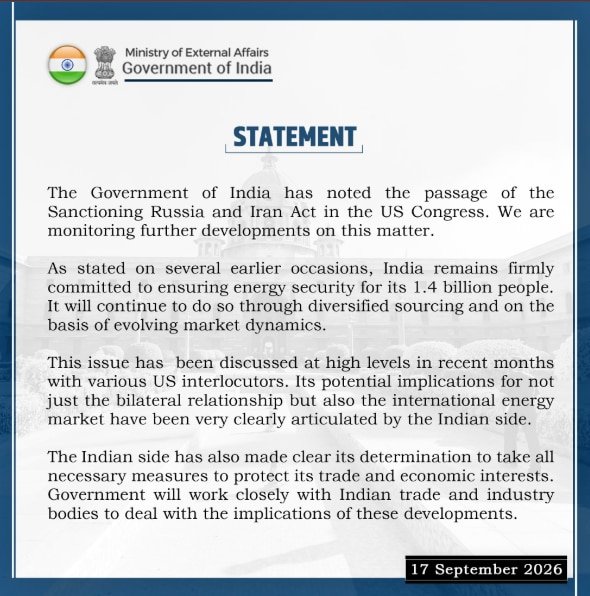
In a statement on Thursday, India’s External Affairs Ministry said the government remained committed to ensuring energy security through diversified sourcing and in response to changing market conditions.
The ministry also said the potential implications of the US legislation had already been discussed at senior levels with various US interlocutors in recent months. India, it said, had clearly communicated its concerns about the possible consequences for bilateral relations as well as the international energy market.
“The Indian side has also made clear its determination to take all necessary measures to protect its trade and economic interests,” the ministry said.
The government added that it would work closely with trade and industry bodies to address the implications of the US move.
What the US Russia sanctions bill means for India
The US legislation, formally called the Lindsey O. Graham Sanctioning Russia and Iran Act of 2026, was passed by the US House of Representatives on Wednesday by a vote of 262-159.
The legislation gives the US president authority to impose tariffs of up to 100 per cent on countries that continue buying Russian oil and gas if the relevant provisions are triggered.
India and China were specifically identified during the House debate as major purchasers of Russian energy that could potentially be affected by the measure.
The legislation had previously cleared the US Senate by an 86-11 vote. It now moves to the White House, where President Donald Trump is expected to sign it into law.
The measure is designed to increase economic pressure on Moscow over the war in Ukraine. Alongside the provisions concerning countries purchasing Russian energy, it targets Russia’s energy and defence sectors and its so-called “shadow fleet” of tankers accused of helping Russia circumvent existing sanctions.
The bill also contains additional sanctions provisions targeting Iran.
A tariff has not yet been imposed on Indian goods
One of the most important distinctions for Indian businesses is that the passage of the legislation does not itself mean that a 100 per cent tariff has been imposed on Indian exports to the United States.
Instead, the legislation provides the US president with the authority to impose tariffs of up to 100 per cent on countries that continue to purchase Russian oil and gas, subject to the conditions and provisions contained in the law.
That distinction is significant because the immediate impact on India’s trade will depend on whether and how the authority is eventually used by the US administration.
For Indian exporters, however, the possibility remains important. If the tariff authority were applied to India, goods entering the US market could become substantially more expensive, potentially affecting demand and the competitiveness of Indian products.
Why Russian oil matters to India
Energy security is at the centre of India’s response because Russian crude has become an important component of India’s oil sourcing since the war in Ukraine disrupted traditional Global energy flows.
Following the escalation of the conflict, Western sanctions and restrictions altered the international oil market. Russian crude was increasingly redirected toward markets willing and able to purchase it, while Indian refiners expanded their sourcing from Russia.
For India, the issue is not simply about maintaining a particular supplier. The government has repeatedly stressed the importance of securing sufficient energy at competitive prices for a large population and a rapidly developing economy.
India’s latest statement therefore emphasises diversified sourcing and evolving market dynamics rather than dependence on any single source of crude oil.
That approach also reflects the nature of the global oil market. Crude oil is traded internationally, and changes in supply, transportation costs, sanctions, discounts and geopolitical conditions can influence prices across markets.
India had already raised concerns with the US
The External Affairs Ministry’s statement indicates that the issue was not unexpected for New Delhi.
According to the ministry, the possible implications of the legislation had been discussed at high levels with several US interlocutors during recent months.
India had communicated its assessment of how the proposed measures could affect both bilateral relations and the wider international energy market.
This diplomatic engagement is important because the proposed tariff authority potentially connects two separate areas of the India-US relationship: energy policy and trade.
The two countries have expanded commercial ties across several sectors, while American companies and Indian exporters have significant interests in each other’s markets. Any major tariff action could therefore extend beyond the immediate issue of Russian crude purchases.
How tariffs could affect Indian exports
If the United States were to use the authority provided by the legislation against India, the most direct economic impact would be on Indian goods entering the American market.
A tariff of up to 100 per cent could significantly increase the landed cost of affected products. Depending on the structure of any future measures, importers, exporters and consumers could all face different parts of the economic impact.
Indian exporters could find their products less competitive against goods from countries that are not subject to comparable tariffs. Businesses could then face difficult choices involving prices, margins, production costs and alternative markets.
The consequences would vary considerably across industries. Companies with limited profit margins and heavy dependence on the US market could face different pressures from businesses that have greater pricing flexibility or diversified export destinations.
For this reason, the actual economic impact cannot be determined solely from the headline figure of a possible 100 per cent tariff. The products covered, the countries targeted, the duration of any measure and the conditions attached to its application would all matter.
The wider energy market could also feel the effects
India’s government has specifically highlighted the possible implications for the international energy market, suggesting that the issue extends beyond bilateral trade.
Russia remains a major participant in global Energy Markets. Changes in its ability to sell crude oil and gas to major buyers can influence supply routes, shipping patterns and pricing conditions.
If large-scale purchases of Russian energy were disrupted, refiners and importers would have to adjust their sourcing arrangements. Other producers could become more important suppliers, while transportation routes and regional price differences could also change.
For India, maintaining flexibility in sourcing is therefore central to managing energy security. A sudden disruption to an important source of crude could create additional costs at a time when global energy prices are already influenced by geopolitical developments.
Why the bill targets Russian energy revenues
The legislation is part of the broader US effort to increase economic pressure on Moscow over the war in Ukraine.
Energy exports are an important component of Russia’s economy, and sanctions policymakers have sought to limit the revenue that Moscow can generate from international oil and gas sales.
The bill’s provisions targeting the so-called shadow fleet reflect another part of that strategy. These vessels have been accused of helping Russian oil move through international markets while avoiding or circumventing existing restrictions.
By combining measures aimed at Russia with potential penalties for countries continuing to purchase Russian energy, the legislation seeks to extend the economic consequences beyond Russia itself.
India’s position, however, has focused on its own energy requirements and economic interests. New Delhi has argued that its energy sourcing decisions must take into account the needs of its population and the realities of international markets.
India faces a balance between energy security and trade exposure
The situation creates a difficult policy balance for India.
On one side is the need to maintain reliable and affordable energy supplies. On the other is the importance of protecting access to major export markets, particularly the United States.
India’s response suggests that it intends to manage both priorities through continued diplomatic engagement, diversified energy sourcing and coordination with trade and industry representatives.
The ministry’s reference to evolving market dynamics also indicates that India’s sourcing decisions can change as global conditions change. Oil purchases are influenced by prices, availability, freight costs, sanctions, insurance arrangements and the broader international market.
That flexibility could become increasingly important if the new US legislation results in additional pressure on countries purchasing Russian energy.
What happens next for India-US trade ties
The immediate significance of the legislation lies in the authority it gives the US president rather than in an automatic 100 per cent tariff on Indian goods.
Whether that authority is used against India, and under what circumstances, will determine the practical consequences for Indian exporters and the wider bilateral economic relationship.
India’s statement makes clear that New Delhi is preparing to address those possibilities. The government said it would work closely with trade and industry bodies to deal with the implications of the US move.
That coordination could become important if Indian businesses face changes in access to the American market or need to assess alternative export destinations.
At the same time, continued diplomatic discussions between India and the United States could shape how the new legislation affects the broader relationship.
A new pressure point in India’s economic diplomacy
The Russia sanctions bill adds another layer to India’s increasingly complicated economic diplomacy. New Delhi has sought to maintain relationships with major powers while protecting its own strategic and economic interests.
Russian energy remains relevant to India’s energy security, while the United States is an important trading and economic partner. The possibility of tariffs linked to Russian oil purchases therefore creates a direct connection between India’s energy decisions and its access to the American market.
For now, India’s government has emphasised that it will protect its trade and economic interests while continuing to pursue energy security through diversified sourcing.
The key issue going forward will be how the new US authority is implemented. The legislation creates the possibility of significant tariffs, but the actual consequences for India will depend on future decisions by Washington, India’s energy sourcing choices and the response of businesses on both sides.
For Indian policymakers and exporters, the situation underscores the importance of flexibility. Energy security, trade access and geopolitical relationships are increasingly interconnected, making the next phase of India-US economic engagement particularly important for both sides.
For breaking news and live news updates, like us on Facebook or follow us on Twitter and Instagram. Read more on Latest India on thefoxdaily.com.






COMMENTS 0