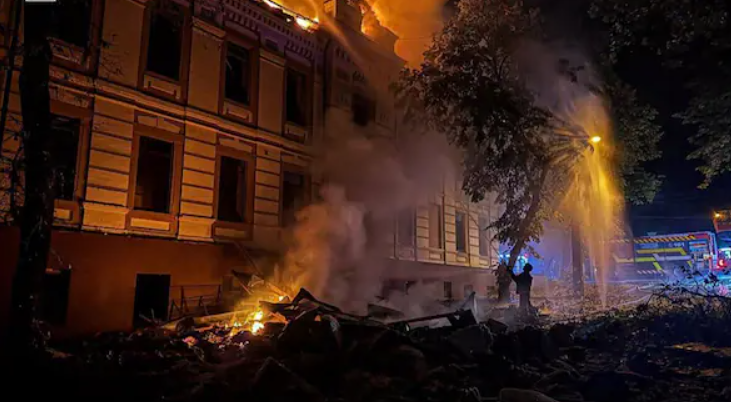
Russia launched one of its largest overnight aerial assaults on Ukraine in recent weeks, firing dozens of ballistic missiles, cruise missiles, guided bombs, and attack drones at Kyiv and several other regions. The attacks once again highlighted Ukraine’s growing shortage of Patriot Air Defence systems, which military analysts consider among the few proven systems capable of intercepting Russian ballistic missiles. As the conflict enters another prolonged phase, the battle is no longer limited to the front lines. Cities, energy facilities, shipping routes, and oil infrastructure have increasingly become strategic targets, affecting military operations, civilian safety, and Global Energy Markets.
The overnight strikes killed multiple civilians, injured dozens more, and damaged residential neighborhoods, industrial facilities, and public infrastructure. Meanwhile, Ukraine reported fresh attacks against Russian oil depots and maritime assets, demonstrating that both countries continue expanding the battlefield beyond conventional military positions.
What Happened During Russia’s Latest Missile Attack?
According to Ukrainian authorities, Russia launched a coordinated overnight attack involving ballistic missiles, cruise missiles, drones, and guided aerial bombs. Kyiv remained the primary target, although several other regions, including Kharkiv, Kherson, and Sumy, also came under attack.
The strikes began shortly after midnight and continued for several hours, forcing millions of residents to seek shelter while air raid sirens echoed across the capital. Emergency responders battled multiple fires, rescued trapped civilians, and cleared damaged residential buildings throughout the morning.
Several districts in Kyiv suffered damage, including residential apartments, office buildings, warehouses, industrial facilities, vehicles, and public infrastructure. Emergency services reported that rescue operations continued long after the attacks ended because of collapsing structures and ongoing fire hazards.
Why Patriot Air Defence Systems Matter
The renewed missile barrage has intensified international discussion surrounding Ukraine’s limited inventory of Patriot missile defence batteries.
The Patriot system was originally developed to intercept high-speed ballistic missiles, cruise missiles, and advanced aircraft. Unlike many short-range air defence systems, Patriot batteries can engage incoming ballistic missiles traveling at extremely high speeds, making them one of Ukraine’s most valuable defensive assets.
Russian forces have increasingly relied on ballistic missiles because they travel faster than conventional cruise missiles and provide defenders with significantly less reaction time.
Military experts have repeatedly warned that limited Patriot coverage forces Ukrainian commanders to prioritize the protection of major cities, government institutions, energy facilities, and military headquarters while leaving other regions more vulnerable.
| Air Threat | Typical Defence Challenge | Role of Patriot System |
|---|---|---|
| Ballistic Missiles | Extremely high speed and steep trajectory | Designed specifically to intercept these threats |
| Cruise Missiles | Low-altitude flight makes detection difficult | Can intercept depending on deployment |
| Attack Drones | Large numbers can overwhelm air defences | Usually countered alongside shorter-range systems |
| Combat Aircraft | Require layered air defence coverage | Provides long-range engagement capability |
Ukraine’s Air Defence Faces Growing Pressure
Ukraine’s air defence network relies on a layered structure combining Western and Soviet-era systems. However, months of continuous missile attacks have steadily depleted interceptor stockpiles.
Air defence is not simply about possessing advanced launchers. Every successful interception requires radar coverage, trained crews, maintenance support, and sufficient interceptor missiles. Even the most advanced defence systems become less effective if replacement missiles cannot be delivered quickly enough.
As Russia increases the frequency of combined missile and drone attacks, Ukrainian commanders must carefully allocate limited resources to defend strategic locations while accepting greater risks elsewhere.
Russia’s Strategy Appears to Be Evolving
Military analysts believe Russia has gradually shifted toward more complex strike packages that combine ballistic missiles, cruise missiles, drones, and guided bombs during the same operation.
This approach creates multiple challenges for defenders:
- Air defence systems must engage several different types of threats simultaneously.
- Large numbers of drones may be used to exhaust interceptor supplies before ballistic missiles arrive.
- Multiple launch directions complicate radar tracking and interception planning.
- Nighttime attacks reduce response time for emergency services after impacts occur.
The objective extends beyond physical destruction. Frequent large-scale attacks can also place sustained psychological pressure on civilian populations while forcing Ukraine to devote increasing resources to homeland defence.
Life Under Constant Air Raid Alerts
For residents of Kyiv, repeated overnight attacks have become part of daily life. Families often move into hallways, underground shelters, or metro stations whenever air raid sirens begin.
The psychological impact of prolonged missile campaigns is increasingly becoming an important aspect of the conflict. Constant disruptions affect schools, workplaces, hospitals, transportation systems, and everyday routines. Sleep deprivation, anxiety, and long-term stress have become recurring concerns for civilians living under continuous threat.
Emergency responders also face extraordinary pressure, often entering damaged buildings while additional attacks remain possible.
Energy Infrastructure Remains a Central Battlefield
While missile attacks targeted Ukrainian cities, Ukraine simultaneously reported strikes against Russian oil depots and fuel-related infrastructure.
Energy facilities have emerged as some of the most strategically important targets during the war because they directly support military logistics and national economies.
Fuel depots, refineries, storage terminals, and transportation hubs all play critical roles in sustaining military operations. Disruptions to these facilities can complicate fuel distribution, reduce export capacity, and increase economic costs.
Neither side views these attacks solely through an economic lens. Energy infrastructure has become closely linked to military capability, making it a recurring target throughout the conflict.
Black Sea Shipping Continues to Face Security Risks
The conflict is also expanding across maritime routes in the Black Sea.
Reports indicated fresh attacks involving oil tankers operating near Russia’s Black Sea export infrastructure. Although there were no reported oil spills or casualties, the incident temporarily disrupted loading operations.
The Black Sea remains one of the world’s most strategically important maritime regions because it supports:
- Global grain exports
- Crude oil transportation
- Energy supply chains
- Regional commercial shipping
- Military naval operations
Any disruption to these routes can influence shipping costs, insurance premiums, and international commodity markets.
Why the Caspian Pipeline Is Strategically Important
The Caspian Pipeline Consortium operates one of the region’s most significant crude oil export routes, transporting oil from Kazakhstan’s Caspian fields to the Russian port of Novorossiysk.
The pipeline spans approximately 1,510 kilometers and carries a substantial share of Kazakhstan’s crude oil exports before shipments continue to international markets by sea.
Because multiple countries and international energy companies have financial interests in the pipeline, disruptions can attract attention well beyond Eastern Europe. Temporary interruptions may affect export schedules, shipping logistics, and broader energy market confidence.
Understanding the Broader Military Picture
The latest wave of attacks illustrates how the conflict has evolved into a multidimensional campaign involving air power, drones, cyber capabilities, maritime operations, and economic pressure.
Rather than focusing exclusively on territorial gains, both countries increasingly seek to reduce each other’s ability to sustain long-term military operations.
Key strategic objectives now include:
- Protecting critical infrastructure.
- Maintaining energy production and fuel supplies.
- Disrupting logistics networks.
- Reducing air defence effectiveness.
- Protecting export routes.
- Maintaining civilian resilience.
International Support Remains Crucial
Ukraine continues to rely heavily on military assistance from Western partners for advanced air defence systems, ammunition, radar technology, and interceptor missiles.
While discussions continue regarding expanded defence production and possible future licensing arrangements for advanced systems, manufacturing sophisticated missile defence equipment requires significant industrial capacity, specialized components, and lengthy production timelines.
Even under accelerated production schedules, expanding inventories of advanced air defence systems cannot occur overnight.
Comparison: Russia’s Offensive vs Ukraine’s Defensive Priorities
| Russia’s Objectives | Ukraine’s Priorities |
|---|---|
| Pressure major cities through missile attacks | Protect civilian population centers |
| Reduce effectiveness of Ukrainian air defence | Preserve interceptor missile inventories |
| Target military production facilities | Maintain industrial resilience |
| Protect domestic energy exports | Disrupt Russian fuel logistics |
| Maintain operational momentum | Strengthen long-term defensive capability |
The Humanitarian Cost Continues to Rise
Beyond military objectives, every large-scale aerial attack carries significant humanitarian consequences. Residential neighborhoods, schools, hospitals, transportation infrastructure, and emergency services remain vulnerable even when military targets are the intended objective.
Repeated attacks also complicate reconstruction efforts. Cities must simultaneously repair damaged infrastructure while preparing for future strikes, creating long-term financial and logistical challenges.
Communities affected by repeated bombardment often face disruptions to healthcare, education, Business activity, and essential public services, adding to the already substantial human cost of the conflict.
What This Means for Global Security
The Ukraine conflict increasingly serves as a case study in modern warfare, demonstrating how drones, precision-guided missiles, electronic warfare, and long-range strike capabilities are reshaping military strategy.
Defence planners around the world are closely monitoring the effectiveness of layered air defence systems, missile interception technologies, and infrastructure protection strategies. Lessons learned from the conflict are already influencing military procurement decisions, defence planning, and investment in next-generation air defence capabilities across Europe and beyond.
What Could Happen Next?
If current trends continue, both Russia and Ukraine are likely to maintain pressure on critical infrastructure while attempting to strengthen their respective military positions. Air defence availability, missile production, drone technology, and international military assistance will remain major factors influencing future operations.
Analysts also expect both sides to continue targeting logistics networks, energy assets, and transportation infrastructure as they seek strategic advantages without relying solely on ground offensives.
Conclusion
Russia’s latest missile and drone attacks on Kyiv underscore the increasingly important role of advanced air defence systems in modern warfare. Ukraine’s limited Patriot inventory has become a central challenge as Russia expands its use of ballistic missiles and complex aerial attack strategies.
At the same time, Ukraine’s continued strikes on Russian energy facilities and maritime assets demonstrate that the conflict extends far beyond traditional front lines. Infrastructure, Energy Security, logistics, and civilian resilience have all become integral parts of the broader war.
As international discussions continue over military assistance and defence production, the effectiveness of air defence systems and the ability to protect both civilian populations and critical infrastructure will remain one of the defining factors shaping the next phase of the conflict.
For breaking news and live news updates, like us on Facebook or follow us on Twitter and Instagram. Read more on Latest Uncategorized on thefoxdaily.com.






COMMENTS 0