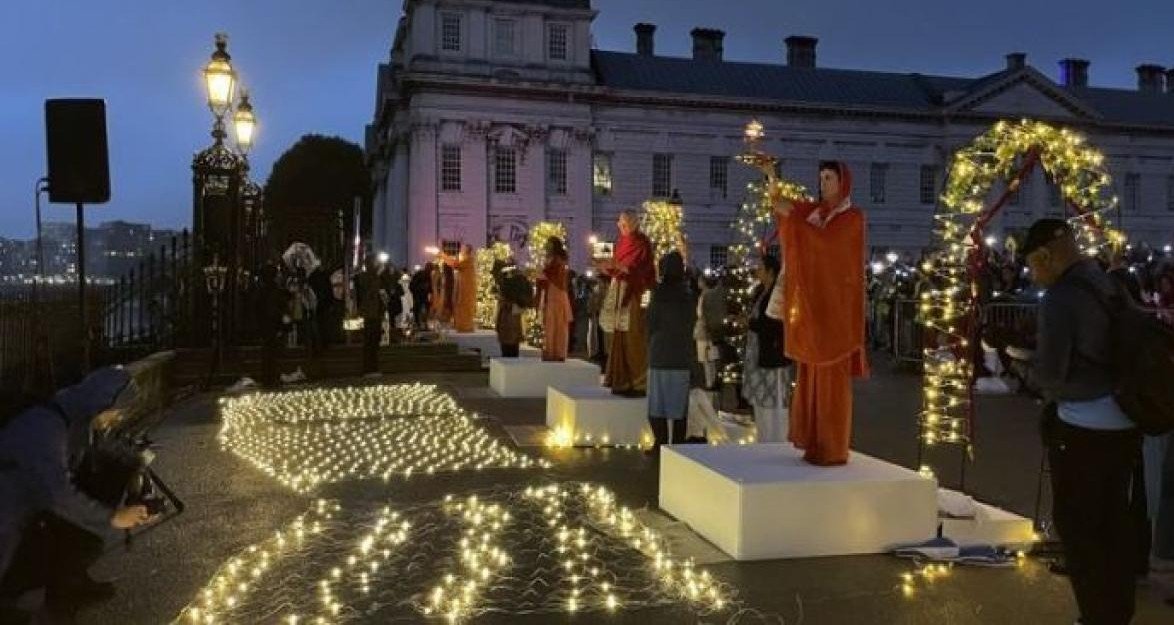
Thousands of people gathered along the River Thames in London for the first Ganga Aarti held on the river, bringing a centuries-old Hindu tradition of gratitude for nature into a distinctly British setting.
Organised by Chinmaya Mission UK in collaboration with the annual Totally Thames festival, the ceremony took place against the backdrop of the Old Royal Naval College in Greenwich. It combined prayer, chanting, Music and the glow of traditional multi-tiered oil lamps while placing unusual emphasis on environmental responsibility.
The event was designed to echo the spiritual atmosphere of Ganga Aarti ceremonies performed along the banks of the River Ganges in India. But rather than attempting to reproduce the ceremony literally, organisers adapted it to the Thames, keeping the ritual entirely on land and ensuring that nothing from the event entered the water.
That decision gave the London ceremony a second message beyond religious devotion. It turned the event into a public statement about the relationship between cultural tradition and environmental stewardship.
Why Ganga Aarti came to the Thames
Ganga Aarti is a Hindu ritual traditionally performed beside the Ganges and other sacred rivers. Participants offer light using large lamps while prayers, devotional music and chanting accompany the ceremony.
For devotees, the ritual represents gratitude and reverence rather than simply a religious performance. Rivers are associated with life, nourishment and continuity, and the Ganges holds a particularly significant place in Hindu religious and cultural traditions.
Bringing the ceremony to London created an opportunity to express that symbolism in relation to another major river.
The Thames has a very different religious and historical identity from the Ganges. It is one of Britain’s defining waterways, running through the heart of London and connecting the capital’s history, commerce, architecture and public life.
The organisers therefore framed the event around a broader idea: rivers can become symbols of life and collective responsibility even when their cultural meanings differ.
Brahmacharini Shripriya Chaitanya, Resident Teacher of Chinmaya Mission UK, said the ceremony was intended to carry the spirit of gratitude associated with Ganga Aarti to the Thames.
For the British Hindu and South Asian community, the event also offered a way to celebrate a familiar cultural and spiritual tradition in a public space far from India. At the same time, it was deliberately presented as an event that people from other backgrounds could attend.
A religious ceremony with an environmental message
The most distinctive aspect of the London event was the way environmental care was incorporated into its design.
Traditional riverbank ceremonies can involve placing offerings or lamps in the water. The Thames event deliberately avoided doing so.
The ceremonial lamps remained on the riverbank rather than being floated on the river. Organisers also said they had taken measures to reduce waste, limit single-use plastics and protect the surrounding site.
This was more than a practical precaution. It reflected the central idea organisers wanted the event to communicate: respect for nature should be demonstrated through behaviour as well as expressed through prayer.
That approach also allowed the organisers to address a modern environmental concern without removing the spiritual character of the ceremony.
Instead of treating environmental responsibility and religious tradition as competing priorities, the event presented them as connected. If a river is regarded as life-giving and worthy of reverence, protecting the river becomes a natural extension of that reverence.
From Mother Ganga to the River Thames
The environmental theme is closely linked to the religious symbolism of the Ganges.
In Hindu tradition, Ganga is revered as sacred and life-giving. The river has shaped religious practices, pilgrimage, literature, art and everyday life across generations.
The London ceremony used that symbolism without suggesting that the Thames carries exactly the same religious status as the Ganges.
Instead, the organisers focused on a shared relationship between people and waterways: rivers sustain communities, support ecosystems and become part of the identity of the places through which they flow.
That interpretation made the ceremony relevant beyond the Hindu community. The language of gratitude for nature can be understood across religious and cultural boundaries, particularly at a time when environmental protection has become an increasingly important public concern.
The event therefore worked on two levels. For Hindu participants, it provided a familiar spiritual form in an international setting. For the wider audience, it offered a cultural event built around a universal idea of caring for the natural world.
Chinmaya Mission’s 75-year legacy
The ceremony was also connected to a significant milestone for Chinmaya Mission.
Founded in 1951, the organisation has grown into a global movement rooted in Vedanta, an important philosophical tradition within Hinduism. It now has more than 350 locations worldwide.
The London event formed part of global celebrations marking 75 years of the organisation.
For Chinmaya Mission, the connection between Ganga Aarti and its institutional history goes beyond geography.
The organisation’s founder, Swami Chinmayananda, dedicated his life to making Vedantic teachings accessible to people in everyday life. The movement subsequently established centres and educational activities in countries far beyond India.
The Thames ceremony was presented as another expression of that international journey: a tradition associated strongly with the Indian subcontinent being interpreted in a British environment without losing its underlying message.
Chaitanya described the Ganges not only as a sacred river but also as a symbol of the flow of knowledge. That symbolism connects directly with Chinmaya Mission’s emphasis on Vedanta, learning and service.
In that sense, the ceremony marked both a spiritual tradition and the organisation’s evolution from an Indian movement into a global network.
Greenwich provided a distinctive setting
The location added another layer to the event.
The ceremony was held near the Old Royal Naval College in Greenwich, an area strongly associated with London’s maritime history and the Thames itself.
The setting created a visual contrast between Indian religious tradition and one of London’s best-known historic riverfront landscapes.
For the audience, that backdrop also reinforced the central idea of the event. The ceremony was not taking place beside the Ganges, but beside another major river that has played an important role in shaping the identity and development of its surrounding society.
Music and chanting formed part of the programme, alongside the traditional lamps and devotional elements. Senior spiritual figures and representatives from Hindu organisations and communities across the United Kingdom also attended.
The combination made the event both a religious gathering and a public cultural occasion.
Why the event was open beyond the Hindu community
Although Ganga Aarti has specific religious meaning within Hinduism, the London organisers intentionally positioned the event as inclusive.
The British Hindu and South Asian community formed an important part of the audience, but people from other backgrounds were also invited.
This distinction matters for diaspora communities. Cultural traditions carried abroad often evolve as they encounter new audiences and new surroundings.
A ceremony that might traditionally be experienced primarily as a religious ritual in India can become a form of cultural diplomacy in another country, introducing wider audiences to its music, symbolism, philosophy and traditions.
The Thames event provided that opportunity without requiring participants unfamiliar with Hinduism to adopt the religious beliefs behind the ceremony.
Its environmental message also created a common point of connection. Gratitude for rivers and concern about their condition are ideas that can be shared by people regardless of religious background.
The Thames adds a new dimension to the tradition
Holding Ganga Aarti on the Thames also highlights how diaspora traditions can adapt without becoming disconnected from their origins.
The ceremony retained familiar elements such as lamps, prayers, chanting and music. At the same time, organisers changed the way the ritual interacted with the river because of the environmental requirements of the location.
That balance is important. Cultural continuity does not necessarily require every physical aspect of a tradition to remain unchanged.
In London, keeping the lamps on the riverbank allowed the symbolic act of offering light to continue while avoiding the introduction of materials into the Thames. The adaptation preserved the central spiritual idea while responding to the environmental context of the new location.
It is an approach that could become increasingly relevant as religious and cultural festivals are held in public spaces where organisers must consider waste, water quality and environmental regulations.
Totally Thames brings culture and conservation together
The collaboration with Totally Thames also placed the ceremony within a broader programme celebrating London’s river.
Totally Thames has been organised through a trust since 1997 and uses arts, environmental, heritage and Education programmes to highlight the significance of the River Thames.
The partnership therefore created an unusual meeting point between a Hindu spiritual tradition and an established London cultural programme.
Rather than treating the Ganga Aarti as an isolated religious event, the collaboration connected it to the wider cultural life of the river.
This helped reinforce the organisers’ environmental message while introducing an element of South Asian religious culture to audiences participating in Thames-related activities.
Why the environmental approach matters
Rivers occupy an unusual position in human societies. They are simultaneously natural ecosystems, sources of water, transportation routes, economic assets and cultural symbols.
That combination means environmental problems involving rivers are rarely just ecological issues. They can affect communities, public Health, local economies and cultural heritage.
The Thames itself has undergone a remarkable transformation over the past two centuries, moving from a heavily polluted industrial waterway to a river that supports a much healthier urban ecosystem than it did during some periods of London’s industrial history.
Against that background, an event centred on gratitude for a river naturally raises questions about responsibility toward waterways.
The London Ganga Aarti did not attempt to solve those challenges through a single ceremony. Its significance lies instead in the message that environmental responsibility can be incorporated into cultural and spiritual events.
The decision not to place anything into the Thames made that message visible rather than merely rhetorical.
A possible new annual tradition
The first Ganga Aarti on the Thames was reported as a sell-out event, and organisers indicated that it could become an annual fixture.
If repeated, the ceremony could develop into a distinctive part of London’s multicultural cultural calendar.
An annual event would also give organisers an opportunity to deepen its environmental dimension. Future editions could potentially continue building connections between Hindu philosophy, community participation and awareness of river conservation, while retaining the central devotional character of the ceremony.
Its future success, however, will depend on maintaining the balance that defined the inaugural event. The ceremony needs to remain meaningful for Hindu participants while remaining accessible to people encountering the tradition for the first time.
A ceremony that crossed more than one boundary
The first Ganga Aarti on the Thames was notable not simply because a familiar Indian ceremony appeared on the banks of a London river.
It brought together several ideas that do not usually share the same stage: Hindu spirituality, diaspora identity, London’s multicultural public life, environmental responsibility and the cultural importance of rivers.
The lamps, music and chanting connected the gathering to a tradition deeply rooted in India. The Thames and Greenwich setting placed that tradition firmly within Britain. The decision to keep the ceremony out of the water demonstrated how the ritual could adapt to its surroundings without abandoning its central message.
For the thousands who attended, the event was therefore both a celebration of faith and a public expression of gratitude for nature.
Whether it becomes a permanent annual fixture remains to be seen. But its first edition demonstrated how cultural traditions can Travel across borders, acquire new meanings and still retain their essential identity.
On the Thames, Ganga Aarti became more than a ceremony beside a river. It became a meeting point between Indian heritage and British public life, with an environmental message at its centre: if rivers sustain life, gratitude for them ultimately has to include the responsibility to protect them.
For breaking news and live news updates, like us on Facebook or follow us on Twitter and Instagram. Read more on Latest World on thefoxdaily.com.

COMMENTS 0