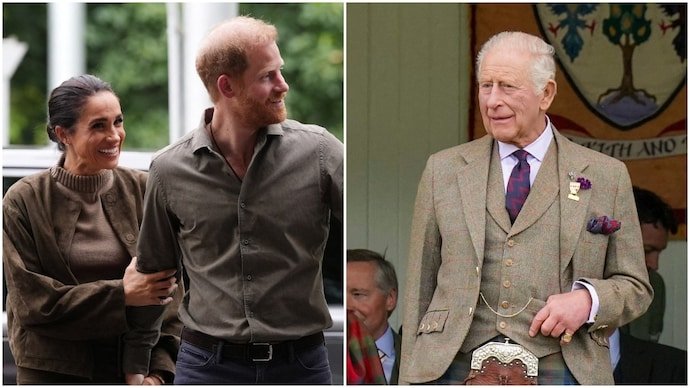
Prince Harry and Meghan Markle have returned to Britain after six years in the United States, but their move back has not changed their position within the monarchy. King Charles III has formally confirmed that the Duke and Duchess of Sussex remain private citizens and non-working royals.
A letter issued on the King’s authority on Monday was sent to senior government and military officials, regional representatives and Harry’s team to remove any uncertainty about the couple’s status.
The message makes clear that Harry and Meghan have not resumed their former roles as working members of the Royal Family and do not represent the sovereign at official public engagements.
The clarification comes after the couple returned to the UK with their children following years of living in California. Their relocation had prompted speculation about whether proximity to the Royal Family could eventually lead to a reconciliation or even some form of return to official duties.
The King’s message makes clear that there will be no such return under the current arrangement.
What King Charles’ letter says about Harry and Meghan
The letter reiterates the terms established after Harry and Meghan stepped back from their official royal roles in 2020.
It states that the couple are “no longer working Members of The Royal Family” and that their position remains distinct from the official state and royal duties carried out by working members of the monarchy.
The guidance also says that Harry and Meghan’s charitable activities are undertaken in their private capacities.
The wording describes their position as being broadly comparable to that of private citizens with commercial and charitable interests.
That distinction is central to understanding the couple’s future in Britain. Living in the UK does not automatically restore the institutional role they gave up six years ago.
Why the Palace issued the clarification now
The decision to issue formal guidance appears to have been driven by uncertainty following the Sussexes’ return to Britain.
Harry and Meghan are expected to carry out public and charitable activities in the country, potentially bringing them into situations where government departments, military bodies and local officials need to know precisely how they should be treated.
The letter was therefore distributed to senior officials to prevent confusion about whether the couple could be invited to participate in events in an official capacity.
According to the guidance, they should not be treated as working members of the Royal Family.
The clarification is particularly relevant because Harry remains a member of the wider royal family and continues to hold his Duke of Sussex title, even though he is no longer performing official duties on behalf of the sovereign.
Harry and Meghan cannot use the HRH styles
The letter also reiterates that Harry and Meghan should not use the styles His Royal Highness and Her Royal Highness.
Their HRH styles remain in abeyance, reflecting the arrangement reached when they stepped back from official royal duties.
This is another important distinction between holding a royal title and being a working royal.
Harry remains the Duke of Sussex and Meghan remains the Duchess of Sussex, but those titles do not mean that they can automatically undertake official engagements on behalf of King Charles.
The Palace’s latest clarification reinforces that difference.
The “half-in, half-out” model remains off the table
The King’s message effectively reaffirms the principle that ended the debate over a possible “half-in, half-out” arrangement.
When Harry and Meghan announced their withdrawal from royal duties, one of the central questions was whether they could remain partially involved in official royal life while simultaneously developing independent commercial careers.
The settlement reached in 2020 ruled out that combination.
The couple instead became financially independent and stepped away from representing the sovereign in an official capacity.
Charles’ latest guidance confirms that this fundamental arrangement remains intact even after their physical return to Britain.
Returning to Britain is not a return to royal duty
The distinction between living in Britain and working for the monarchy is at the heart of the King’s statement.
Harry and Meghan can live in the United Kingdom, run charitable organisations, participate in private events and maintain commercial interests without becoming working royals again.
Their relocation does not automatically change the constitutional or administrative status established in 2020.
This is particularly important because members of the working Royal Family carry out engagements on behalf of the sovereign, attend state occasions and undertake duties as representatives of the Crown.
Harry and Meghan are not being restored to that role simply because they have moved back.
The couple’s charity work will remain private
The letter specifically addresses the Sussexes’ charitable activities.
It states that the Duke and Duchess’s charity work is a personal matter and is carried out in a private capacity.
This means their involvement in charitable causes should not be interpreted as official royal business.
The distinction could become increasingly important as Harry and Meghan resume a more visible presence in Britain.
A public appearance connected to one of their charitable projects may attract significant media attention, but that does not make it an engagement carried out on behalf of King Charles or the Royal Family.
What this means for Harry’s public appearances
Harry is expected to resume public-facing activities in Britain, including charitable work and engagements connected to causes he has supported for years.
His visibility could increase now that he is once again living in the country on a regular basis.
But the Palace’s guidance makes the institutional boundaries clear.
Harry may represent his own charitable organisations or personal causes, but he will not be regarded as an official representative of the King at those events.
That distinction allows him to remain publicly active while keeping the responsibilities of the working monarchy separate from his independent activities.
Meghan’s expected UK charity work
Meghan is also expected to undertake charitable activities in Britain in the coming weeks.
Her return to the country could therefore increase her public presence after several years of living primarily in the United States.
But the same rules apply to her.
Any charity or public engagement undertaken by Meghan will be considered part of her private activities rather than official royal work.
The Palace’s statement effectively creates a clear line between the Sussexes’ personal projects and the formal responsibilities of the Royal Family.
Harry and Meghan’s children are returning to British life
The Sussexes’ return also includes their two children, Prince Archie and Princess Lilibet.
The family is expected to establish a more permanent life in Britain, with the children reportedly set to attend school in the UK.
The move represents a significant change for Archie and Lilibet, who have spent most of their childhood in California.
It also brings Harry’s children physically closer to members of the wider Royal Family, potentially creating more opportunities for family contact outside the intense public spotlight that has surrounded the Sussexes for years.
However, the children’s presence in Britain does not alter Harry and Meghan’s official status.
Why the Sussexes left royal duties in 2020
Harry and Meghan stepped back from official royal duties in 2020 after a prolonged period of tensions within the Royal Family and intense scrutiny from the British media.
The couple subsequently moved to the United States and established an independent life in California.
They also entered into commercial partnerships and developed a range of media and charitable projects outside the formal structure of the monarchy.
Their departure became one of the most significant internal disruptions faced by the Royal Family in recent decades.
Harry subsequently discussed his experiences and family Relationships in interviews, documentaries and his memoir, keeping the disagreements surrounding the departure in the public eye.
The bitter family rift has complicated the return
Harry and Meghan’s departure was followed by a highly publicised breakdown in relations with some members of the Royal Family.
Harry has spoken publicly about disagreements involving his family, the British press and the security arrangements available to him in the UK.
The relationship between Harry and his father has also been the subject of intense public attention, particularly after King Charles became monarch.
The couple’s return to Britain therefore represents a major change in circumstances, but it does not mean every disagreement within the family has been resolved.
The King’s latest letter carefully avoids making the return a symbolic restoration of the Sussexes to frontline royal life.
Security remains a separate issue
The letter also addresses the long-running dispute over Harry’s security in Britain.
It makes clear that operational security matters should continue to be directed to the relevant police authorities.
That is significant because Harry has repeatedly argued that he is not adequately protected when he visits Britain and has pursued legal action over security arrangements.
The Palace’s statement indicates that the issue remains separate from Harry’s family relationship with the King.
His status as a private citizen means security decisions continue to be handled through the appropriate public authorities rather than through his being restored to official royal duties.
Why the security issue matters after the move
Harry’s return to Britain could increase the frequency of his public appearances, creating renewed attention around his security arrangements.
He is a high-profile individual with a history of intense media interest, while his relationship with the Royal Family remains globally significant.
At the same time, the Palace has made clear that security should not be interpreted as evidence of a return to official royal status.
The arrangements surrounding his protection will continue to be determined through the relevant authorities rather than simply by virtue of his being the King’s son.
How the 2020 Sandringham Agreement still shapes the Sussexes’ position
The latest guidance effectively brings the 2020 Sandringham Agreement back to the centre of the discussion.
The agreement followed the announcement that Harry and Meghan wanted to step back from frontline royal duties while pursuing financial independence.
Among its central principles was the rejection of a model in which the couple would simultaneously perform official royal work and operate commercial ventures independently.
That settlement created the framework under which the Sussexes have lived for the past six years.
The King’s letter makes clear that moving back to the UK does not reopen those negotiations.
Harry’s royal identity has not disappeared
Although the Palace refers to Harry and Meghan as private citizens, the couple remain part of the wider royal family by birth and marriage.
Harry remains the King’s son and the Duke of Sussex.
That creates an unusual position in which a person can be both a prominent member of the royal family and outside the working structure of the monarchy.
The King’s clarification is designed to ensure that these two concepts are not confused.
Harry’s family relationship with the monarch is personal. His role as a working representative of the Crown is institutional. The latter ended in 2020 and has not been restored.
Why the distinction matters at official events
The working Royal Family represents the sovereign at a range of public and constitutional events.
Those duties can include state ceremonies, diplomatic receptions, military commemorations, national celebrations and official visits.
A private citizen cannot simply assume the same role without formal authorisation.
By sending the guidance to government departments, military officials and local representatives, the Palace is ensuring that those institutions understand that Harry and Meghan should not be treated as official royal representatives.
This is particularly relevant when event organisers are deciding seating arrangements, invitations, security and protocol.
Could Harry and Meghan ever return as working royals?
The latest letter does not suggest that such a return is being considered.
Instead, it explicitly reinforces the current arrangement.
The couple’s present status is described as continuing to be fully respected, including their financial independence and desire for privacy.
That does not prevent the possibility of future personal reconciliation within the family, but a family reconciliation would be different from reinstatement as working royals.
The two issues should not be confused.
The message to government and military officials
The distribution of the letter beyond the Royal Family is an important detail.
The guidance went to government and military officials and local representatives across Britain as well as Harry’s team.
This suggests the primary goal was administrative clarity.
When a globally famous royal moves back into the country, there can be uncertainty about invitations, ceremonial roles, security, precedence and official communications.
The King’s office has now provided a formal instruction so that institutions do not mistake Harry and Meghan’s physical presence in Britain for a restoration of official status.
What this means for the monarchy
The arrangement allows the Royal Family to maintain a clear working structure while avoiding the appearance that Harry and Meghan have been pushed completely outside the family.
The Sussexes can remain members of the wider family while conducting their lives independently.
For the monarchy, that separation reduces confusion over who speaks for the sovereign and who is carrying out official duties.
For Harry and Meghan, it preserves their freedom to pursue charitable and commercial activities without taking on the formal responsibilities of working royals.
The latest letter therefore reinforces the compromise that has existed since 2020 rather than fundamentally changing it.
Harry and Meghan’s status compared with working royals
| Issue | Harry and Meghan | Working royals |
|---|---|---|
| Official royal duties | Do not undertake duties on behalf of the sovereign | Carry out official engagements for the monarchy |
| Representation of the King | Do not represent the sovereign at official appearances | Can represent the sovereign at authorised engagements |
| HRH styles | Remain in abeyance and are not used | Applicable according to individual royal status |
| Charitable work | Conducted in a private capacity | Often connected to official patronages or royal duties |
| Commercial independence | Retained | Subject to restrictions associated with working royal status |
| Public appearances | Personal, commercial or charitable | Official royal engagements |
Why the UK’s return is still significant
Despite the King’s clarification, Harry and Meghan’s return remains a major development for the British Royal Family.
The couple spent six years living in the United States after stepping away from royal duties, making the move back across the Atlantic a significant change in their personal and family circumstances.
Their presence in Britain could make them more visible in the country’s public life and potentially increase contact with relatives they have seen less frequently since 2020.
But the Palace is clearly determined to prevent that visibility from creating confusion about institutional roles.
The message is essentially that geography has changed; royal duties have not.
King Charles draws the line clearly
King Charles’ decision to formally restate Harry and Meghan’s status provides the clearest possible answer to speculation surrounding their return to Britain.
The Duke and Duchess of Sussex are back in the country, but they are not returning to the working Royal Family.
They remain private citizens with commercial and charitable interests, their HRH styles remain unused, and their charitable activities are considered private rather than official.
The 2020 arrangements remain the foundation of their relationship with the institution.
What happens next for Harry and Meghan?
The Sussexes are now expected to build a new chapter of their lives in Britain while continuing their independent projects.
Harry is likely to remain active in areas such as veterans’ causes and the Invictus Games, while Meghan is expected to participate in charitable work and other personal projects.
Their children are also beginning a new phase of life in Britain as the family settles more permanently in the country.
The key difference from their earlier years as working royals is that none of these activities will automatically carry the authority or representation of the Crown.
That separation is likely to remain one of the defining features of the Sussexes’ place within the Royal Family.
Harry and Meghan return, but the royal role stays in the past
King Charles has drawn a firm institutional line following Prince Harry and Meghan Markle’s return to Britain.
The couple are back in the UK after six years in the United States, but their return does not revive the official duties they abandoned in 2020. A letter issued under the King’s direction confirms that they remain non-working royals and should be treated as private citizens.
The guidance also settles several practical questions. Harry and Meghan will not use their HRH styles, their charity work remains private, and they do not represent the sovereign at official appearances. Security matters will continue to be handled by the relevant authorities rather than through a restoration of royal duties.
The decision effectively preserves the framework created by the 2020 Sandringham Agreement, including the principle that there will be no “half-in, half-out” arrangement combining commercial independence with official royal responsibilities.
For Harry and Meghan, the move back to Britain can therefore provide greater proximity to family, renewed involvement in British charitable life and a different Environment for raising Archie and Lilibet. But it will not restore their place on the official royal stage.
The message from King Charles is clear: Harry and Meghan can return home without returning to royal duty.
For breaking news and live news updates, like us on Facebook or follow us on Twitter and Instagram. Read more on Latest World on thefoxdaily.com.



COMMENTS 0