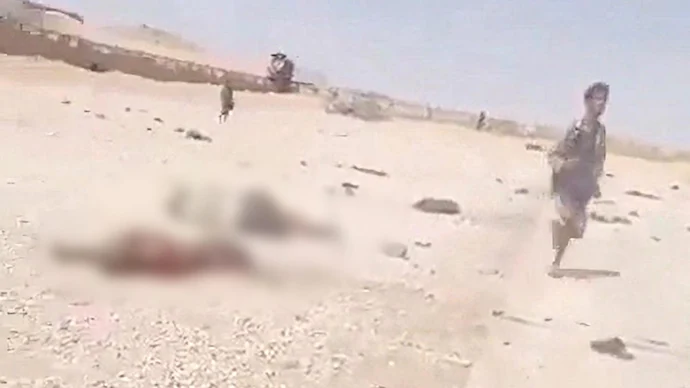
At least 53 people were killed and 200 injured after Yemen’s Houthi movement launched a missile attack on a government security forces training camp in the southern province of Shabwa on Monday, local authorities said. The attack targeted forces during a training exercise and marks a further escalation in the renewed conflict between the Houthis and Yemen’s internationally recognised government.
According to sources in the local administration cited by Reuters, the Iran-aligned Houthis fired three ballistic missiles at the camp. The attack caused significant casualties, with videos shared on social media showing injured people and bloodied bodies lying across the ground at the site.
The identities of the people and bodies shown in the footage could not be independently verified. The available information also does not establish the full extent of the damage to the training facility or the precise circumstances surrounding the strike.
Houthi military spokesperson Yahya Saree confirmed on X that the group had targeted the camp, claiming it was operated by Saudi forces. Saudi authorities had not immediately responded to a request for comment, according to Reuters.
The attack comes as fighting intensifies between the Houthis and forces loyal to Yemen’s internationally recognised government, which is backed by a Saudi-led coalition. Both sides have stepped up military operations in recent weeks, threatening to reverse a period of relative calm and deepen a conflict that has devastated the country for more than a decade.
What happened in the Houthi missile attack on Shabwa?
The attack took place at a government security forces training camp in Shabwa province, where security personnel were reportedly participating in a training exercise when the missiles struck.
Local authorities said the strike killed 53 people and injured around 200 others. The scale of the reported casualties makes the incident one of the significant attacks in the latest phase of renewed fighting in Yemen.
Sources in the local administration told Reuters, speaking on condition of anonymity, that the Houthis launched three ballistic missiles at the security forces. The attack highlights the threat posed by the group’s missile capabilities as fighting expands across areas contested by the Houthis and government-backed forces.
Video footage circulated on social media after the attack showed people lying on the ground, including injured individuals and bodies covered in blood. However, the identities of those shown could not be independently established, and the footage alone does not provide a complete account of the circumstances of the strike.
Yahya Saree confirmed the attack in a post on X, saying the group had targeted a camp that he claimed was run by Saudi forces. The claim could not be independently verified from the information available, and Saudi authorities had not immediately commented.
The competing descriptions of the target underline the importance of distinguishing confirmed details from claims made by the parties involved in the conflict. Local authorities reported the casualties, while the Houthi spokesperson acknowledged the strike and offered the group’s account of the facility’s affiliation.
Why is Shabwa province strategically important?
Shabwa is an energy-rich province in southern Yemen that overlooks the Gulf of Aden. Its location and energy infrastructure give it importance beyond the immediate military confrontation.
The province is home to the Balhaf liquefied natural gas (LNG) facility, described in the report as Yemen’s largest industrial investment. The facility reflects the importance of energy infrastructure to the country’s economy and its potential significance in any broader struggle for territorial control.
Energy-producing regions can become strategically sensitive during armed conflicts because control over infrastructure, transport routes and access to export facilities can influence economic resources and military calculations.
For Yemen, the vulnerability of such facilities is particularly concerning given the country’s prolonged conflict and severe economic difficulties. Continued fighting can disrupt commercial activity, weaken public finances and complicate efforts to restore essential services.
Shabwa’s location also places it within a wider regional security environment shaped by the Gulf of Aden, the Red Sea and nearby maritime routes. Instability in southern Yemen can therefore have implications beyond the province itself, particularly when the conflict intersects with threats to international shipping and energy supplies.
However, the reported missile strike does not by itself establish that the Balhaf LNG facility was targeted or damaged. The confirmed information concerns the attack on the security forces’ training camp and the casualties reported by local authorities.
Renewed fighting between the Houthis and Yemen’s government
The missile attack comes amid a fresh escalation in fighting between the Houthis and Yemen’s internationally recognised government, which receives support from a Saudi-led coalition.
The two sides have exchanged attacks since the Houthis advanced in September towards territory near the Bab el-Mandeb Strait, a strategic maritime passage connecting the Red Sea with the Gulf of Aden.
The strait is an important shipping chokepoint because vessels travelling between Europe and Asia through the Suez Canal must pass through the Red Sea and its southern approaches. Any sustained instability in the surrounding region can raise concerns about commercial shipping, transport costs and the security of international trade.
Government forces launched a campaign this month to recapture areas held by the Houthis and have reportedly recovered ground near the strait. The military operations indicate that the conflict is entering a more active phase, with both sides attempting to improve their positions on the battlefield.
Meanwhile, the Houthis are besieging Taiz, described in the report as the last major urban stronghold of anti-Houthi forces in Yemen’s southern highlands.
The developments point to a conflict involving several strategically important areas, from inland urban centres to territory near major maritime routes. Advances by either side could alter local control and influence the security environment around the Bab el-Mandeb Strait.
The attack in Shabwa adds to the risks facing government-aligned forces as they seek to recover territory. The reported casualties also demonstrate the potential human cost of renewed military operations, particularly when attacks hit groups gathered at training facilities.
How the conflict is linked to the wider Iran war
Yemen’s renewed fighting has become connected to the wider US-Israeli war on Iran, adding another layer to an already complex regional conflict.
The Houthis are aligned with Iran and have expanded their attacks on Saudi Arabia amid the wider confrontation. According to the report, their targets have included Riyadh’s international airport and Saudi Aramco, the Saudi state oil company.
The group’s activities have raised concerns about the vulnerability of Saudi infrastructure and the possibility that hostilities could spread further across the region. Attacks on airports and energy assets can have consequences for civilian movement, commercial operations and economic confidence, even when the wider conflict remains geographically concentrated.
Saudi Arabia has been a central participant in Yemen’s conflict since it led a military intervention in 2015. Its support for Yemen’s internationally recognised government has made the country a key external actor in the struggle against the Houthis.
The Houthi spokesperson’s claim that the Shabwa camp was operated by Saudi forces also illustrates how the group frames its operations in the context of the broader regional confrontation. However, the claim about the camp’s affiliation had not been independently confirmed in the available reporting.
The involvement of regional powers complicates the prospects for a settlement. Military developments inside Yemen can be influenced by wider strategic calculations, while attacks connected to the Iran war can increase the risk of retaliation and further escalation.
For countries across the region, the challenge is to prevent separate military confrontations from reinforcing one another. Continued attacks involving the Houthis, Saudi Arabia and other regional actors could make de-escalation more difficult and increase pressure on already vulnerable populations.
Bab el-Mandeb Strait: Why the shipping route matters
The Bab el-Mandeb Strait is one of the most strategically significant maritime passages in the region. Located at the southern entrance to the Red Sea, it links the Red Sea to the Gulf of Aden and the wider Indian Ocean.
Its importance comes from its role in international shipping. Commercial vessels travelling through the Suez Canal route between Europe and Asia must also navigate the Red Sea and pass through the strait to reach the Gulf of Aden.
Military activity near the strait can therefore have consequences beyond the immediate conflict zone. Threats to shipping may prompt companies to reassess routes, increase security measures or consider longer alternatives, potentially raising transport times and costs.
The Houthis’ advance towards areas near the strait has heightened concern because control of nearby territory can affect the broader security environment around this crucial passage. Government forces’ campaign to recover territory near the waterway is therefore significant not only for Yemen’s internal conflict but also for regional maritime security.
However, the reported strike on the Shabwa training camp does not establish that commercial shipping was directly affected. Its wider significance lies in the timing of the attack, which comes as military operations intensify and the conflict increasingly intersects with regional security concerns.
How Yemen’s war began in 2014
Yemen’s current conflict began in 2014, when the Houthis seized the capital, Sanaa, forcing the internationally recognised government south.
The takeover triggered a major political and military crisis. In 2015, a Saudi-led coalition intervened in support of the government, opening a new phase of fighting that resulted in years of violence and a prolonged stalemate.
The conflict has involved changing front lines, competing political authorities and external support for opposing sides. Despite periods of reduced fighting, the underlying dispute has remained unresolved.
The Saudi-led intervention brought Yemen’s internal struggle into a wider regional framework, with Riyadh seeking to support the government and counter the growing influence of the Houthis. The movement’s alignment with Iran has further connected the conflict to broader tensions between regional powers.
Years of fighting have damaged infrastructure, disrupted economic activity and contributed to one of the world’s most severe humanitarian crises. Millions of people have faced the consequences of displacement, shortages and reduced access to essential services.
The renewed fighting threatens to undermine whatever stability was achieved during periods of reduced hostilities. Further military escalation could make humanitarian access more difficult and place additional pressure on communities already affected by years of conflict.
Why the 2022 truce matters
A truce agreed in 2022 helped reduce fighting between the main parties for a period, offering a degree of relief after years of intense conflict.
Although the truce did not resolve all the underlying political and territorial disputes, it marked an important reduction in hostilities. The relative calm created space for efforts to address humanitarian needs and explore possible paths towards a political settlement.
The renewed fighting now threatens to reverse those gains. The latest military operations, including the reported missile attack in Shabwa, indicate that the conflict remains vulnerable to renewed escalation despite the earlier reduction in violence.
A return to sustained fighting could increase civilian casualties, damage infrastructure and further restrict the movement of people and humanitarian supplies. It could also complicate diplomatic efforts to reduce tensions between the Houthis, the internationally recognised government and the regional powers involved in the conflict.
The deterioration is particularly concerning because Yemen’s institutions and economy have already been weakened by years of war. Any fresh escalation risks deepening the challenges facing communities that depend on humanitarian assistance and access to basic services.
Humanitarian concerns grow as violence escalates
The latest attack comes against the backdrop of a humanitarian crisis that has persisted throughout Yemen’s prolonged conflict. Aid agencies have warned that conditions are deteriorating rapidly as renewed fighting threatens to intensify civilian suffering.
With local authorities reporting 53 deaths and 200 injuries in the Shabwa strike, the incident highlights the immediate human cost of the latest escalation. The full circumstances of the attack and the identities of those shown in the circulating footage have not been independently verified.
Beyond the immediate casualties, a wider return to intense fighting could disrupt medical services, damage essential infrastructure and make it more difficult for humanitarian organisations to reach affected populations.
Displacement is another concern. When front lines shift or attacks intensify, families may be forced to leave their homes, while communities receiving displaced people can face additional pressure on housing, healthcare and other services.
Economic disruption can also worsen humanitarian conditions. Damage to energy infrastructure, interruptions to transport and insecurity around commercial routes can reduce economic opportunities and complicate the delivery of essential goods.
The humanitarian consequences extend beyond the battlefield. A prolonged conflict can affect access to food, clean water, healthcare and education, particularly for children and other vulnerable groups.
What happens next in Yemen’s escalating conflict?
The immediate consequences of the Shabwa attack will depend on the response of Yemen’s government-aligned forces and the Houthis, as well as any further military operations undertaken by the two sides.
Government forces have already launched a campaign to recover Houthi-held areas and have regained ground near the Bab el-Mandeb Strait. The Houthis, meanwhile, continue to exert pressure on anti-Houthi forces around Taiz and have expanded attacks on Saudi targets amid the wider Iran war.
The latest strike could add to pressure for stronger security measures, but the available information does not establish what response government forces or Saudi Arabia will take. Saudi authorities had not immediately commented on the Houthi spokesperson’s claim that the camp was operated by Saudi forces.
The broader trajectory of the conflict will also depend on whether regional tensions continue to intensify. As the Houthis’ operations intersect with the wider confrontation involving Iran, the United States, Israel and Saudi Arabia, the risk of further escalation remains a major concern.
For Yemen, the central challenge is to prevent renewed fighting from deepening a crisis that has already devastated the country. The reported deaths and injuries in Shabwa underscore the stakes as military operations expand and the prospects for a durable political settlement remain uncertain.
Ultimately, the missile strike is another indication that Yemen’s conflict remains unresolved despite the reduction in hostilities following the 2022 truce. Without sustained efforts to reduce violence and address the underlying political disputes, renewed fighting threatens to worsen the humanitarian situation and increase instability around one of the world’s most important maritime corridors.
For breaking news and live news updates, like us on Facebook or follow us on Twitter and Instagram. Read more on Latest World on thefoxdaily.com.





COMMENTS 0