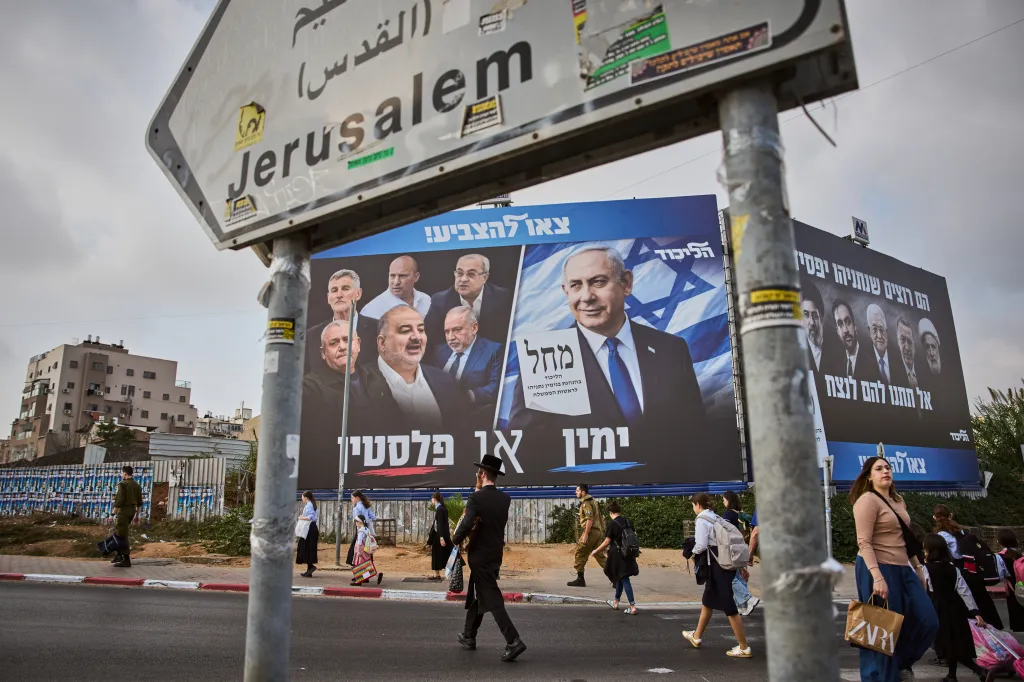
Israel’s parliamentary election could produce a prolonged political stalemate if neither Prime Minister Benjamin Netanyahu nor opposition challenger Gadi Eisenkot can assemble a majority in the 120-member Knesset. With at least 61 lawmakers needed to support a government, the election’s outcome may depend as much on smaller parties and post-election negotiations as on the main contenders’ performances at the ballot box.
Thirty-four parties are contesting the election, reflecting the fragmentation of Israel’s political landscape. Under the country’s proportional representation system, parties can win parliamentary seats based on their share of the vote, provided they cross the electoral threshold of 3.25 per cent. This creates opportunities for smaller political groups to influence government formation even when they cannot lead the government themselves.
Three broad outcomes are possible: neither camp manages to form a viable coalition, a minority government emerges with limited parliamentary support, or rival political forces agree to a national unity government. Each option would require negotiations among parties with differing positions on security, governance, religion and the country’s political future.
The central question is therefore not simply which leader receives the most support. It is whether either side can secure enough parliamentary backing to govern, and whether the political compromises required to reach 61 seats prove acceptable to potential coalition partners.
Why 61 seats matter in Israel’s election
Israel’s Knesset has 120 seats, making 61 the minimum number needed for a parliamentary majority. A party does not need to win that many seats independently to lead the government. Instead, its leader must be able to assemble a coalition whose members collectively provide sufficient parliamentary support.
This arrangement makes coalition negotiations a central part of Israeli politics. A party with a relatively small number of seats can become influential if its support determines whether a larger bloc reaches the majority threshold. The same arithmetic can make government formation difficult when parties refuse to cooperate with one another.
The 3.25 per cent electoral threshold adds another layer to the process. Parties that fail to cross it do not enter the Knesset, while parties that clear it can contribute seats to potential coalitions. Smaller groups may therefore have strong incentives to coordinate before an election, although alliances do not guarantee that their members will agree on a government afterwards.
Senior Israeli journalist and political commentator Yaron Deckel told the Press Trust of India that the final seat distribution and the willingness of smaller parties to support either camp would be decisive. He said neither the opposition nor Netanyahu’s bloc appeared positioned to reach 61 seats independently.
The result could leave voters waiting for a government even after ballots have been counted. The party that finishes first does not automatically gain the ability to govern; the decisive test is whether its leader can obtain sufficient support from other lawmakers.
Benjamin Netanyahu faces another test of political support
Benjamin Netanyahu, 77, is seeking another term as leader of the right-wing Likud party. His political position has been shaped by security concerns following the October 2023 attack, Israel’s subsequent military campaigns and domestic controversy surrounding his leadership.
The October 2023 attack killed around 1,200 people, according to the supplied report. Israel subsequently conducted military campaigns in Gaza, Lebanon and Iran, placing national security and military strategy at the centre of political debate.
Netanyahu has also faced a long-running corruption trial. He is charged with fraud, breach of trust and bribery, allegations he denies. Separately, the International Criminal Court issued an arrest warrant for him in 2024 over alleged war crimes and crimes against humanity.
These issues form part of the political context in which voters are assessing his leadership. Supporters may prioritise his experience and security credentials, while critics have questioned his handling of the country’s security and governance. The election will test how these competing assessments translate into parliamentary seats.
Netanyahu’s ability to form a government will also depend on the positions of parties that could become coalition partners. His potential allies include far-right parties led by Itamar Ben-Gvir and Bezalel Smotrich, as well as ultra-Orthodox parties. Their willingness to cooperate, and the terms they demand, could influence the shape and stability of any administration.
Even if Likud performs strongly, the final outcome will depend on whether the broader right-wing bloc can secure enough support. A favourable seat tally for Netanyahu would not, by itself, settle the question of who governs.
Gadi Eisenkot’s challenge: Military experience and a promise of change
Gadi Eisenkot, 66, a former chief of the Israel Defense Forces (IDF), has emerged as Netanyahu’s principal challenger. His military background is central to his campaign, particularly in an election shaped by questions about the country’s security failures, military strategy and political accountability.
Eisenkot previously served as an observer in Netanyahu’s war cabinet. He later resigned after criticising the government for failing to establish a clear war strategy. His departure placed him in opposition to a leadership he had once observed from within, giving his criticism a different context from that of politicians who had never been involved in the government’s wartime decision-making.
Supporters see his military experience as an advantage in addressing national security challenges. Pavan Chaurasia, an assistant professor at Delhi University, told PTI in Jerusalem that Eisenkot’s lack of previous public office had also become a feature of the campaign. Some supporters regard him as an outsider to the existing political establishment and point to the absence of corruption charges against him as a reason to support his candidacy.
His military credentials, however, do not automatically translate into a parliamentary majority. Eisenkot must still work with other opposition parties, some of which have different political priorities and constituencies. Even a strong performance by his party would not guarantee that the opposition as a whole could form a government.
The challenge is therefore twofold: persuading voters that he offers an alternative to Netanyahu and persuading other political groups to support a workable governing arrangement. The second task could prove just as important as the first once the election results become clear.
Naftali Bennett and other opposition parties could shape the outcome
Former prime minister Naftali Bennett is another significant opposition figure. He is leading an alliance with centrist leader Yair Lapid, creating another potential route for parties seeking to replace Netanyahu’s government.
Bennett, a right-wing politician, has criticised Netanyahu’s handling of security and governance. He served as prime minister in 2021 under a power-sharing arrangement with Lapid, demonstrating that politicians from different ideological backgrounds can cooperate when they share an objective of forming a government.
Other important players include Yair Golan’s Democrats, Avigdor Liberman’s Yisrael Beiteinu and Arab-led parties such as Ra’am and the Joint List. On the other side, Netanyahu’s potential partners include far-right parties led by Itamar Ben-Gvir and Bezalel Smotrich, alongside ultra-Orthodox political groups.
The presence of so many parties makes the election difficult to assess through a simple Netanyahu-versus-Eisenkot comparison. A party can perform well without having enough allies to form a government, while a smaller party can acquire considerable negotiating power if its seats become essential to reaching 61.
The political distance between potential partners also matters. Parties may agree that a particular leader should leave office but disagree over security policy, religious exemptions, governance or the distribution of ministerial positions. An opposition alliance must overcome those differences before it can function as a governing coalition.
Arab-led parties could become especially important if their parliamentary support determines whether an opposition candidate can receive the opportunity to form a government. Their role would depend on the final seat tally and whether other parties were willing to accept their support.
Scenario one: Political deadlock and the possibility of another election
The first possible outcome is that neither Netanyahu’s bloc nor the opposition can assemble a coalition with sufficient parliamentary support. In that situation, Israel could face a prolonged period of uncertainty while political leaders attempt to negotiate an agreement.
Deckel has warned that campaign commitments could make compromises difficult. Parties that have publicly ruled out cooperation with particular leaders or political groups may find it difficult to reverse those positions without angering supporters. The more fragmented the Knesset, the more complicated the process of assembling a viable coalition could become.
A deadlock would not necessarily mean that the government formation process ends immediately. Political leaders could continue negotiations, reconsider their positions or explore arrangements that were not central to their campaign messaging. The possibility of another election would become more significant if those efforts repeatedly failed.
The security situation adds urgency to the negotiations. Israel’s recent military campaigns and continuing debates over national security mean that prolonged political uncertainty could complicate decisions requiring a clear and durable political mandate.
However, a hung parliament does not automatically result in an immediate return to the polls. The outcome depends on the constitutional process, the opportunities available to potential nominees and whether a candidate can eventually secure sufficient support.
Scenario two: A minority government backed by smaller parties
A second possibility is the formation of a minority government. Such an administration would not have the dependable support of 61 lawmakers but could attempt to govern with backing from parties outside the formal coalition on selected parliamentary votes.
Under the scenario described by Deckel, Arab-led parties could recommend an opposition candidate to President Isaac Herzog without formally joining the government. Their support could help establish that the candidate has a viable route towards government formation, depending on the wider parliamentary arithmetic.
Formal coalition membership and parliamentary support are not identical. A party may agree to support a candidate or particular measures without taking ministerial positions or accepting collective responsibility for the government’s entire programme. Such arrangements can offer a route forward when a conventional majority coalition is difficult to assemble.
The weakness is stability. A minority administration would need to negotiate support repeatedly, potentially facing difficulties over legislation, budgets and other major decisions. If outside parties withdrew their backing, the government could find itself unable to maintain effective parliamentary support.
Deckel noted that Israel has experienced minority governments after coalitions collapsed during a parliamentary term, but forming one immediately after an election would be unusual. A minority arrangement could provide a temporary political solution, yet it might not resolve the underlying divisions that produced the deadlock.
For the opposition, the approach could offer an opportunity to replace Netanyahu without securing a conventional coalition majority. For the parties providing outside support, it could provide influence while allowing them to remain outside the government. Whether those interests align long enough to sustain an administration would be the central challenge.
Scenario three: A national unity government
A third possibility is a national unity government involving major political rivals. Such an arrangement could bring together parties that disagree on important domestic and political questions but are willing to cooperate because of the country’s security circumstances or the difficulty of forming an alternative government.
Deckel has suggested that the security situation could provide a reason for rival camps to consider this option. He also pointed to the relationship between Netanyahu and Eisenkot, saying that their personal relations were less hostile than Netanyahu’s relations with some other opposition figures.
A unity government would require more than an agreement to work together. Its participants would need to decide who becomes prime minister, how ministerial responsibilities are divided and which policies can be pursued jointly. They would also need a way to manage disagreements without bringing down the arrangement.
One possibility is a rotating premiership, under which rival leaders agree to serve successive terms as prime minister. Such an arrangement has precedent in Israeli politics, but it requires considerable trust and a credible mechanism for transferring power when the agreed period ends.
Deckel described a rotating premiership as unlikely but not impossible, noting the difficulty of ensuring that a leader hands over office as agreed. Even if rival parties were willing to negotiate, disagreements over leadership and policy could prevent a unity government from taking shape.
A national unity arrangement could reduce the immediate pressure created by a fragmented parliament. Yet its durability would depend on whether its members could agree on the most pressing issues facing the country. Bringing rivals into one government would not automatically resolve their differences over security, governance or domestic policy.
How Israel’s government formation process works
After the results are established, President Isaac Herzog will consult political factions and appoint the lawmaker he considers most likely to form a government. The nominee must then attempt to assemble a coalition with adequate parliamentary backing.
The process gives political parties an opportunity to indicate which candidate they support, but it does not guarantee that their recommendations will translate into a successful coalition. Negotiations must establish a workable agreement among enough lawmakers to support the new government.
Under the timetable described in the supplied report, the nominee has up to 42 days to form a government. If the first attempt fails, another candidate may be given an opportunity. If no viable government can be formed, another election may become necessary.
This process explains why election night may not deliver a definitive answer about who will become prime minister. Initial results reveal the relative strength of the parties, while subsequent negotiations determine whether those parties can work together.
The distinction is particularly important in a fragmented political system. A party that wins the largest number of seats may still be unable to assemble a majority, while another candidate may eventually succeed by negotiating a broader agreement.
When will Israel’s election results be known?
The final vote tally is expected by October 30, while the official results are scheduled to be published on November 4. Initial projections and preliminary counts may provide an early indication of the balance between the main blocs, but the final allocation of seats will determine the available options for government formation.
The electoral threshold of 3.25 per cent makes the count particularly important for smaller parties. A relatively small change in a party’s final vote share can determine whether it enters the Knesset, affecting the number of seats available to each potential coalition.
Once the results are confirmed, the attention will shift from campaigning to negotiations. Party leaders will need to decide which alliances they are prepared to enter, which conditions they will demand and whether their supporters will accept the compromises involved.
The timetable for establishing a government will therefore depend on the election result and the progress of those discussions. Even after the official results are published, the identity and composition of the next government may remain uncertain.
What the election could mean for Israel’s political direction
The election will determine more than whether Netanyahu retains office. The coalition that eventually emerges will influence how Israel addresses security policy, the aftermath of the October 2023 attack, military strategy and domestic governance.
For Netanyahu, the challenge is to turn support for Likud and its potential partners into a workable parliamentary majority. For Eisenkot and the broader opposition, the task is to demonstrate that their parties can cooperate beyond their shared opposition to the incumbent prime minister.
Smaller parties face a different calculation. Their parliamentary strength could allow them to influence the formation and priorities of the next government, but the extent of that influence will depend on how many seats they win and what compromises the larger blocs are willing to make.
The decisive moment may therefore come after the ballots have been counted. A clear parliamentary majority would simplify the process, but a fragmented result would make coalition negotiations central to Israel’s political future. Deadlock, minority rule and national unity remain distinct possibilities, each dependent on the willingness of rival parties to find common ground.
Until the final seat tally and coalition negotiations become clear, no single outcome can be treated as certain. Israel’s next government will ultimately depend not only on which parties win votes, but on which political leaders can assemble a parliamentary arrangement capable of governing.
For breaking news and live news updates, like us on Facebook or follow us on Twitter and Instagram. Read more on Latest World on thefoxdaily.com.




COMMENTS 0