The latest chapter in US-Iran relations is being written amid a mix of optimism, uncertainty, and competing claims.
President Donald Trump has publicly stated that Iran has agreed never to develop a nuclear weapon, presenting the emerging agreement as a major diplomatic breakthrough after more than 100 days of conflict that destabilized the Middle East, rattled Energy Markets, and raised fears of a wider regional war.
At the same time, Trump has forcefully rejected reports suggesting that the United States is offering hundreds of billions of dollars to Iran as part of the peace process.
The Controversy surrounding the reported financial package has become one of the most debated aspects of the negotiations, overshadowing even some of the nuclear provisions that originally formed the core of the talks.
With details of the agreement still limited and negotiations ongoing, the dispute over the alleged $300 billion package highlights the political, economic, and strategic challenges facing both Washington and Tehran.
What Trump Actually Said About Iran’s Nuclear Program
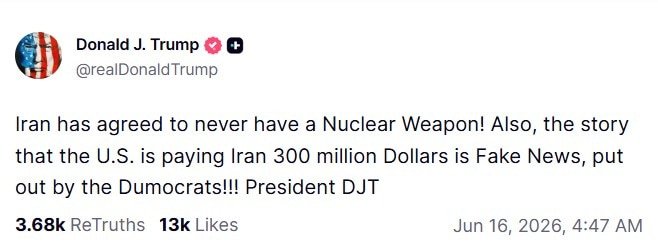
In a message posted on social media, Trump declared that Iran had agreed never to possess a nuclear weapon.
The statement reflects what appears to be a central objective of the US negotiating position throughout the conflict and subsequent peace talks.
For successive American administrations, preventing Iran from developing nuclear weapons capability has remained a key National Security priority.
The issue has shaped US foreign policy toward Iran for decades and has often been cited as one of the most significant security concerns in the Middle East.
By announcing that Iran has agreed to permanently forgo nuclear weapons, Trump is attempting to frame the agreement as a major strategic achievement.
However, many analysts note that the effectiveness of such commitments ultimately depends on verification mechanisms, enforcement measures, and long-term compliance.
Why Iran’s Nuclear Program Has Been So Controversial
The debate over Iran’s nuclear ambitions did not begin with the current conflict.
For years, international powers have sought assurances that Iran’s nuclear activities remain exclusively peaceful.
Supporters of diplomatic engagement argue that robust inspections and monitoring can prevent weaponization while allowing civilian nuclear development.
Critics, meanwhile, have often questioned whether diplomatic agreements provide sufficient guarantees.
The concerns generally focus on:
- Uranium enrichment activities
- Stockpiles of enriched material
- Inspection access
- Verification mechanisms
- Potential military applications
- Regional security implications
The latest framework reportedly seeks to address several of these issues through renewed international oversight and future negotiations.
The Confusion Over the $300 Billion Figure
One of the most controversial elements surrounding the negotiations involves reports of a $300 billion reconstruction-related package.
Trump has publicly dismissed reports suggesting the United States is paying Iran hundreds of billions of dollars.
However, the controversy stems from differing interpretations of what the reported figure actually represents.
Several media reports have discussed a figure of approximately $300 billion, but descriptions vary significantly depending on the source.
This has created confusion among policymakers, analysts, and the public.
Is It a Payment, Investment Fund, or Reconstruction Program?
The central disagreement revolves around how the proposed economic package should be characterized.
Iranian accounts reportedly describe the proposal as reconstruction assistance linked to damage suffered during the conflict.
Some reports portray it as compensation necessary to support a durable peace agreement.
Western descriptions have generally framed the same figure differently.
Rather than direct government payments, some accounts characterize it as a broader international investment and reconstruction initiative that could involve private-sector participation.
The distinction is politically important.
| Iranian Narrative | Western Narrative |
|---|---|
| Compensation for war damage | Investment and reconstruction initiative |
| Economic relief package | Facilitated international investment |
| Part of peace settlement demands | Post-conflict economic development |
| Linked to damages suffered | Focused on future growth projects |
The same number therefore carries very different political implications depending on how it is presented.
Why the Economic Component Matters So Much
Peace agreements are rarely only about ending military conflict.
In many cases, economic considerations become equally important.
Countries emerging from conflict often face challenges such as:
- Damaged infrastructure
- Reduced investment
- Economic disruption
- Energy market instability
- Capital shortages
- Reconstruction needs
Iran’s economy has faced years of sanctions, geopolitical pressure, and economic restrictions.
As a result, economic relief has become a central component of negotiations.
Without meaningful economic improvements, analysts argue that any political agreement could face significant domestic pressure.
What Is Reportedly Included in the Emerging Framework?
Although the memorandum remains preliminary and many details have not been officially released, reports suggest the framework addresses several major issues.
Topics reportedly under discussion include:
- Nuclear restrictions
- Sanctions relief
- International inspections
- Uranium stockpile management
- Economic cooperation
- Regional security concerns
Officials have indicated that additional negotiations will be required before a comprehensive and permanent settlement can be finalized.
This means the current framework should be viewed as the beginning of a process rather than the final destination.
The Importance of International Atomic Energy Agency Inspections
One of the most significant reported elements involves the return of international inspectors.
Verification is often the cornerstone of nuclear agreements.
Without independent monitoring, commitments regarding enrichment activities or nuclear materials become difficult to assess.
International inspectors generally play several roles:
- Monitoring compliance
- Inspecting facilities
- Reviewing enrichment activities
- Verifying nuclear materials
- Building international confidence
The reported return of inspectors suggests that transparency mechanisms may become a central feature of the final agreement.
Why Both Governments Are Selling the Deal Differently
One of the most fascinating aspects of the emerging settlement is how differently it is being presented by each side.
For Washington, the emphasis is on security, Diplomacy, and preventing nuclear proliferation.
For Tehran, the focus appears to be on economic relief, reconstruction, and national recovery.
This difference is not unusual.
Major international agreements often require leaders to present outcomes in ways that resonate with domestic audiences.
Political survival frequently depends on convincing voters that negotiations produced favorable results.
The Political Stakes for Trump
The agreement carries significant political implications for President Trump.
After months of conflict, voters are closely watching the administration’s ability to deliver stability without becoming entangled in a prolonged regional crisis.
A successful agreement could provide several political benefits:
- Reduced geopolitical tensions
- Greater energy market stability
- Lower risk of military escalation
- Improved economic confidence
- A major foreign policy achievement
At the same time, critics are likely to scrutinize every aspect of the agreement, particularly any provisions involving sanctions relief or economic incentives.
Can Iran Be Trusted to Abandon Nuclear Weapons?
This question remains at the center of the broader debate.
Supporters of diplomacy argue that negotiated agreements combined with inspections offer the best path toward preventing nuclear proliferation.
Critics contend that enforcement challenges and geopolitical realities require caution.
The answer will likely depend on factors including:
- Verification systems
- Inspection access
- Political commitment
- Regional stability
- International cooperation
History suggests that agreements succeed not merely because they are signed, but because mechanisms exist to ensure compliance over time.
The Energy Market Angle Most Coverage Is Missing
Much of the discussion has focused on diplomacy and Politics, but the economic impact could be equally important.
Iran sits at the center of one of the world’s most strategically important energy regions.
Any reduction in tensions can influence:
- Oil prices
- Shipping routes
- Energy investment
- Global inflation pressures
- Supply chain stability
This explains why financial markets and energy companies are watching developments closely.
Even the perception of reduced geopolitical risk can affect global economic expectations.
The Fragility of Preliminary Agreements
One important reality often overlooked in headlines is that preliminary frameworks are not final peace treaties.
Many agreements encounter difficulties during implementation.
Potential obstacles include:
- Political opposition
- Verification disputes
- Regional tensions
- Economic disagreements
- Security incidents
- Domestic political pressure
As a result, optimism surrounding the announcement is being balanced by caution among analysts who recognize how difficult lasting peace agreements can be to achieve.
Future Outlook: Can the Agreement Hold?
President Trump’s declaration that Iran has agreed never to obtain nuclear weapons represents one of the most significant claims made during the peace process so far.
At the same time, his rejection of reports involving a $300 billion payment highlights the political sensitivity surrounding the economic aspects of the negotiations.
The coming weeks will likely determine whether the preliminary framework evolves into a durable agreement or encounters the kinds of obstacles that have challenged previous diplomatic efforts.
Success will depend not only on nuclear commitments but also on sanctions relief, economic incentives, verification mechanisms, regional security concerns, and continued political will from both sides.
For now, the agreement remains a work in progress. What is clear, however, is that the stakes extend far beyond Washington and Tehran. The outcome could influence Middle East stability, Global energy markets, nuclear non-proliferation efforts, and international diplomacy for years to come.
For breaking news and live news updates, like us on Facebook or follow us on Twitter and Instagram. Read more on Latest World on thefoxdaily.com.





COMMENTS 0