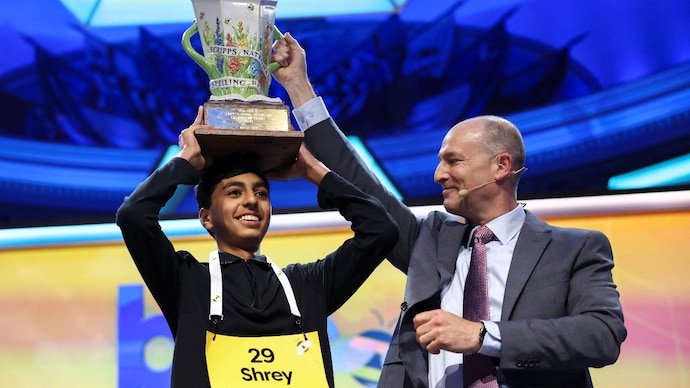
Indian-origin teenager Shrey Parikh has won the 2026 Scripps National Spelling Bee after an intense and fast-paced final that showcased not only extraordinary vocabulary skills but also remarkable composure under pressure.
The 14-year-old from Rancho Cucamonga, California, secured victory in the United States’ most famous spelling competition by correctly spelling 32 difficult words in just over 90 seconds during a dramatic lightning-round tiebreaker.
The championship came down to a tense duel between two Indian-origin finalists Shrey Parikh and 12-year-old Ishaan Gupta in a finale that captivated audiences in Washington, DC.
When the buzzer finally stopped, the audience erupted into applause as Shrey smiled in relief, stretched his fingers, and realised he had officially become the latest champion of the Scripps National Spelling Bee.
The winning word was “cashaw,” also spelled “cushaw,” a term associated with a type of squash and historically linked to older agricultural vocabulary.
How Shrey Parikh Won the 2026 Spelling Bee
The decisive moment came during the now-famous “spell-off” round a format introduced to avoid marathon finals and test speed alongside accuracy.
In this round, finalists are given 90 seconds to spell as many words correctly as possible.
Shrey delivered a near-flawless performance.
He rapidly pressed the buzzer after each correct answer, maintaining extraordinary rhythm and concentration while spelling highly complex words from multiple linguistic origins.
Although he briefly stumbled over words such as:
- cydyddau
- sawder
- uayeb
the mistakes were not enough to slow his momentum.
By the end of the spell-off, Shrey had correctly spelled 32 words, significantly ahead of Ishaan Gupta, WHO managed 25.
| Final Spell-Off Results | Correct Words Spelled |
|---|---|
| Shrey Parikh | 32 |
| Ishaan Gupta | 25 |
The result cemented Shrey’s reputation as one of the strongest competitive spellers in recent years.
What Is the Scripps National Spelling Bee?
The Scripps National Spelling Bee is widely considered the most prestigious spelling competition in the United States.
Founded in 1925, the contest has evolved into a major educational and cultural event watched by millions.
Each year, students from across the United States and several international regions compete through local and regional qualifying rounds before reaching the national stage.
The competition tests:
- Vocabulary knowledge
- Language origins
- Pronunciation understanding
- Memory
- Concentration under pressure
Contestants often study for years, memorising thousands of words derived from Greek, Latin, German, Arabic, French, Sanskrit, Japanese, and dozens of other linguistic roots.
Modern spelling bee preparation has become so advanced that many contestants train with professional coaches, digital databases, mock competitions, and extensive etymology analysis.
The Growing Dominance of Indian-Origin Students
Shrey Parikh’s victory also continues one of the most remarkable trends in American academic competitions: the dominance of Indian-American students in the National Spelling Bee.
Over the past two decades, Indian-origin contestants have won an overwhelming number of championships.
In many recent years, Indian-American finalists have virtually dominated the competition.
| Year | Winner |
|---|---|
| 2026 | Shrey Parikh |
| 2025 | Faizan Zaki |
| 2024 | Bruhat Soma |
This success has drawn attention from educators, sociologists, and cultural commentators trying to understand why Indian-origin families have excelled so consistently in spelling competitions.
Why Indian-American Students Excel in Spelling Bees
Experts often point to a combination of cultural, educational, and community-driven factors behind the trend.
Several Indian-American families place strong emphasis on:
- Academic discipline
- Structured study routines
- Competitive learning environments
- Language development
- Long-term preparation strategies
In addition, spelling competitions have become deeply embedded within sections of the Indian-American community.
Over time, specialised coaching networks, study groups, regional contests, and mentoring systems have emerged to support young participants.
Many contestants also grow up in multilingual households, which can strengthen sensitivity to pronunciation patterns and language structures.
However, experts caution against reducing success solely to ethnicity.
The competition demands enormous personal dedication regardless of background.
Top spellers routinely spend years studying thousands of words, roots, and linguistic systems.
Shrey Parikh’s Journey to the Championship
Shrey entered the 2026 competition as one of the favourites.
His reputation had grown steadily after finishing third in the 2024 Scripps National Spelling Bee.
But his path to victory was not straightforward.
Last year, he reportedly missed another spelling opportunity after losing his school bee while battling a fever.
Instead of discouraging him, the setback appeared to sharpen his focus.
Over the following months, Shrey established himself as one of the most dominant young competitors in online spelling circuits, defeating many of the same participants he later faced at the national finals.
His 2026 victory therefore felt less like a surprise and more like the culmination of years of preparation and resilience.
The Pressure of the Spell-Off Format
The spell-off format has dramatically changed the nature of the National Spelling Bee finals.
Earlier competitions sometimes stretched for hours or even ended with co-champions after judges exhausted word lists.
To avoid endless finals, organisers introduced the lightning-round spell-off format, which tests speed alongside accuracy.
This transformed spelling bees from purely intellectual contests into high-pressure mental endurance events.
Contestants must now:
- Process words rapidly
- Control nerves
- Maintain pronunciation focus
- Manage time pressure
- Recover instantly from mistakes
Shrey’s calm and rhythm during the final round demonstrated exceptional composure for a 14-year-old competitor.
The Winning Word: What Does “Cashaw” Mean?
The word that sealed Shrey’s victory was “cashaw,” sometimes spelled “cushaw.”
The term refers to a type of winter squash commonly associated with older agricultural and regional American vocabulary.
Like many spelling bee championship words, it originated from linguistic blending and historical usage patterns unfamiliar to most everyday speakers.
Winning words are intentionally selected to test contestants’ mastery of:
- Pronunciation clues
- Etymology
- Language origin
- Sound-letter relationships
Spellers often rely heavily on understanding word roots rather than simple memorisation.
Beyond Spelling: Who Is Shrey Parikh?
One reason spelling bee champions often fascinate audiences is that many are highly accomplished beyond academics.
Shrey Parikh is no exception.
Apart from spelling competitions, he reportedly enjoys:
- Tennis
- Mathematics
- Chess
- Reading
- Music
He also performs percussion in his school band and plays multiple instruments, including:
- Snare drum
- Bass drum
- Timpani
- Triangle
- Glockenspiel
- Marimba
The combination of musical training and competitive spelling is interesting because researchers have long explored links between music Education, memory development, concentration, and pattern recognition.
Many top spelling bee contestants also participate heavily in mathematics, chess, or classical music training.
The Psychology Behind Elite Competitive Spelling
Competitive spelling at the national level is far more psychologically demanding than many viewers realise.
Top contestants spend years studying:
- Etymology dictionaries
- Language-origin systems
- Phonetic structures
- Historical word evolution
- Pronunciation rules
Preparation often resembles Olympic-style training for the brain.
Elite spellers must develop:
- Memory retention
- Pattern recognition
- Stress management
- Rapid recall abilities
- Mental endurance
The final rounds can become especially intense because a single hesitation or misplaced letter can end years of preparation instantly.
Why the Spelling Bee Still Matters in the Digital Age
Some critics occasionally question whether spelling competitions remain relevant in an era dominated by smartphones, autocorrect, and Artificial Intelligence.
Yet the continued popularity of the Scripps National Spelling Bee suggests the contest represents something larger than memorising words.
For many educators, spelling bees encourage:
- Deep language engagement
- Curiosity about word origins
- Critical listening skills
- Discipline and persistence
- Intellectual confidence
The competition has also evolved into a cultural event celebrating academic excellence at a time when sports and entertainment often dominate public attention.
In many ways, spelling bee champions have become symbols of intellectual achievement and perseverance.
The Broader Legacy of Indian-American Academic Success
The continued success of Indian-origin students in competitions like the Spelling Bee also reflects broader trends within the Indian-American community.
Indian-Americans are among the most highly educated demographic groups in the United States, with strong representation in fields such as:
- Technology
- Medicine
- Engineering
- Academia
- Research
Academic competitions often become extensions of that culture of educational ambition.
However, some experts also caution about the pressures associated with hypercompetitive environments.
Balancing achievement with emotional well-being remains an increasingly important conversation in high-performance academic cultures.
Conclusion
Shrey Parikh’s victory at the 2026 Scripps National Spelling Bee was more than just a triumph of vocabulary.
It was the culmination of years of discipline, preparation, resilience, and mental focus under extraordinary pressure.
By spelling 32 difficult words in just over 90 seconds, the California teenager not only defeated a talented field of finalists but also reinforced the extraordinary legacy of Indian-origin competitors in America’s most prestigious academic contest.
His win reflects the evolving nature of modern spelling bees where linguistic mastery, speed, psychological endurance, and strategic thinking now intersect.
For audiences watching across the world, Shrey’s performance was a reminder that even in an age dominated by technology and Automation, human memory, focus, and intellectual discipline can still captivate millions.
For breaking news and live news updates, like us on Facebook or follow us on Twitter and Instagram. Read more on Latest World on thefoxdaily.com.



COMMENTS 0