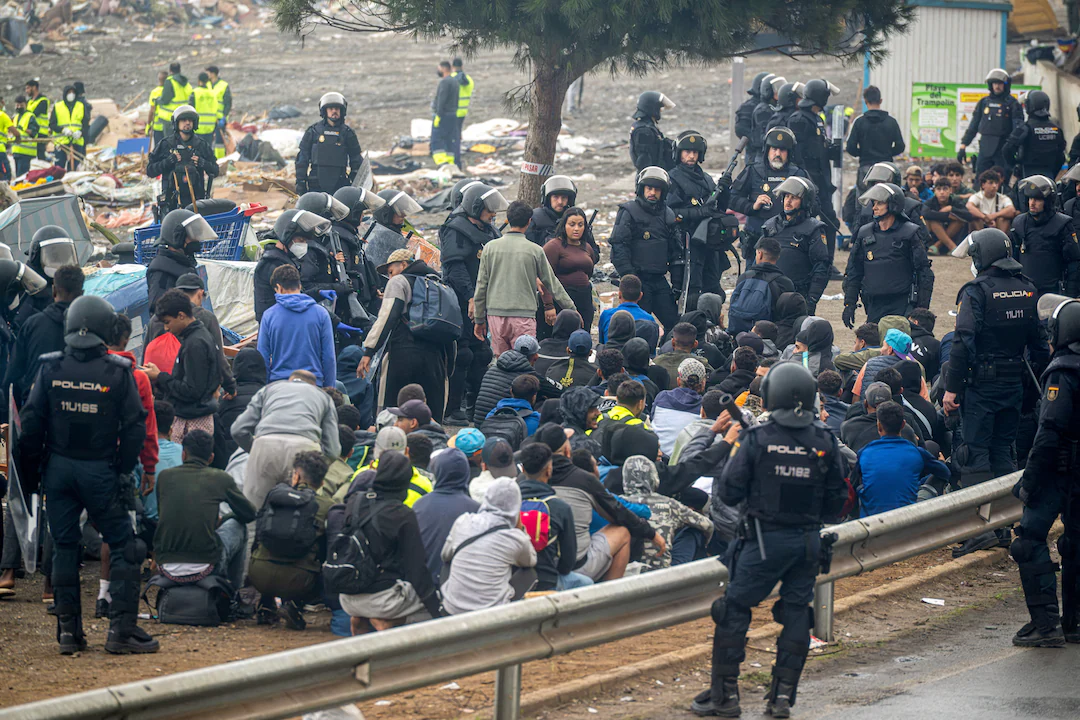
Spain‘s efforts to clear a growing backlog of migrants in Ceuta, its North African enclave bordering Morocco, are raising concerns over asylum rights, alleged forced returns and access to essential services. Under pressure to resolve the crisis, Prime Minister Pedro Sanchez’s government is pursuing faster procedures and encouraging migrants to return to their countries of origin, but humanitarian organisations warn that vulnerable people risk being sent back without adequate assessments of their individual circumstances.
The situation has left thousands of migrants facing uncertainty months after a large-scale border crossing on July 30. Some remain without stable accommodation, while others are waiting for their asylum claims to be processed. Charities, lawyers and migrant-support organisations say the delays and the authorities’ approach to returns could put people who qualify for international protection at risk.
Among those affected is Fatna, a 21-year-old woman who arrived in Ceuta while heavily pregnant with her disabled son. Nearly three months later, her newborn daughter is experiencing kidney problems and needs specialist hospital treatment on mainland Spain. However, travelling while her asylum claim is under review requires a permit, which authorities have been reluctant to grant to migrants awaiting decisions.
The case illustrates the human consequences of the administrative backlog. While the government says it is managing the situation responsibly and respecting migrants’ rights, interviews conducted by Reuters with migrants, lawyers, non-governmental organisations and security personnel point to concerns about the treatment of asylum-seekers, the pace of registration and the possibility of people being returned without proper safeguards.
Why Ceuta is facing a migrant backlog
Ceuta is a small Spanish port city on Morocco’s northeastern border and one of the European Union’s few land borders with Africa. Covering approximately 20 square kilometres and home to around 84,000 residents, the enclave has limited capacity to accommodate a sudden influx of people requiring housing, medical care, legal assistance and asylum processing.
The mass crossing on July 30 placed additional pressure on local services. In the weeks that followed, migrants remained scattered across the city, with some sleeping outdoors or sheltering in the surrounding hills. Others relied on charities and civil society groups for food, accommodation and support while waiting for their cases to move forward.
The scale of the challenge has exposed the limitations of the local reception system. Social services have struggled to meet the needs of those arriving, leaving humanitarian organisations to provide assistance beyond their usual capacity. One Catholic migrant reception centre, San Antonio, which normally accommodates seven people, took in Fatna’s family and dozens of other vulnerable migrants.
The pressure is not limited to accommodation. Authorities must register migrants, establish their identities and circumstances, assess asylum claims and determine whether individuals qualify for protection or can lawfully be returned. Each stage requires administrative capacity, trained personnel and access to legal and interpretation services.
When these systems become overwhelmed, people can remain in legal uncertainty for extended periods. The delays also complicate efforts to identify children, people with disabilities, survivors of violence and others whose circumstances may require urgent attention.
Sanchez government faces pressure to resolve the crisis
Prime Minister Pedro Sanchez’s government is under pressure from European partners and an increasingly frustrated public to bring the situation under control. The political challenge comes ahead of a snap election scheduled for November 29, adding to the scrutiny surrounding immigration policy.
Sanchez, one of Europe’s remaining left-leaning leaders, has defended his government’s approach. He said Spain was managing the influx of cases responsibly, with a sense of solidarity and respect for migrants’ Human Rights.
However, the government is also working on faster procedures for processing asylum applications, with the stated intention of returning most people who do not qualify for protection, particularly to Morocco. Authorities have sought to distinguish between people fleeing persecution or serious danger and those they consider to have migrated primarily for economic reasons.
That distinction is central to the dispute. Governments have the authority to assess whether applicants qualify for asylum and to return people who do not have a legal right to remain, subject to applicable safeguards. But humanitarian organisations argue that these decisions must be based on individual assessments rather than assumptions about nationality or the circumstances of a mass crossing.
Spanish right-wing and far-right parties have criticised Sanchez’s immigration policies, including the government’s decision earlier in the year to provide legal status to nearly one million irregular migrants. They have described the July crossing as a deliberate invasion by Morocco, an accusation Morocco denies, and called for migrants to be returned.
The competing pressures have placed the government in a difficult position: it must demonstrate that it can manage the border and process applications efficiently while ensuring that people with legitimate protection needs are not denied their rights.
Human rights groups allege serious violations in Ceuta
Humanitarian organisations have raised concerns about how migrants are being treated and whether authorities are providing adequate safeguards during the processing of asylum claims and returns.
Last week, eight charities, including Oxfam and Amnesty International, submitted a complaint to Spain’s ombudsman alleging serious human rights violations in Ceuta. According to the complaint, the alleged violations included the forced return of migrants from conflict-affected countries and the denial of interpreters and legal assistance.
These allegations are particularly significant because access to legal advice and interpretation can determine whether an asylum-seeker is able to explain their circumstances and understand the consequences of an administrative decision. Without those safeguards, applicants may struggle to communicate experiences of persecution, threats or other risks that could affect their eligibility for protection.
Spokespeople for Spain’s central government, interior ministry, territorial policy ministry and migration ministry did not respond to Reuters’ requests for comment on the allegations of mistreatment.
Wendell Soares, coordinator of the San Antonio Catholic migrant reception centre, said some people could face serious danger if they were returned to Morocco. He also warned against treating migrants as a single, indistinguishable group, stressing that each person has an individual history and set of circumstances.
The distinction is important in asylum proceedings. Some people may be seeking employment or better economic opportunities, while others may be escaping persecution, violence or threats to their safety. Establishing which circumstances apply requires an assessment of the evidence and the individual’s situation.
The complaint to the ombudsman raises questions about whether the safeguards needed for those assessments are being applied consistently amid pressure to reduce the backlog. The allegations remain contested claims reported by humanitarian organisations, rather than findings of a final legal determination.
Migrants allege they were deported without explanation
One of the most contentious aspects of the situation is the government’s effort to encourage migrants to return voluntarily. Authorities say thousands have crossed back into Morocco since the summer, but several non-governmental organisations have alleged that some people were pressured or returned without being given a meaningful opportunity to understand the process.
The government said this week that approximately 12,000 migrants had chosen to return since mid-August. Interior Minister Fernando Grande-Marlaska rejected claims of covert deportations, describing the returns as voluntary. He also said authorities had received up to 1,200 asylum applications and resolved 700 of them.
However, at least nine non-governmental organisations, through public statements or interviews with Reuters, have claimed that migrants they support were coerced into returning.
According to the complaint submitted to the ombudsman, the organisation Asociación Elin said migrants from Sudan and Chad were summoned by police on September 24 and 25 before being deported without warning.
Messages reviewed by Reuters also described the experience of Moroccan migrant Azhaar Chaouni. In text messages to volunteers with German organisation Mission Lifeline, Chaouni said police collected him and other migrants from makeshift camps on the beach in buses, telling them they were being taken to reception centres.
Chaouni later wrote that they had been deported without explanation and said he was in Morocco.
These accounts raise questions about how authorities establish whether a return is genuinely voluntary. A return cannot be meaningfully described as voluntary if a person is subjected to coercion or is prevented from exercising applicable legal rights. Determining what happened in individual cases requires examining the circumstances, the procedures followed and any available evidence.
The disagreement also illustrates the difficulty of verifying events during a large-scale migration operation. Government figures describe the overall number of people who have returned, while charities report experiences involving individuals they support. Those figures and accounts measure different aspects of the situation and do not, on their own, establish whether every return was voluntary or forced.
Why Moroccan migrants may still qualify for asylum
Morocco’s designation as a safe country of origin under European Union rules does not automatically remove the right of Moroccan citizens to apply for asylum, according to Andrea de Petris, an immigration expert at the Brussels-based think tank CEPN.
The designation can influence how an application is assessed, but it does not mean that every person from that country faces the same circumstances or can safely return. Individual applicants may have specific grounds for seeking protection that need to be examined by the relevant authorities.
Under the principle of individual assessment, authorities must consider the applicant’s personal circumstances and the risks they could face if returned. Relevant factors can include threats from individuals or groups, persecution linked to personal characteristics and other circumstances that may justify international protection under applicable law.
De Petris said each individual must receive a specific assessment of their circumstances. He also warned that such procedures would inevitably require substantial time and resources.
This requirement creates a practical challenge for Spain as it attempts to process thousands of cases. A streamlined procedure may reduce administrative delays, but speed cannot replace the examination necessary to determine whether someone faces a genuine risk of persecution or serious harm.
Where a person has a potentially valid asylum claim, an assessment based only on nationality or a general assumption about the safety of the country of origin may fail to identify individual risks. This is particularly relevant for applicants whose circumstances differ substantially from those of the wider population.
LGBT migrants fear persecution if they are returned
The concerns surrounding asylum assessments are illustrated by Rayane, a 19-year-old gay Moroccan migrant awaiting news about his application at the San Antonio reception centre.
Rayane said his family had rejected him and that he could not live openly in Morocco, where same-sex sexual acts are criminalised. He fears returning and hopes to reach mainland Europe.
His circumstances highlight the risks that some applicants may face because of their sexual orientation or other personal characteristics. For people who fear persecution, a return to their country of origin may carry consequences that cannot be captured by a general assessment of national conditions.
Whether an individual qualifies for asylum depends on the facts of their case and the applicable legal criteria. Nevertheless, claims involving a risk of persecution require careful consideration, particularly when applicants may be reluctant or unable to disclose sensitive information without appropriate support.
Access to interpreters, confidential legal advice and a fair opportunity to explain personal circumstances can be especially important in such cases. Humanitarian organisations argue that these safeguards are essential to ensuring that protection claims are assessed properly before a person is returned.
Rayane’s fear of deportation also illustrates how uncertainty can affect people while their applications remain unresolved. Migrants awaiting decisions may face prolonged anxiety about their future, particularly when they hear reports that others have disappeared from reception facilities or been returned to Morocco.
Unaccompanied minors and vulnerable families face additional risks
Children, people with disabilities and families with urgent medical needs are among the groups facing heightened difficulties in Ceuta. Their circumstances may require additional protection measures, specialised accommodation or access to services that are not readily available in an overstretched reception system.
Spain has transferred 262 minors to the mainland since the July crossing, according to the reported figures. However, the government’s approach to the remaining adults has focused on encouraging as many as possible to return voluntarily.
Identifying vulnerable people can be difficult when thousands of migrants are dispersed across a small area and some are sleeping outdoors or staying in makeshift camps. Without reliable registration and access to support services, individuals who need urgent medical treatment or specialised protection may remain outside the formal system.
Fatna’s family illustrates the consequences. She arrived in Ceuta while heavily pregnant and travelling with her disabled three-year-old son. Her newborn daughter has since developed kidney problems, and the family urgently needs access to specialist hospital care on mainland Spain.
According to the report, Fatna’s asylum claim remains under review, and she needs a permit to travel while the application is pending. The family’s situation demonstrates how administrative restrictions and delays can intersect with urgent healthcare needs.
Her husband, Mohamed, said the family was desperate to remain in Spain because of concerns about their children’s future. They fear that their disabled son would not survive if they returned to Morocco.
Such cases underline the importance of identifying vulnerability early in the asylum process. Families with seriously ill children or dependants with disabilities may need urgent assistance while their legal status is being determined.
They also raise broader questions about how authorities should balance border-management procedures with humanitarian obligations. Resolving an application is an administrative task, but delays can have immediate consequences for access to healthcare, accommodation and family welfare.
Why Spain’s asylum-processing target is under pressure
The situation in Ceuta has raised concerns about the feasibility of processing the remaining applications within the 12-week period set out under the European Union’s new migration and asylum pact.
Frontline workers and humanitarian organisations have warned that the backlog could take months to resolve. Seven organisations and workers cited in the Reuters report expected the process to continue well beyond the intended timeframe.
Raul Piera, a representative of a police union, said limited resources, including staffing shortages and a lack of functioning computers, were slowing registration. By October 14, authorities were registering around 100 migrants’ cases a day, according to his account.
Police union estimates suggested that approximately 7,000 to 8,000 migrants remained scattered across Ceuta, sleeping outdoors or staying in facilities provided by charities and civil society groups. Piera said the remaining workload could extend well into the following summer.
These estimates differ from the number of asylum applications the government says it has received and resolved. The figures refer to different categories of people and stages in the process, including those who may not yet have been registered. Spain’s government has declined to comment on estimates of the number of unregistered migrants, while Territorial Policy Minister Angel Victor Torres said on October 14 that it was impossible to know how many people were hiding.
The gap between the intended processing period and the time available to handle cases highlights the strain on the administrative system. Registration is only an initial step: authorities must still assess individual claims, determine eligibility for protection and make decisions that can withstand legal scrutiny.
When the number of cases exceeds the capacity of the system, even relatively straightforward administrative tasks can generate delays. Limited access to staff, equipment, interpretation and legal support can further slow the process.
Could transferring migrants to mainland Spain ease the pressure?
The European Union’s new migration pact provides for asylum applications to be processed in border zones to facilitate faster decisions in certain circumstances. However, the rules do not require applicants to remain in the precise location where they first arrived. Transfers to other border zones in Spain could therefore help relieve pressure on Ceuta.
Juan Miguel Morales, director-general of the non-governmental organisation Sur Acoge, said transferring vulnerable migrants was the only option if their applications were to be assessed properly.
Moving applicants to other locations could distribute the administrative workload and make it easier to access accommodation, legal assistance, interpreters and healthcare. It could also reduce the concentration of people in a city whose reception facilities have struggled to accommodate the influx.
However, transfers would require coordination between authorities and receiving facilities. Simply moving migrants elsewhere would not resolve the underlying problem if the new locations lacked the resources needed to process applications and provide adequate support.
The challenge is therefore not only geographical but also administrative. Authorities need sufficient personnel, functioning systems and clear procedures to identify vulnerable applicants and process cases efficiently without compromising individual rights.
For migrants with urgent medical needs, transfers may also have to take account of continuity of care and access to appropriate treatment. Families such as Fatna’s need a process that considers their humanitarian circumstances while their legal claims are being examined.
Medical conditions worsen as migrants remain outdoors
The prolonged backlog has also created public-health concerns. Migrants who spend extended periods outdoors may face exposure to poor weather, inadequate sanitation and limited access to medical services.
Enrique Robiralta, head of the doctors’ union, said doctors at Ceuta’s only hospital were treating migrants for scabies, tuberculosis and gastrointestinal infections associated with prolonged periods outdoors. At least seven women had given birth, according to the report.
These conditions illustrate the consequences of leaving large numbers of people without stable accommodation and reliable access to basic services. Overcrowding and inadequate sanitation can increase the risk of infectious diseases, while delays in treatment may make existing health problems more difficult to manage.
Pregnant women, newborn babies, people with disabilities and those with chronic conditions can face additional risks when access to specialised care is limited. The strain on healthcare services also creates challenges for local authorities already dealing with pressure on accommodation and social support.
Charities and civil society groups have stepped in to provide shelter and assistance, but their resources are limited. Reception centres designed for a small number of people cannot indefinitely substitute for a formal system capable of meeting the needs of thousands.
The medical situation adds urgency to calls for the authorities to accelerate registration, identify vulnerable people and arrange appropriate accommodation and treatment. Faster processing may help reduce uncertainty, but it must be accompanied by practical support for people who remain in the enclave.
What the Ceuta crisis reveals about European migration policy
The developments in Ceuta expose a broader tension in European migration policy: governments want faster border procedures and more efficient returns, while asylum systems must preserve the right of individuals to seek protection and receive fair assessments.
The European Union’s migration pact seeks to streamline procedures and establish common rules for handling applications, including processing at external borders. Yet the experience in Ceuta suggests that ambitious timelines can be difficult to achieve when arrivals exceed local capacity and administrative resources are insufficient.
The case also illustrates the difference between creating rules and implementing them. A deadline for processing applications cannot, on its own, provide the staff, equipment, interpreters, legal support and accommodation needed to meet that target.
Where governments pursue faster returns, safeguards become particularly important. Authorities must distinguish between people who do not qualify for international protection and those who could face persecution or serious harm if sent back. They must also ensure that decisions are based on individual circumstances and that applicants can exercise their applicable rights.
For the European Union, the challenge extends beyond the immediate pressure on Ceuta. Border regions need arrangements that allow cases to be distributed when local facilities become overwhelmed, while ensuring that transfers do not undermine access to legal procedures or essential services.
The crisis also demonstrates why cooperation between governments, local authorities and humanitarian organisations matters. Charities can help identify vulnerable people and provide immediate support, but long-term solutions require public institutions to maintain adequate reception capacity and reliable processing systems.
What happens next for migrants waiting in Ceuta?
The immediate priorities are likely to remain the registration of outstanding cases, the assessment of asylum applications, the identification of vulnerable migrants and the provision of adequate accommodation and medical care.
Spain’s government says it is working to manage the backlog and has defended its approach to voluntary returns. Humanitarian organisations, meanwhile, have called attention to alleged forced returns, gaps in legal assistance and the risks faced by people whose individual circumstances may justify protection.
The allegations submitted to the ombudsman could bring further scrutiny to the treatment of migrants and the procedures followed during returns. Any assessment of individual cases would need to establish what occurred, whether applicable safeguards were respected and whether people had a meaningful opportunity to pursue their legal claims.
Authorities also face a capacity problem. If registration continues at the pace described by the police union, processing the estimated remaining population could take considerably longer than the intended 12-week period. Transfers to other parts of Spain may ease pressure, but their effectiveness will depend on the availability of suitable facilities and personnel.
For migrants themselves, the consequences are immediate. Those awaiting decisions face uncertainty over their legal status, while people sleeping outdoors remain exposed to health risks. Families with children, disabled dependants or urgent medical needs may be particularly affected by delays.
Conclusion: Faster asylum decisions must preserve individual rights
Spain’s attempt to clear the migrant backlog in Ceuta has become a test of how quickly a government can manage a large-scale border crisis without compromising the safeguards that apply to asylum-seekers. Pressure from political opponents, public frustration and administrative constraints has encouraged the government to pursue faster procedures and voluntary returns.
However, reports from migrants, lawyers and humanitarian organisations raise questions about whether vulnerable people are receiving adequate legal assistance, whether returns are genuinely voluntary and whether individual protection claims are being assessed properly.
The experiences of Fatna’s family, LGBT migrants who fear persecution and people from conflict-affected countries demonstrate why a single approach cannot account for every case. Nationality alone does not determine whether a person qualifies for asylum, and a general designation of a country as safe does not remove the need to consider individual circumstances.
At the same time, the scale of the backlog shows that fair procedures require more than legal rules. Authorities need sufficient staff, functioning registration systems, interpreters, legal support, accommodation and access to healthcare to process applications effectively.
As Spain works to resolve the crisis, the central challenge will be to reduce delays without treating administrative speed as a substitute for due process. The outcome in Ceuta could offer wider lessons for European migration policy, particularly on how to manage pressure at external borders while protecting the rights and dignity of people seeking safety.
For breaking news and live news updates, like us on Facebook or follow us on Twitter and Instagram. Read more on Latest World on thefoxdaily.com.






COMMENTS 0