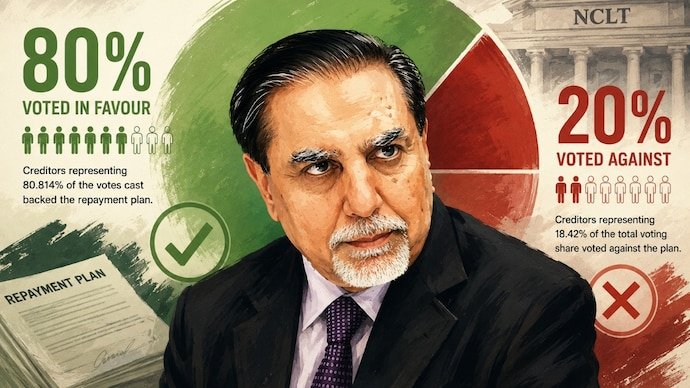
The National Company Law Tribunal’s approval of Subhash Chandra’s repayment plan has put an extraordinary set of numbers at the centre of India’s insolvency debate: admitted claims of about Rs 22,006.57 crore against a personal contribution of Rs 6.25 crore. Yet the headline numbers alone do not explain how the plan was approved, who supported it, or what creditors actually voted against.
The key lies in the creditor voting record. The repayment plan received 77.48% of the total voting share in favour, while 18.42% voted against and creditors representing another 4.10% did not vote. Because abstentions were excluded from the calculation of votes actually cast, the favourable votes amounted to 80.814% of the votes cast.
The NCLT approved the plan on August 25, 2026, in the personal insolvency proceedings involving Chandra, the founder associated with the Essel Group and Zee. The order is significant not only because of the size of the claims but also because it illustrates how a personal-guarantor insolvency case can produce a very different outcome from a conventional corporate debt resolution.
At the same time, the Rs 22,006.57 crore figure should not be interpreted as money Chandra personally borrowed. The claims largely arose from personal guarantees he had provided for borrowings by companies associated with the wider Essel Group. The underlying corporate borrowers remain separately liable for their debts.
How the Subhash Chandra repayment plan was approved
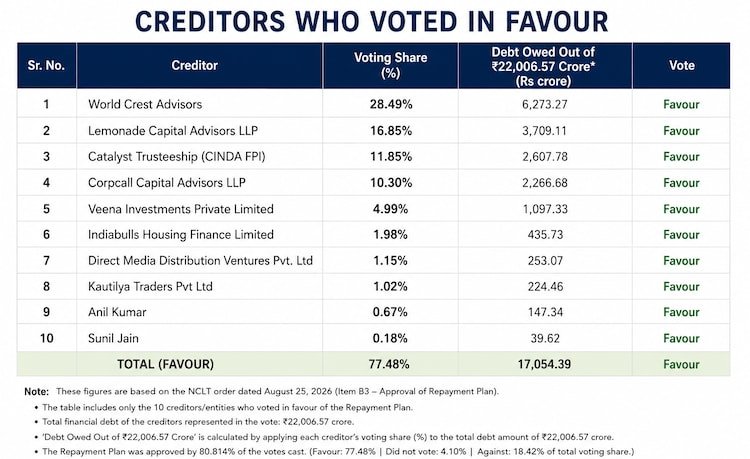
The voting took place in November 2024, with the voting window closing on November 1. The NCLT order records the individual voting positions of creditors under the item concerning approval of the repayment plan.
Ten creditors or creditor entities voted in favour. Seven voted against. Six creditor entries did not vote.
The distinction between the total voting share and votes actually cast is crucial. The 77.48% supporting the plan was calculated against the entire voting share. Once the 4.10% that did not vote is removed, 95.90% of the voting share remains as votes cast. The 77.48% favourable vote therefore becomes 80.814% of the votes actually cast.
| Voting position | Share of total voting share | What it means |
|---|---|---|
| In favour | 77.48% | Creditors supporting the repayment plan |
| Against | 18.42% | Creditors opposing the repayment plan |
| Did not vote | 4.10% | Creditors whose voting share was excluded from votes cast |
| Votes actually cast | 95.90% | Total of votes in favour and against |
| Approval among votes cast | 80.814% | 77.48% divided by 95.90% |
That calculation explains why two different approval percentages appear in reports about the case. There is no contradiction between 77.48% and 80.814%; they use different denominators.
Who voted in favour of Subhash Chandra’s plan?
The strongest support came from a group of creditors and entities that together accounted for 77.48% of the total voting share.
World Crest Advisors held the largest individual voting share at 28.49%. It was followed by Lemonade Capital Advisors LLP with 16.85% and Catalyst Trusteeship (CINDA FPI) with 11.85%.
Corpcall Capital Advisors LLP represented another 10.30%, while Veena Investments Private Limited held 4.99%.
The remaining supporters included Indiabulls Housing Finance Limited with 1.98%, Direct Media Distribution Ventures Pvt Ltd with 1.15%, Kautilya Traders Pvt Ltd with 1.02%, Anil Kumar with 0.67% and Sunil Jain with 0.18%.
| Creditor or entity | Voting share |
|---|---|
| World Crest Advisors | 28.49% |
| Lemonade Capital Advisors LLP | 16.85% |
| Catalyst Trusteeship (CINDA FPI) | 11.85% |
| Corpcall Capital Advisors LLP | 10.30% |
| Veena Investments Private Limited | 4.99% |
| Indiabulls Housing Finance Limited | 1.98% |
| Direct Media Distribution Ventures Pvt Ltd | 1.15% |
| Kautilya Traders Pvt Ltd | 1.02% |
| Anil Kumar | 0.67% |
| Sunil Jain | 0.18% |
The concentration of support is particularly important. The five largest supporters alone accounted for 72.48% of the total voting share. In practical terms, the outcome was therefore heavily influenced by a relatively small number of creditors with substantial voting weights.
Why some creditors challenged the supporters’ right to vote
The voting dispute was not limited to whether the repayment amount was adequate. Dissenting creditors also questioned whether certain entities supporting the plan were associates of Chandra and therefore should have been excluded from voting.
The entities facing that challenge included Veena Investments, Direct Media Distribution Ventures, World Crest Advisors, Lemonade Capital Advisors and Corpcall Capital Advisors.
The NCLT did not accept the challenge. The tribunal found that the objecting creditors had not established that these entities met the statutory definition of an “associate” under the Insolvency and Bankruptcy Code. Their participation and voting rights were therefore not treated as legally impermissible.
This finding mattered enormously because removing a large voting block could have materially changed the balance of the creditor vote. The tribunal’s decision effectively preserved the votes that provided the repayment plan with its majority support.
Which creditors voted against the plan?
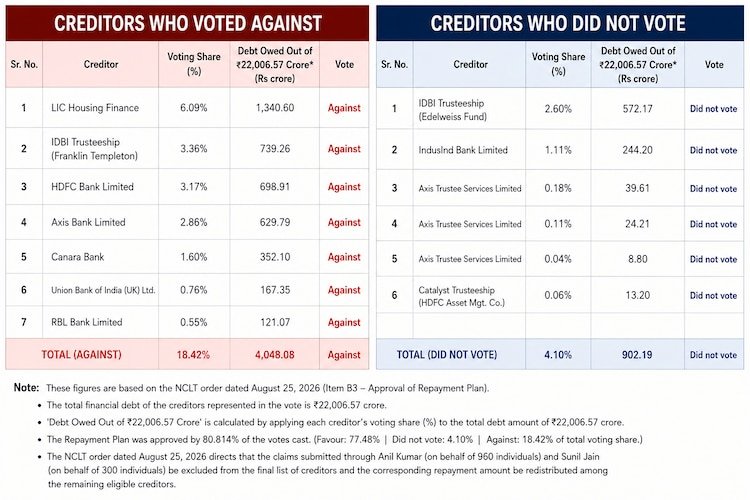
Seven creditors opposed the repayment plan, accounting for 18.42% of the total voting share.
LIC Housing Finance was the largest dissenting creditor, with a voting share of 6.09%. It was followed by IDBI Trusteeship Services, representing the Franklin Templeton interest, at 3.36%; HDFC Bank at 3.17%; and Axis Bank at 2.86%.
Canara Bank accounted for 1.60%, Union Bank of India (UK) Ltd for 0.76% and RBL Bank for 0.55%.
| Creditor | Voting share |
|---|---|
| LIC Housing Finance | 6.09% |
| IDBI Trusteeship Services representing Franklin Templeton interest | 3.36% |
| HDFC Bank | 3.17% |
| Axis Bank | 2.86% |
| Canara Bank | 1.60% |
| Union Bank of India (UK) Ltd | 0.76% |
| RBL Bank | 0.55% |
The opposition was driven largely by concerns over the extremely low recovery offered under the plan. LIC Housing Finance provided one of the clearest illustrations. Its admitted claim was about Rs 1,322.39 crore, while the proposed repayment to it was only Rs 38.09 lakh, equivalent to approximately 0.028% of its admitted claim.
For a lender with a claim of more than Rs 1,300 crore, a recovery measured in tens of lakhs naturally became one of the central arguments against approving the plan.
Why 4.10% of creditors did not vote
Not every creditor took a position on the repayment proposal.
Six creditor entries representing 4.10% of the voting share were recorded as “Did not vote”. They included IDBI Trusteeship Services representing the Edelweiss Fund, with 2.60%; IndusInd Bank, with 1.11%; Catalyst Trusteeship representing HDFC Asset Management, with 0.06%; and three Axis Trustee Services entries holding 0.18%, 0.11% and 0.04% respectively.
These abstentions did not count as votes against the plan. Instead, they reduced the denominator used to calculate the percentage of votes cast. This is why the 80.814% approval figure is higher than the 77.48% share of the entire voting pool that supported the proposal.
What does the Rs 22,006 crore claim actually represent?
The most important piece of context is that the Rs 22,006.57 crore figure does not mean Chandra personally took out a Rs 22,000-crore loan.
Chandra’s exposure arose primarily from personal guarantees attached to loans borrowed by companies linked to the Essel Group. A personal guarantee can make the guarantor liable when the principal borrower fails to meet its obligations, but that does not make the guarantor the original borrower of the entire underlying loan amount.
That distinction is particularly important in this case because the corporate borrowers remain separately responsible for their debts and creditors retain recovery avenues against those borrowers and their assets.
Government sources cited in recent reporting have also pointed to a distinction between guarantees given when loans were originally sanctioned and guarantees later provided as additional Security. According to those reports, only around Rs 2,574 crore of the admitted claims related to loans for which Chandra had provided a personal guarantee at the time of the original borrowing, while many other guarantees were provided subsequently.
As a result, describing the case simply as a Rs 22,000-crore personal loan write-off would give readers the wrong impression.
Why is Chandra paying only Rs 6.25 crore?
The apparent mismatch between Rs 22,006.57 crore of admitted claims and a Rs 6.25-crore personal contribution is at the heart of the controversy.
The tribunal’s reasoning, however, was not based simply on the amount of claims. It considered Chandra’s personal financial position, including the value of his estate and the recovery that creditors could realistically expect through the insolvency process.
The NCLT considered whether rejecting the repayment plan would necessarily produce a better outcome for creditors. One possibility was that Chandra could move toward bankruptcy, but bankruptcy would not automatically mean that creditors would recover the full value of their admitted claims.
The tribunal also relied on the principle that creditors’ commercial judgment has an important role in insolvency proceedings. Where the statutory requirements are satisfied and creditors approve a plan by the required majority, the tribunal does not simply substitute its own commercial assessment for that decision.
That does not mean every creditor agreed with the economics of the settlement. The voting record shows precisely the opposite: several significant institutional lenders considered the proposed recovery inadequate and opposed the plan.
The Rs 6.25 crore payment is not the entire Essel debt recovery
Another point frequently lost in the headline figure is that Chandra’s Rs 6.25-crore contribution relates to his personal insolvency plan. It does not erase the underlying corporate liabilities of the principal borrowers.
The repayment arrangement also involves payments of roughly Rs 1,494 crore by the principal borrowing companies, according to reporting based on the NCLT proceedings.
This means the case should not be understood as creditors collectively receiving Rs 6.25 crore in exchange for cancelling every outstanding Essel-linked liability. The tribunal was dealing with Chandra’s position as a personal guarantor, while the corporate borrowers remain distinct legal entities with their own obligations.
NCLT also changed parts of the creditor list
The tribunal’s August 25 order did more than approve the repayment plan.
It identified a deficiency involving claims submitted through Anil Kumar and Sunil Jain on behalf of hundreds of individuals. The NCLT directed that claims relating to 960 and 300 individuals respectively be excluded from the final creditor list and that the corresponding repayment amount be redistributed among the remaining eligible creditors.
At the same time, the tribunal rejected the broader attempt to disqualify the five entities accused of being associates of Chandra. The distinction is important: the NCLT did not accept every objection raised by dissenting creditors, but neither did it simply approve every aspect of the original creditor composition without scrutiny.
Why HDFC Bank and LIC Housing Finance are opposing the outcome
The controversy is unlikely to end with the NCLT order.
HDFC Bank and LIC Housing Finance are planning to challenge the ruling, according to recent reports. Their opposition reflects a broader concern about the recovery available to lenders when a personal guarantor’s admitted liabilities are substantially larger than the value of the guarantor’s personal estate.
For lenders, the case raises a practical question: how much protection does a personal guarantee actually provide when the guarantor does not have assets sufficient to cover the guaranteed debt?
The answer depends heavily on the guarantor’s assets, the structure of the guarantees, the underlying borrowers, the available security and the recovery prospects in each individual case. A personal guarantee creates a legal obligation, but it does not necessarily create an asset pool capable of satisfying the entire guaranteed amount.
What the Subhash Chandra case means for creditors
The case highlights the difference between the amount claimed and the amount that can realistically be recovered.
An admitted claim establishes the amount recognised within the insolvency process. It does not automatically establish that the debtor possesses assets of equivalent value. In a personal insolvency proceeding, the recoverable amount can be constrained by the debtor’s actual estate and the legal routes available to creditors.
That distinction is particularly relevant when guarantees cover large corporate borrowings. The face value of a guarantee can be enormous compared with the guarantor’s personal wealth.
The case also shows why creditor voting percentages must be read carefully. A plan backed by 80.814% of votes cast did not receive unanimous support. Major financial institutions opposed it, while another 4.10% of the voting share did not vote at all.
The decisive factor was therefore not universal creditor acceptance. It was that the supporting votes were sufficient under the applicable insolvency framework and that the NCLT found the legal objections insufficient to prevent approval.
What happens next in the Subhash Chandra insolvency case?
The immediate next stage is likely to focus on the legal challenges to the NCLT’s decision. HDFC Bank and LIC Housing Finance have indicated that they intend to contest the ruling, putting the approval under further judicial scrutiny.
The broader questions will include whether the tribunal correctly applied the insolvency framework, whether the creditor voting process was valid, whether the disputed entities were properly permitted to vote and whether the repayment plan provides the legally required basis for resolving Chandra’s personal insolvency.
The case could also become an important reference point for understanding personal-guarantor insolvency in India. But it should not automatically be treated as a model for every large corporate debt dispute. The facts of each guarantee, the guarantor’s assets, the principal borrowers and the voting composition of creditors can be very different.
For now, the clearest reading of the numbers is this: Rs 22,006.57 crore represents admitted claims against Chandra in his personal-guarantor insolvency proceedings, while Rs 6.25 crore is his proposed personal contribution under the approved repayment plan. The plan passed because creditors holding 77.48% of the total voting share supported it, translating to 80.814% of the votes actually cast.
The lenders who opposed it have not disappeared from the story. HDFC Bank, LIC Housing Finance and other dissenting creditors continue to challenge the outcome. That means the Rs 22,000-crore versus Rs 6.25-crore headline may be only the beginning of the legal and financial debate surrounding Subhash Chandra’s insolvency case.
For breaking news and live news updates, like us on Facebook or follow us on Twitter and Instagram. Read more on Latest World on thefoxdaily.com.


COMMENTS 0