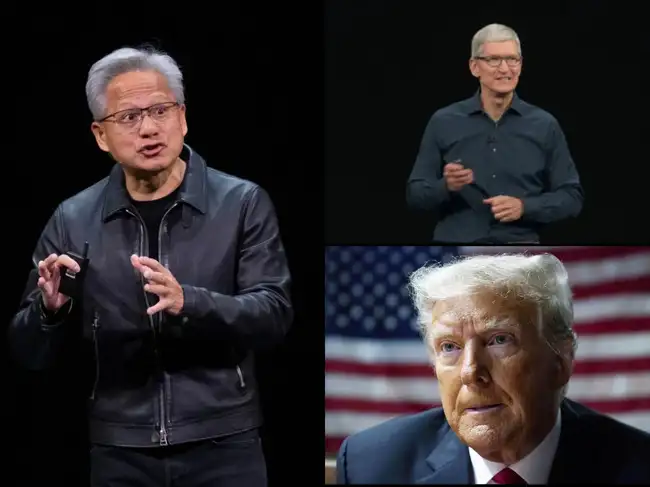
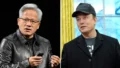
US President Donald Trump has suggested that former Apple CEO Tim Cook should replace Jensen Huang as the next chief executive of Nvidia, bringing one of the technology industry’s most influential business leaders into the spotlight amid a sudden leadership shake-up at the AI chipmaker.
Trump described Cook as a “legend” and praised his record at Apple, suggesting that he could be a suitable replacement for Huang. The comments came on Thursday, November 12, after Huang resigned as Nvidia’s chief executive and a member of its board with immediate effect.
Cook stepped down as Apple’s CEO on September 1, 2026, after leading the iPhone maker for 15 years. He now serves as executive chairman of Apple’s board, while John Ternus has taken over as chief executive.
Cook’s possible association with Nvidia would represent a major development in the technology industry. He previously took charge of Apple following the departure of its legendary co-founder Steve Jobs and transformed the company into one of the world’s most valuable businesses.
Why Donald Trump Wants Tim Cook to Replace Jensen Huang
Trump’s suggestion followed Huang’s unexpected departure from Nvidia. The president praised Cook’s leadership experience and described him as a legendary business figure who could potentially take over the world’s leading AI chipmaker.
However, Trump’s comments do not amount to a formal appointment or indicate that Cook has agreed to take the position. Nvidia’s board is responsible for selecting the company’s next permanent chief executive, and the process of identifying a successor is still under way.
Huang’s resignation followed reports about his personal relationships and allegations involving a Chinese businesswoman whom US authorities reportedly suspected of having links to Chinese intelligence. The reports prompted questions about possible national security implications and led Nvidia’s board to initiate an independent investigation.
Huang has denied knowingly participating in any espionage activity. The allegations surrounding the businesswoman have not been independently established as proof that Nvidia’s confidential information or US national security was compromised.
Nvidia has appointed its chief financial officer, Colette Kress, as interim CEO while the board searches for a permanent replacement. The company said it would consider both internal and external candidates.
Who Is Tim Cook? A Look at His Early Life and Education
Timothy Donald Cook was born on November 1, 1960, in Robertsdale, Alabama, United States. He grew up in a working-class family. His father, Donald Cook, worked at a shipyard, while his mother, Geraldine Cook, was employed at a drugstore.
Cook developed an interest in engineering and technology during his early years. He attended Robertsdale High School, where he performed exceptionally well academically and graduated in 1978.
He subsequently enrolled at Auburn University in Alabama, earning a Bachelor of Science degree in industrial engineering in 1982. His education provided a foundation for the operations and supply-chain career that would eventually define much of his professional life.
Cook later pursued a Master of Business Administration degree at Duke University’s Fuqua School of Business, graduating in 1988 as a Fuqua Scholar. The distinction is awarded to students who achieve strong academic results in their MBA programme.
Unlike technology executives who begin their careers developing software or designing computer hardware, Cook built his reputation through business operations, manufacturing, logistics and supply-chain management.
Tim Cook’s Career Before Joining Apple
After completing his education, Cook began working at IBM, where he spent approximately 12 years. He gradually moved into senior management positions and eventually became director of North American fulfilment for the company’s personal computer business.
His responsibilities included overseeing manufacturing and distribution operations across North and Latin America. The experience gave him a detailed understanding of how large technology companies manage production, inventory and global supply networks.
In 1994, Cook left IBM to join Intelligent Electronics, where he became chief operating officer of its reseller division. Three years later, he moved to Compaq Computer Corporation as vice president of corporate materials, responsible for managing product procurement and inventory.
His time at Compaq was relatively short. In 1998, Apple co-founder Steve Jobs recruited him to join Apple as senior vice president of worldwide operations.
The decision was significant because Apple was struggling financially at the time. The company was attempting to reorganise its business and compete more effectively in the personal computer market.
Cook accepted the opportunity despite concerns about Apple’s uncertain future. His expertise in operations and supply-chain management would soon become an important part of the company’s turnaround.
How Steve Jobs Chose Tim Cook to Join Apple
When Cook joined Apple in March 1998, Steve Jobs had returned to the company and was working to rebuild its product strategy and financial position.
Jobs was widely recognised for his product vision, design philosophy and ability to create consumer technology that attracted global attention. Cook brought a different set of strengths, particularly in manufacturing efficiency, inventory management and supplier relationships.
Cook helped Apple improve the way it organised production and managed its global supply chain. His approach focused on making operations more efficient, reducing unnecessary inventory and ensuring that the company could respond to changing demand.
He later became executive vice president of worldwide sales and operations and was appointed chief operating officer in 2005. In that position, he managed important aspects of Apple’s worldwide operations, including sales, distribution, customer support and supply-chain activities.
His relationship with Jobs also developed during this period. Although the two executives had different leadership styles, Cook became one of the most important figures in Apple’s senior management team.
Tim Cook Replaced Steve Jobs as Apple CEO in 2011
In August 2011, Steve Jobs resigned as Apple’s chief executive officer after facing serious health challenges. The company’s board appointed Cook, who had been serving as chief operating officer, to take over the position.
Jobs remained involved with Apple as chairman of the board. However, he died on October 5, 2011, less than two months after Cook became CEO.
Cook therefore inherited the responsibility of leading Apple after the departure of a co-founder whose personality and creative vision had become closely associated with the company’s identity.
The transition attracted considerable attention because investors and technology observers questioned whether Apple could maintain its product momentum without Jobs leading the company.
Cook’s leadership approach differed from that of his predecessor. Rather than building his public identity around product presentations and personal creative direction, he focused heavily on execution, operational discipline, expanding existing businesses and strengthening Apple’s international presence.
Over time, Apple continued to introduce new products and services while expanding its existing product categories. Cook’s tenure demonstrated that the company could maintain its position as a major technology business under a leadership style different from Jobs’.
How Tim Cook Transformed Apple During His 15-Year Tenure
Cook led Apple from 2011 until September 2026, overseeing a period of substantial financial growth and business expansion.
When he became CEO, Apple’s annual revenue stood at approximately $108 billion for fiscal 2011. By fiscal 2025, the company’s annual revenue had exceeded $416 billion, according to Apple’s published figures.
Its market capitalisation also increased from approximately $350 billion when Cook took charge to around $4 trillion by the time of the leadership transition announced in 2026.
Several important developments shaped Apple’s business during his tenure:
- Apple Watch: Apple entered the smartwatch market with the Apple Watch in 2015, creating a major new product category focused on fitness, communication and health-related features.
- AirPods: The company expanded its accessories business with wireless earbuds that became an important part of its broader device ecosystem.
- Apple Services: Cook oversaw the expansion of services such as Apple Music, Apple TV, iCloud and Apple Pay. Apple’s services business grew into a major source of recurring revenue.
- Apple Silicon: Apple transitioned its Mac computers towards processors designed in-house, giving the company greater control over hardware and software integration.
- Apple Vision Pro: The company entered spatial computing with its mixed-reality headset, opening another product category beyond its established devices.
- International expansion: Apple increased its presence in international markets, expanding its global customer base and distribution network.
Cook also placed significant emphasis on privacy, accessibility and environmental commitments. Apple expanded its efforts to reduce its carbon footprint while making privacy and security important parts of its public positioning.
His achievements helped establish him as one of the most influential corporate leaders in the technology industry, even though his approach was often more focused on operational execution than the product-led public image associated with Jobs.
Why Tim Cook Stepped Down as Apple’s CEO in September 2026
Apple announced its leadership transition on April 20, 2026, confirming that Cook would become executive chairman of the board and John Ternus would succeed him as chief executive on September 1.
The transition followed a long-term succession-planning process approved by Apple’s board. Cook continued as CEO through the summer before formally handing over responsibility to Ternus.
Ternus had served as Apple’s senior vice president of hardware engineering and had spent more than two decades at the company. His experience in product development and engineering made him an internal successor with extensive knowledge of Apple’s operations and product strategy.
Cook praised Ternus as the right person to lead Apple into its next phase. He also confirmed that he would continue contributing to the company in his new position.
As executive chairman, Cook remains involved in selected areas of Apple’s work, including engagement with policymakers around the world. He has not retired from the company and continues to hold a senior board position.
Could Tim Cook Actually Become Nvidia’s Next CEO?
Trump’s suggestion has generated interest because Cook has extensive experience leading a global technology company. However, taking over Nvidia would involve a different set of responsibilities from those he handled at Apple.
Apple’s business centres on consumer electronics, software, services and an integrated hardware ecosystem. Nvidia, meanwhile, has become a central supplier of graphics processing units, AI accelerators, networking technology and computing systems used by data centres and artificial intelligence companies.
The companies also have different operational and technical priorities. Cook’s experience managing Apple’s manufacturing partnerships and global supply chain could be relevant to Nvidia, particularly as demand for advanced AI chips continues to grow.
However, Nvidia’s next chief executive would also need to manage relationships with major cloud providers, semiconductor manufacturers, governments, research institutions and customers developing large-scale AI systems.
Cook has experience dealing with governments and international business regulations, but there is no public indication that he has expressed interest in taking over Nvidia.
Neither Cook nor Apple immediately commented on Trump’s suggestion. Nvidia’s board has begun looking for a permanent successor following Huang’s resignation, and there is no confirmed indication that Cook is part of its formal succession process.
Who Is Running Nvidia After Jensen Huang’s Resignation?
Nvidia has appointed Colette Kress, its longtime chief financial officer, as interim chief executive officer. She will continue in her finance role while temporarily leading the company until a permanent successor is selected.
Kress joined Nvidia in September 2013 and has overseen the company’s financial organisation during a period of major expansion. Her appointment provides continuity while the board evaluates potential candidates from inside and outside the company.
The board has also appointed Harvey C. Jones as its first-ever chairman. Jones is expected to play a role in overseeing the company’s leadership transition and the search for a permanent CEO.
Huang’s departure marks a major change for Nvidia because he co-founded the company in 1993 and led it for more than three decades. Under his leadership, Nvidia evolved from a graphics-chip manufacturer into one of the most important suppliers of computing hardware for artificial intelligence.
The company now occupies a central position in the global AI industry, with its processors used in data centres, advanced computing systems and AI development infrastructure.
Trump’s Relationship With Tim Cook and Jensen Huang
Trump has maintained contact with prominent technology executives during his administration, particularly those involved in artificial intelligence, semiconductor manufacturing and investment in the United States.
Cook has previously engaged with Trump on Apple’s manufacturing and investment plans. In 2025, Apple announced an additional $100 billion investment commitment in US manufacturing, bringing its stated four-year US investment commitment to $600 billion.
Cook also presented Trump with a commemorative plaque connected to Apple’s investment announcement. The interaction illustrated the company’s efforts to maintain communication with the administration on manufacturing, trade and other business issues.
Huang has also developed a close relationship with Trump. Nvidia’s chief executive has met the president and advocated for policies that would allow American semiconductor companies to compete internationally, including in the Chinese market.
Trump has previously praised Huang’s leadership and discussed the importance of maintaining US competitiveness in artificial intelligence. The president’s latest comments therefore come after a period in which Huang was viewed as an important technology-industry contact for the administration.
What Tim Cook’s Possible Move Could Mean for the Technology Industry
Although Trump’s suggestion does not establish that Cook will join Nvidia, the possibility raises questions about the future direction of one of the world’s most important AI companies.
Nvidia’s next CEO will inherit a business operating at the centre of the global artificial intelligence boom. Demand for advanced chips has expanded as technology companies invest in data centres, AI models, cloud computing and specialised infrastructure.
The company must also navigate competition, supply-chain constraints, export restrictions and growing scrutiny of the strategic importance of advanced semiconductors.
A leader with Cook’s experience in global operations and government relations could bring a different management perspective. At the same time, Nvidia’s board will need to consider the technical, strategic and organisational requirements of leading a semiconductor company whose products are closely tied to the future of AI computing.
For now, Colette Kress remains Nvidia’s interim CEO, while the board searches for a permanent replacement. Cook continues to serve as Apple’s executive chairman under John Ternus, and Trump’s suggestion remains a proposal rather than an announced leadership decision.
The coming weeks should provide more clarity about Nvidia’s succession plans and whether the company intends to appoint an internal executive or bring in an outside leader. Until then, Cook’s name adds an unexpected dimension to a major leadership transition in the global technology industry.
For breaking news and live news updates, like us on Facebook or follow us on Twitter and Instagram. Read more on Latest World on thefoxdaily.com.

COMMENTS 0