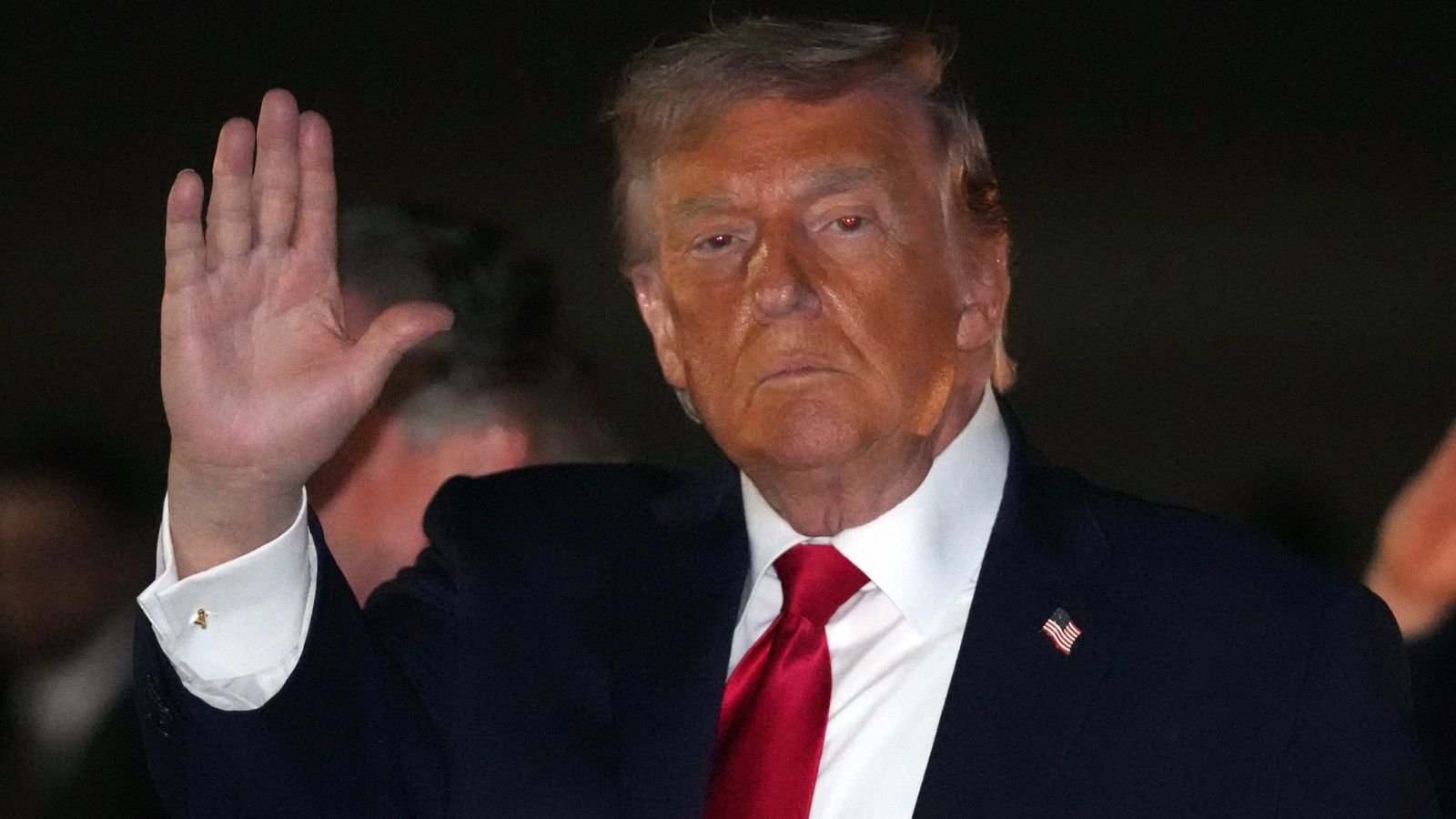
US President Donald Trump has confirmed that he was secretly moved from the aircraft he had been travelling on after leaving Turkiye last month because of a security threat. Trump said the Secret Service and military officials wanted him to board a different plane, but he offered few details about the Nature of the threat or how the decision was made.
His comments followed a Washington Post report describing an unusually complex security operation after the NATO summit in Turkiye. The report said the threat was linked to Iran and that Trump was transferred to another aircraft while the presidential plane continued its journey as a decoy.
The episode is notable not simply because a US president was moved for security reasons. American presidents have previously made secret overseas trips, travelled on unmarked aircraft and used decoys. What makes this case unusual is the combination of a concealed aircraft switch, the president’s separation from the travelling press pool and the fact that the operation remained undisclosed for weeks.
What Trump said about the aircraft switch
Speaking to reporters after returning from an event in Ohio, Trump acknowledged that he had been moved to another aircraft because officials believed there was a threat.
Trump said the decision was made by the Secret Service and military personnel rather than by him. He indicated that he did not ask for extensive details and treated the incident as part of the risks associated with being president.
Trump said he was told to use a “different flight, different plane” and acknowledged that there was apparently a threat. He also said he believed the aircraft he had originally been travelling on may have been at greater risk.
The president did not describe the specific threat, identify its source in his own remarks or explain what intelligence had prompted the security change. The available account instead links the operation to a reported credible threat from Iran.
Trump also sought to play down any personal concern about the incident, saying that he was not frightened and that threats against him were not unusual.
How the secret plane operation reportedly unfolded
The operation involved considerably more than simply transferring Trump from one aircraft to another.
According to the report that preceded Trump’s confirmation, the president was moved through an airport catering vehicle and taken to another government aircraft. The original presidential aircraft then departed, creating the appearance that Trump remained aboard.
Trump later stopped in Britain before secretly returning to the aircraft associated with his presidential travel. The unusual sequence was designed to conceal his actual location while the security operation was under way.
For a presidential security detail, aircraft movements can become sensitive information. The location of the president, the aircraft being used, the timing of departures and the identities of people travelling with him can all provide information that hostile actors could potentially exploit.
That helps explain why presidential travel plans are often protected until a visit is safely under way or completed. However, the reported operation went further because the public and travelling journalists were initially unaware that Trump was no longer aboard the aircraft that appeared to be carrying him.
Why the aircraft itself became part of the security concern
The circumstances surrounding Trump’s aircraft also added another layer to the episode.
Trump had arrived in the region aboard a luxury aircraft gifted by Qatar. The source material notes that the aircraft did not contain some of the missile detection and countermeasure capabilities associated with older presidential aircraft.
That distinction matters because presidential aircraft are not simply transportation. They are also designed around security, communications and continuity-of-government requirements. Any decision to move a president between aircraft therefore involves more than choosing another plane for convenience.
In this case, the security concern reportedly led officials to use a smaller government aircraft for part of the journey. Trump was later able to return to the presidential aircraft without the change becoming publicly apparent at the time.
The precise assessment behind the aircraft switch remains unclear from the information available. Neither Trump nor the supplied account provides enough detail to establish exactly what intelligence triggered the decision or what specific danger officials believed they were addressing.
The unusual issue: the press pool was left behind
One of the most consequential aspects of the episode concerns the White House press corps.
Presidential reporters normally travel as part of a press pool. The arrangement serves an obvious journalistic purpose: reporters accompanying the president can independently document where the president is, what he does and whether official accounts match what actually happened.
During the aircraft switch, however, the press pool remained connected to the aircraft that was being used as the decoy.
That created an unusual situation. Journalists travelling with the president were, for a period, unable to independently confirm his location. Trump himself had earlier responded to a question about the danger by telling reporters, “If I go, you go?” even though he was no longer aboard the aircraft serving as the decoy.
Garrett M. Graff, author of Raven Rock: The Story of the US Government’s Secret Plan to Save Itself – While the Rest of Us Die, argued that the press pool has a broader role than simply reporting presidential events. He described independent press access as part of protecting the presidency and democratic accountability.
The disagreement is therefore not necessarily about whether presidential security should remain secret. It is about how much secrecy can be maintained while still preserving an independent means of confirming the president’s whereabouts and activities.
Secret presidential travel is not new
The United States has a long history of keeping presidential movements secret when security conditions require it.
Presidents have travelled to conflict zones without advance public disclosure, used aircraft that were not immediately identifiable and employed decoy arrangements to reduce the possibility of an attack.
In 2023, President Joe Biden made a secret trip to Kyiv during Russia’s war against Ukraine. He travelled to Poland on an Air Force C-32 and then continued by train to the Ukrainian capital. Two journalists travelled with him and documented the visit.
Trump himself used a decoy arrangement during his first presidency for a secret 2019 visit to Afghanistan. A separate press pool was used while he travelled to Bagram, allowing reporters to cover the trip without revealing his movements beforehand.
George W. Bush’s 2003 trip to Iraq and Barack Obama’s 2010 visit to Afghanistan were also conducted under tight secrecy because of the security risks surrounding presidential travel to active or potentially dangerous areas.
These examples show that secrecy itself is not unprecedented. The distinction in Trump’s latest trip lies in how the secrecy reportedly continued even after the operation was under way and in the fact that the normal press pool was not in a position to independently verify the president’s location.
Earlier presidential decoys followed different rules
There are also historical examples of presidential misdirection involving aircraft.
In 2000, President Bill Clinton secretly travelled from India to Pakistan after appearing to board one military aircraft and then moving onto another nearby. Multiple aircraft were involved in the deception, including one painted to resemble Air Force One.
But Clinton’s former press secretary, Joe Lockhart, later emphasized an important difference. Reporters had been briefed about the arrangement and understood that Clinton would not actually be aboard the aircraft they were following.
The distinction illustrates why the press-access controversy surrounding Trump’s operation is separate from the basic question of whether deception can be used for presidential protection.
The United States has also faced situations in which presidential whereabouts had to be concealed during emergencies. On September 11, 2001, President George W. Bush was moved between military bases while authorities worked to protect him and eventually return him to Washington.
In that case, the White House did not publicly create the impression that Bush was somewhere he was not in order to maintain a normal presidential press operation. The circumstances were different, but the comparison highlights the difficult balance between security and accurate public accountability.
Why presidential location matters beyond journalism
The concern raised by the episode extends beyond whether reporters can publish a story.
Knowing the president’s actual location can be important to the functioning of government. The president is the head of the executive branch and the commander in chief of the US military. During a crisis, uncertainty about where the president is, who is travelling with him and what communications are available can have implications that go beyond ordinary media coverage.
That does not mean every presidential movement should be disclosed in real time. Doing so could expose security vulnerabilities and make travel more predictable. The challenge is establishing a system in which security personnel can conceal sensitive movements while some trusted mechanism remains available to independently verify presidential status.
Graff pointed to the potential consequences if nobody outside the security operation could independently establish where the president was or who was exercising presidential authority. Such a situation, even if temporary, could become dangerous during a fast-moving international crisis.
What remains unclear about the Iran threat
Trump’s confirmation establishes that officials moved him because they believed there was a threat. It does not establish the full nature of that threat.
Several important questions remain unanswered, including what intelligence prompted the decision, how officials assessed the credibility of the threat, whether it specifically targeted Trump or the aircraft, and how long the security concern was expected to last.
The supplied account also does not establish whether the threat resulted in any additional security measures beyond the aircraft switch.
Those details may remain classified because revealing them could expose intelligence sources, surveillance capabilities or security procedures. For that reason, the absence of information should not automatically be interpreted as evidence that officials acted improperly.
At the same time, the lack of public information makes it difficult to independently assess how necessary each element of the operation was. That tension is likely to remain central to the debate over the episode.
What the incident means for presidential security
The episode demonstrates how quickly presidential travel arrangements can change when security officials identify a credible risk. It also shows why aircraft selection, route planning, communications and press access are interconnected rather than separate issues.
For the Secret Service and military, the immediate priority is protecting the president. For the White House press corps, the priority is maintaining independent access and preventing the government from becoming the sole source of information about presidential movements and actions.
Those priorities can conflict, particularly during an alleged threat involving a foreign adversary.
The most important lesson may therefore be procedural rather than political. Secret presidential travel is likely to remain necessary in certain circumstances. But the arrangements used to protect the president can still be examined afterward, particularly when they affect the ability of independent journalists to establish basic facts about presidential activity.
What could happen next
The next significant development will likely depend on whether the administration provides more information about the reported threat and the decision-making behind the aircraft switch.
If additional details emerge, they could clarify whether the operation represented a routine application of presidential security protocols or an unusually broad response to a specific intelligence warning.
The controversy over press access may also continue independently of the threat itself. Even if the security decision is ultimately accepted as necessary, questions about whether and how a press pool should accompany or independently track the president during such operations are likely to remain.
For now, the confirmed facts are relatively limited: Trump was moved to another aircraft after leaving Turkiye, officials cited a threat, the operation was kept secret, and the president later returned to his presidential aircraft. The broader questions about the threat, the security assessment and the decision to separate Trump from the normal press pool remain unresolved.
Trump plane switch puts security and transparency in the spotlight
Trump’s confirmation turns what had been a reported secret operation into an acknowledged episode in presidential travel. The use of another aircraft and a decoy flight is not without precedent in US presidential history. What makes this case stand out is the reported combination of a foreign security threat, a complex aircraft switch and the temporary loss of independent press access to the president.
The incident ultimately highlights an enduring problem in presidential security: the safest way to move a president may sometimes be the least transparent way to do it. The challenge for the White House is ensuring that necessary secrecy does not eliminate the independent mechanisms that allow the public, Congress and the press to establish what happened.
For breaking news and live news updates, like us on Facebook or follow us on Twitter and Instagram. Read more on Latest World on thefoxdaily.com.


COMMENTS 0