- What Happened During the Idaho Air Show Crash?
- What Is the EA-18G Growler?
- Why Military Air Shows Are Inherently Risky
- How Rare Are Mid-Air Collisions at Air Shows?
- The Importance of the Successful Ejection
- Why the Incident Matters Beyond Idaho
- Mountain Home Air Force Base’s Aviation History
- The Psychology of Air Show Spectacles
- Could Air Show Safety Rules Change?
- Social Media’s Role in Modern Aviation Incidents
- Conclusion
A dramatic mid-air collision involving two US Navy EA-18G Growler fighter jets during an air show in Idaho has once again highlighted the razor-thin margins between precision flying and catastrophe in Military aviation displays.
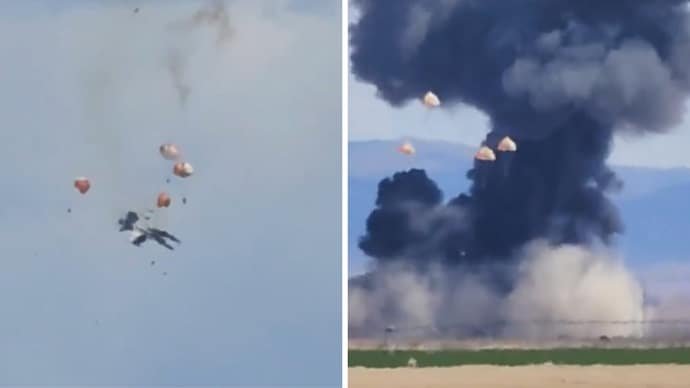
The crash occurred during the Gunfighter Skies Air Show at Mountain Home Air Force Base on Sunday afternoon, sending shockwaves through thousands of spectators who watched the two aircraft collide in the sky before exploding into debris.
Videos circulating online captured the terrifying moment the jets struck each other during an aerial maneuver. Seconds later, parachutes appeared in the sky as all four crew members successfully ejected before the aircraft crashed to the ground.
While no fatalities were reported, the incident has reignited debate over air show safety, the risks associated with complex aerial demonstrations, and the increasing operational pressures facing military aviation teams.
What Happened During the Idaho Air Show Crash?
BREAKING: 2 U.S. Navy Super Hornets/Growlers crash and collide during Gunfighter Skies Air Show at Mountain Home Air Force Base in Idaho.
Aviation sources tell KTVB that both aircrews ejected safely. pic.twitter.com/GPsdrwTFWq
— Open Source Intel (@Osint613) May 17, 2026
The incident unfolded shortly after 12:30 pm local time during the Gunfighter Skies Air Show at Mountain Home Air Force Base in Idaho.
The aircraft involved were two EA-18G Growler electronic warfare jets highly sophisticated military aircraft used by the US Navy for electronic attack missions, radar jamming, and battlefield support.
According to witnesses and video footage, the two jets collided mid-air during a coordinated aerial display.
Moments after impact:
- The aircraft broke apart in the air
- Smoke and debris became visible above the base
- Emergency response teams rushed toward the crash zone
- Four parachutes were seen descending safely
- The remaining air show events were immediately canceled
The jets reportedly crashed around two miles outside the base perimeter.
Authorities later confirmed that all four crew members safely ejected from the aircraft.
What Is the EA-18G Growler?
The EA-18G Growler is one of the US Navy’s most advanced electronic warfare aircraft.
Built by Boeing and based on the F/A-18 Super Hornet platform, the aircraft plays a critical role in modern warfare by disrupting enemy radar, communications, and air defense systems.
| EA-18G Growler Specifications | Details |
|---|---|
| Primary Role | Electronic warfare aircraft |
| Manufacturer | Boeing |
| Crew | 2 personnel per aircraft |
| Capabilities | Radar jamming, electronic attack, surveillance |
| Based On | F/A-18 Super Hornet |
| Operator | US Navy |
Unlike standard fighter jets focused mainly on combat missions, the Growler specializes in controlling the electromagnetic battlefield.
That makes it one of the most strategically important aircraft in modern military operations.
Why Military Air Shows Are Inherently Risky
Military air shows may look effortless to spectators, but they involve some of the most technically demanding flying conditions in aviation.
Pilots often operate:
- At extremely close distances
- At high speeds
- Under precise timing requirements
- During complex synchronized maneuvers
- With limited reaction windows
Even tiny errors can become catastrophic within seconds.
In many cases, pilots are flying only meters apart while traveling hundreds of kilometers per hour.
That leaves virtually no room for miscommunication or mechanical failure.
Experts often compare aerial demonstration flying to “precision choreography in the sky,” except with military-grade aircraft carrying enormous momentum and fuel loads.
How Rare Are Mid-Air Collisions at Air Shows?
Mid-air collisions involving military aircraft at public air shows are relatively rare, but when they occur, they attract enormous attention because of their dramatic nature and the potential for mass casualties.
Several factors usually contribute to such incidents:
- Pilot misjudgment
- Mechanical failure
- Loss of situational awareness
- Communication breakdowns
- Unexpected maneuver timing
- Environmental conditions
Investigators will now likely examine:
- Flight data
- Radio communications
- Aircraft maintenance records
- Pilot coordination procedures
- Air show choreography plans
The US Navy and Air Force traditionally conduct extremely detailed investigations after any aviation accident, particularly those involving advanced military aircraft.
The Importance of the Successful Ejection
One of the most remarkable aspects of the crash was the successful ejection of all four crew members.
Modern military ejection systems are designed to save pilots during catastrophic emergencies occurring within fractions of a second.
However, ejecting from a fast-moving aircraft remains incredibly dangerous.
Pilots face risks including:
- Extreme physical force
- Spinal injuries
- Head trauma
- Parachute malfunctions
- Ground impact injuries
That all four crew members survived strongly suggests that the ejection systems functioned exactly as designed and that the pilots reacted with exceptional speed.
Military aviation experts often note that successful ejections are rarely “routine.”
They represent years of intensive emergency-response training executed under enormous pressure.
Why the Incident Matters Beyond Idaho
The Idaho crash is not just a local aviation story.
It touches broader issues surrounding:
- Military readiness
- Pilot training demands
- Aviation safety standards
- Public military demonstrations
- Operational pressure on defense forces
Modern military pilots already operate under intense workloads.
Many air forces globally are facing:
- Pilot shortages
- High operational tempos
- Aging aircraft fleets
- Growing maintenance pressures
- Increasing geopolitical tensions
Although there is no evidence linking those issues directly to the Idaho crash, incidents like this inevitably raise questions about whether military aviation systems are being stretched too thin.
Mountain Home Air Force Base’s Aviation History
Mountain Home Air Force Base has long been associated with major military aviation events and training exercises.
The base plays a significant role in US Air Force operations and frequently hosts advanced aircraft demonstrations.
However, the location has also witnessed serious aviation accidents in the past.
Previous incidents include:
- A Thunderbirds crash during a 2003 air show
- A fatal hang glider accident in 2018
- Multiple historical training-related aviation incidents
Military aviation, by its nature, involves higher levels of risk than commercial aviation.
Aircraft are pushed closer to performance limits, pilots train for combat scenarios, and operational demands are far more aggressive.
That reality means even well-managed air shows carry unavoidable dangers.
The Psychology of Air Show Spectacles
Despite the risks, military air shows remain enormously popular worldwide.
They serve multiple purposes:
- Public engagement
- Recruitment
- National pride
- Technological showcasing
- Pilot skill demonstration
For many spectators, these events provide rare close-up exposure to advanced military aircraft and highly trained aviation teams.
But incidents like the Idaho collision also expose the hidden danger behind the spectacle.
What appears graceful from the ground often involves split-second calculations performed under extreme physical and psychological pressure.
Could Air Show Safety Rules Change?
The investigation into the Idaho crash could potentially influence future military air show procedures.
Possible areas of review may include:
- Minimum aircraft separation distances
- Formation maneuver protocols
- Risk assessment procedures
- Pilot briefing requirements
- Emergency response coordination
Historically, major aviation accidents often lead to procedural reforms.
Even when pilots survive, investigations typically aim to identify systemic vulnerabilities before another incident occurs.
Military organizations place enormous emphasis on learning from accidents because aviation failures can have both operational and public-relations consequences.
Social Media’s Role in Modern Aviation Incidents
The Idaho collision also demonstrates how social media has transformed public awareness of aviation accidents.
Within minutes of the crash:
- Videos spread online globally
- Witness footage circulated across platforms
- Real-time speculation exploded online
- Aviation analysts began examining footage frame-by-frame
In earlier decades, military investigations often unfolded privately over weeks or months.
Today, public analysis begins almost instantly.
This creates both advantages and challenges:
- Faster public awareness
- Greater transparency pressure
- Rapid misinformation risks
- Intense scrutiny of military operations
Modern military organizations increasingly operate under a digital microscope where every incident becomes globally visible within minutes.
Conclusion
The mid-air collision involving two EA-18G Growler fighter jets during Idaho’s Gunfighter Skies Air Show could have ended in catastrophe.
The successful ejection of all four crew members prevented what might otherwise have become one of the deadliest military air show accidents in recent years.
But the incident also serves as a stark reminder of the enormous risks behind military aviation displays.
Air shows are designed to inspire awe, showcase technological superiority, and celebrate pilot skill. Yet they also operate at the edge of precision, where even a momentary miscalculation can become disastrous.
As investigators examine what caused the Idaho collision, the aviation world will be watching closely not only to understand what went wrong, but to determine whether broader lessons about military air show safety need to be learned.
Because in modern aviation, survival alone is never considered the end of the story. It is usually the beginning of a much larger investigation.
For breaking news and live news updates, like us on Facebook or follow us on Twitter and Instagram. Read more on Latest World on thefoxdaily.com.




COMMENTS 0