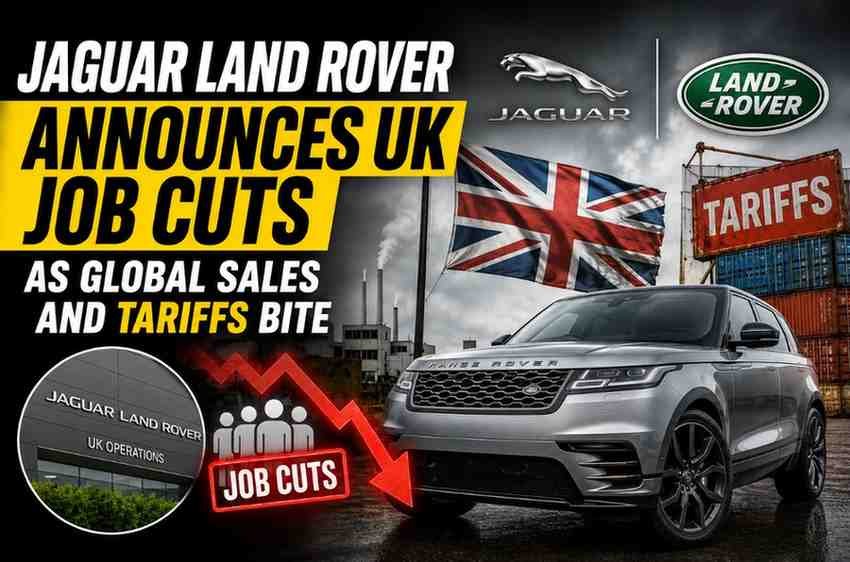
- Why Jaguar Land Rover Is Cutting Jobs
- US Tariffs Added Fresh Pressure on JLR
- The Bigger Problem: The EV Transition Is Expensive
- Jaguar’s Reinvention Comes With Risk
- Why Britain’s Auto Industry Is Under Pressure
- What This Means for Employees
- Can JLR Recover Strongly?
- How JLR’s Situation Reflects the Entire Auto Industry
- What Happens Next?
- Conclusion
Jaguar Land Rover (JLR) has announced plans to reduce up to 500 jobs in the United Kingdom through a voluntary redundancy programme, highlighting the growing pressure facing global automakers in 2026. The move comes at a time when the British luxury carmaker is dealing with weaker international sales, fresh tariff disruptions in the United States, and the expensive transition toward an all-electric future.
While the cuts represent roughly 1.5 per cent of JLR’s UK workforce, the decision carries significance far beyond the numbers. It reflects how even premium automotive brands are being forced to rethink operations as geopolitical uncertainty, slowing consumer demand, and electric vehicle investments reshape the industry.
The layoffs are expected to primarily affect management-level roles and are being positioned as voluntary redundancies rather than compulsory job losses. Still, the announcement has intensified concerns about the future of traditional automotive Manufacturing in Britain, especially as companies face mounting pressure from both governments and investors to accelerate electrification.
Why Jaguar Land Rover Is Cutting Jobs
JLR says the restructuring is designed to align the company with its “current and future business needs.” But beneath the corporate language lies a combination of economic and industry-wide challenges that are hitting automakers globally.
The biggest immediate issue has been declining sales across key markets. During the first half of 2025, JLR reported a 4.4 per cent fall in global deliveries, dropping to 198,699 vehicles. Some regions performed significantly worse:
| Market | Sales Performance | Key Challenge |
|---|---|---|
| United Kingdom | Down 11.2% | Weak consumer demand and economic pressure |
| China | Down 15.1% | Intense EV competition and slower luxury spending |
| United States | Stable volumes | Tariff disruptions and shipping uncertainty |
china’s slowdown is particularly important because the country has historically been one of the largest growth drivers for luxury automotive brands. However, domestic Chinese EV manufacturers are now aggressively competing in both Technology and pricing, making life harder for foreign premium brands.
Meanwhile, UK consumers are also becoming more cautious about high-ticket purchases due to inflationary pressures and economic uncertainty.
US Tariffs Added Fresh Pressure on JLR
One of the biggest short-term shocks came from the United States, JLR’s single largest market globally. Earlier this year, the company temporarily halted shipments to North America after the US administration imposed a 25 per cent tariff on British-made vehicles.
Although the tariff was later reduced to 10 per cent for the first 100,000 imported vehicles, the damage had already disrupted supply chains and sales planning.
For a company heavily dependent on exports, sudden tariff changes can create massive uncertainty. Automakers work with long production cycles, global parts networks, and carefully timed deliveries. Even a few weeks of disruption can affect dealer inventories, customer orders, and revenue forecasts.
The tariff issue also reveals a larger trend reshaping the global automotive sector: Politics and trade policy are becoming just as important as engineering and design.
Luxury carmakers that once focused mainly on product innovation are now increasingly forced to navigate international trade tensions, localisation rules, and supply-chain security concerns.
The Bigger Problem: The EV Transition Is Expensive
JLR’s restructuring also reflects the financial burden of transitioning from petrol and diesel vehicles to electric mobility.
Jaguar has already committed to becoming an all-electric luxury brand, a move that requires billions of dollars in investment across:
- Battery technology
- Electric vehicle platforms
- Software systems
- Charging infrastructure partnerships
- Manufacturing upgrades
- Supply-chain transformation
Unlike startups entering the EV market fresh, legacy automakers like JLR must simultaneously maintain existing combustion-engine operations while investing heavily in future technologies.
That balancing act is expensive.
Automakers today are effectively running two industries at once: the old petrol-driven business that still generates profits, and the new electric ecosystem that requires huge upfront spending before becoming fully profitable.
This financial squeeze is one reason why many traditional manufacturers worldwide are reducing operational costs, simplifying management structures, and reassessing workforce requirements.
Jaguar’s Reinvention Comes With Risk
Jaguar’s transformation into an all-electric luxury brand is among the boldest strategic shifts in the automotive industry.
The company is attempting to reposition itself as a high-end electric-only brand capable of competing with premium EV manufacturers globally. However, the transition comes with significant risks.
Jaguar has already stopped production of several existing models before its next-generation EV lineup fully arrives. This creates a temporary gap where brand visibility and sales momentum can weaken.
At the same time, consumer expectations for electric luxury vehicles are evolving rapidly. Buyers now expect:
- Longer driving ranges
- Fast charging capability
- Advanced software features
- Autonomous driving assistance
- Premium digital experiences
Competing in this space requires far more than traditional automotive engineering excellence.
Companies like Tesla, BYD, Mercedes-Benz, BMW, Lucid, and even emerging Chinese EV brands are aggressively investing in software-defined vehicles and battery innovation.
For JLR, the challenge is not simply building electric cars it is convincing buyers that Jaguar’s electric future is worth waiting for.
Why Britain’s Auto Industry Is Under Pressure
The JLR layoffs also reflect broader concerns surrounding the UK automotive sector.
Britain has long been a major automotive manufacturing hub, but Brexit-related trade complications, rising energy costs, and global competition have created new challenges for manufacturers operating in the country.
Several concerns continue to affect the industry:
- Higher manufacturing costs compared to Asia
- Supply-chain instability
- Battery production dependency
- Trade barriers with major export markets
- Labour shortages in advanced manufacturing
Many analysts believe the future competitiveness of Britain’s car industry will depend heavily on domestic battery production and government-backed EV infrastructure investments.
Without stronger local EV supply chains, manufacturers may increasingly shift production closer to battery hubs in Europe, China, or North America.
What This Means for Employees
JLR has emphasised that the current job reductions are voluntary, meaning eligible employees can choose to leave under negotiated packages.
Still, the announcement highlights how workforce structures are changing across the automotive sector.
Electric Vehicles generally require fewer moving parts than internal combustion engine vehicles. That means some traditional manufacturing and engineering roles may gradually become less necessary over time.
At the same time, demand is increasing for new skill sets such as:
- Battery engineering
- Software development
- Artificial intelligence systems
- Vehicle cybersecurity
- Advanced electronics manufacturing
The auto industry’s employment landscape is shifting from mechanical expertise toward digital and electrical specialisation.
This transition is likely to reshape automotive workforces globally over the next decade.
Can JLR Recover Strongly?
Despite the current turbulence, JLR still holds several strategic advantages.
Range Rover remains one of the strongest luxury SUV brands globally, with consistently high demand in multiple markets. Land Rover products also continue to maintain strong brand loyalty.
The company additionally benefits from Tata Motors’ financial backing, which provides greater long-term stability compared to some independent luxury manufacturers.
However, the next few years will be critical.
Success will likely depend on three major factors:
1. Electric Vehicle Execution
JLR’s future EV lineup must deliver competitive performance, range, design, and software capabilities.
2. Global Economic Stability
Luxury vehicle demand is highly sensitive to economic slowdowns, interest rates, and consumer confidence.
3. Trade and Tariff Stability
Continued geopolitical tensions and tariff uncertainty could heavily affect profitability in export-driven markets.
How JLR’s Situation Reflects the Entire Auto Industry
What is happening at Jaguar Land Rover is not isolated.
Across the global automotive industry, manufacturers are facing a historic transition simultaneously driven by:
- Electrification
- Artificial intelligence integration
- Autonomous driving technology
- Supply-chain restructuring
- Geopolitical tensions
- Changing consumer preferences
In many ways, the automotive sector is experiencing its biggest transformation since the invention of mass production.
Companies that fail to adapt quickly risk losing relevance. But companies that move too aggressively also risk massive financial strain if consumer demand or infrastructure development lags behind expectations.
That creates a delicate balancing act for legacy automakers like JLR.
What Happens Next?
JLR’s immediate focus will likely remain on stabilising profitability while preparing for its next generation of electric vehicles.
The company is expected to continue streamlining operations, controlling costs, and prioritising investments that support long-term electrification goals.
Meanwhile, the global luxury EV race is only becoming more competitive.
Chinese automakers are rapidly expanding internationally, Tesla continues to dominate EV mindshare, and traditional European brands are investing billions into next-generation platforms.
For Jaguar Land Rover, the coming years may determine whether it successfully reinvents itself for the electric era or struggles to maintain relevance in an industry evolving faster than ever before.
Conclusion
Jaguar Land Rover’s decision to cut up to 500 UK jobs is about far more than workforce reduction. It reflects the enormous pressures reshaping the global automotive industry in real time.
From US tariffs and weakening international demand to the costly shift toward electric mobility, JLR finds itself navigating one of the most challenging periods in modern automotive History.
Yet the company’s future is not solely defined by the current layoffs.
The success of Jaguar’s electric reinvention, the continued strength of the Range Rover brand, and the company’s ability to adapt to a rapidly changing global market will ultimately determine whether this restructuring becomes a temporary adjustment or the beginning of a much larger transformation.
One thing is increasingly clear: in today’s auto industry, survival is no longer just about building great cars. It is about navigating technology disruption, global politics, energy transitions, and economic uncertainty all at once.
For breaking news and live news updates, like us on Facebook or follow us on Twitter and Instagram. Read more on Latest Business on thefoxdaily.com.






COMMENTS 0