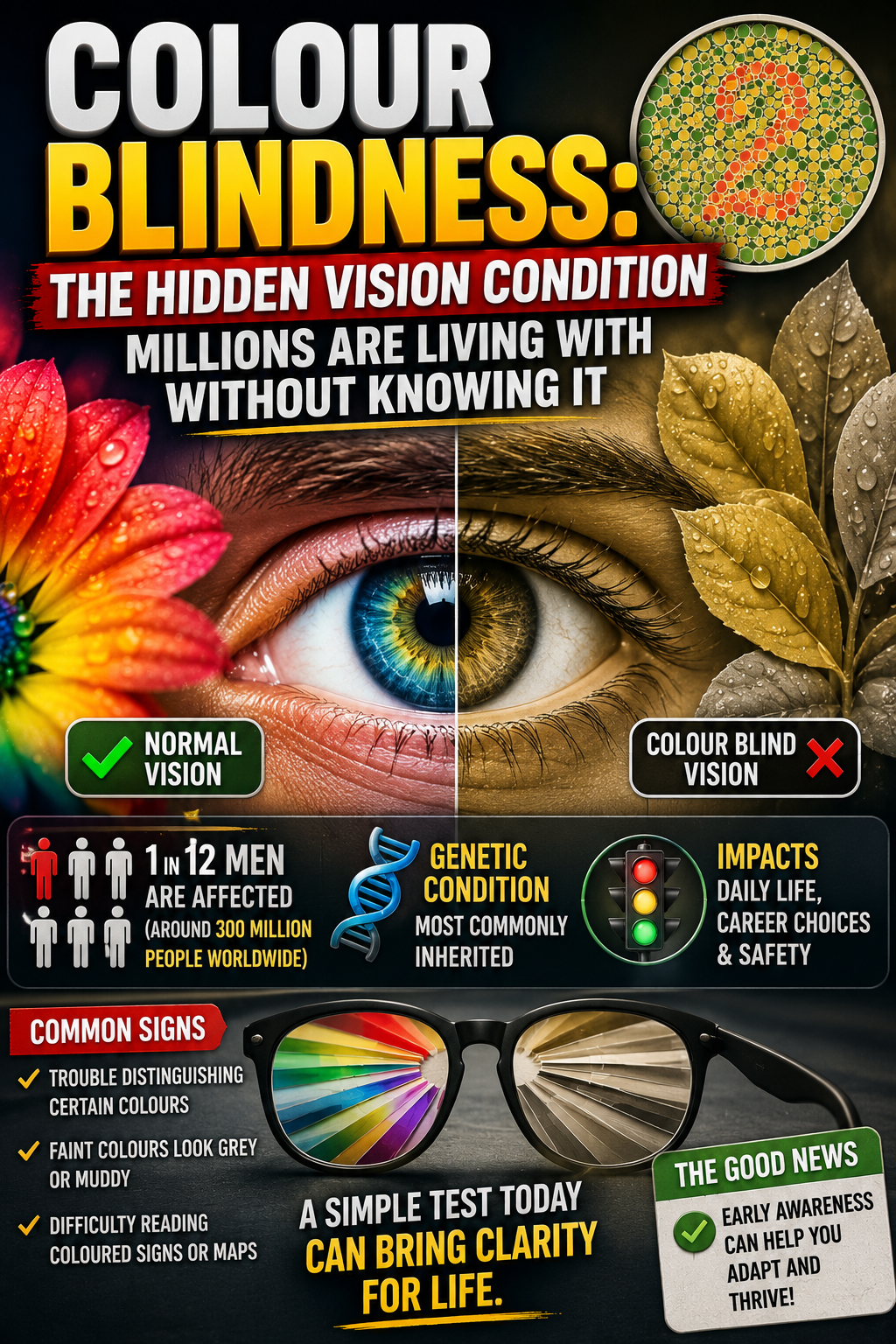
Colour blindness is one of the most common Vision conditions in the world and one of the least talked about. Globally, it affects approximately 300 million people, including roughly 1 in 12 men and 1 in 200 women. Yet despite those striking numbers, a significant portion of people who have it have no idea. Children go through years of school struggling to read colour coded charts. Adults make career decisions without knowing their colour perception is different from those around them. Some people only find out in their 40s or 50s.
So what exactly is colour blindness, why does it happen, who is most at risk, and what does it actually mean for everyday life? This article goes beyond the basics to give you a genuinely complete picture including insights that most coverage on this topic simply leaves out.
What Is Colour Blindness? Not What Most People Think
First, let’s correct the most persistent myth: colour blindness almost never means seeing the world in black and white. That condition called achromatopsia is extraordinarily rare, affecting roughly 1 in 30,000 people. The overwhelming majority of colour blind individuals see colour. They just perceive certain colours differently, or have difficulty distinguishing between specific hues that appear identical or confusingly similar to them.
The term “colour vision deficiency” is actually more accurate than “colour blindness,” and it’s increasingly preferred in clinical settings. But “colour blindness” has stuck in the public lexicon, so we’ll use both interchangeably here.
At its core, colour vision depends on specialised photoreceptor cells in the retina called cones. Humans have three types of cones, each sensitive to different wavelengths of light: short (blue), medium (green), and long (red). The brain processes signals from all three cone types together to produce the full spectrum of colour perception. When one or more cone types are absent, dysfunctional, or present in an altered form, colour vision is affected.
Types of Colour Blindness: A Spectrum of Conditions
Colour blindness is not a single condition it’s a family of related but distinct vision differences. Understanding the types matters, because they vary considerably in severity and in which colours are affected.
Red-Green Colour Blindness
This is by far the most common form, and it comes in two main subtypes:
- Deuteranopia and deuteranomaly: Related to the green sensitive cones. Deuteranomaly (reduced green sensitivity) is the most common type of colour blindness overall. People with this condition often confuse greens, yellows, oranges, and reds.
- Protanopia and protanomaly: Related to the red-sensitive cones. Red hues appear darker and are easily confused with green, brown, or black.
Blue-Yellow Colour Blindness
Less common than red green, this type involves the short-wavelength (blue) cones:
- Tritanopia: Complete absence of blue cones, causing confusion between blue and green, and between yellow and violet.
- Tritanomaly: Reduced blue cone function, a milder version of the same confusion.
Complete Colour Blindness (Achromatopsia)
As noted, this is the rarest form the absence of functional cone cells entirely. People with achromatopsia see the world in shades of grey and are typically also highly sensitive to bright light (photophobia). It is usually associated with other visual impairments including poor visual acuity.
| Type | Cones Affected | Colours Confused | Prevalence (Males) |
|---|---|---|---|
| Deuteranomaly | Green (reduced) | Red, green, yellow, orange | ~5% |
| Protanomaly | Red (reduced) | Red, green, brown | ~1% |
| Deuteranopia | Green (absent) | Red and green indistinguishable | ~1% |
| Protanopia | Red (absent) | Red appears very dark | ~1% |
| Tritanopia | Blue (absent) | Blue/green, yellow/violet | Rare (<0.01%) |
| Achromatopsia | All cones | All colours (greyscale only) | ~0.003% |
What Causes Colour Blindness? Genetics, Disease, and Damage
The Genetic Route: Why More Men Are Affected
The most common forms of colour blindness red green types are caused by mutations in genes located on the X chromosome. This is why the condition is far more prevalent in men than in women. Men have one X chromosome (XY), so a single mutation on that chromosome is enough to cause colour blindness. Women have two X chromosomes (XX), meaning they typically need mutations on both to be affected a much rarer occurrence. However, women with one affected X chromosome are carriers, and they can pass the condition to their sons.
This X linked inheritance pattern explains one of the most fascinating genetic quirks of colour blindness: a colour blind grandfather can pass the trait through his unaffected daughter to his grandson, skipping a generation visibly but carrying silently through the family line.
Acquired Colour Blindness
Not all colour blindness is inherited. A range of medical conditions and external factors can cause acquired colour vision deficiency at any point in life:
- Eye diseases: Glaucoma, macular degeneration, diabetic retinopathy, and cataracts can all damage cone cells or the optic nerve, impairing colour vision.
- Neurological conditions: Multiple sclerosis, Parkinson’s disease, and Alzheimer’s disease have all been associated with changes in colour perception, sometimes as an early warning sign before other symptoms appear.
- Medications: Certain drugs including hydroxychloroquine (used for lupus and rheumatoid arthritis), ethambutol (for tuberculosis), and some cardiovascular medications are known to affect colour vision.
- Toxic exposure: Chronic exposure to solvents, heavy metals such as lead and mercury, and certain industrial chemicals can damage the visual system over time.
- Nutritional deficiency: Severe vitamin A deficiency can impair colour vision along with night vision, particularly in populations with limited dietary diversity.
Acquired colour blindness is clinically important for a reason that inherited forms are not: it can be a signal that something else is going wrong. A patient who notices sudden changes in colour perception should seek prompt ophthalmological evaluation.
The Hidden Impact: How Colour Blindness Affects Real Life
This is where most coverage falls short. Colour blindness is frequently treated as a minor curiosity a quirk that makes traffic lights confusing and shopping for ripe fruit mildly awkward. The reality is considerably more complex.
Education and Childhood
Children with undiagnosed colour blindness routinely struggle in school in ways that go unrecognised. Colour coded learning tools are pervasive in early education maps, graphs, diagrams, science experiments, and reading exercises all rely heavily on colour differentiation. A child who cannot distinguish red from green on a map or identify the “correct” colour in a worksheet may be labelled inattentive, slow, or careless when in reality, they simply cannot see what the teacher sees.
This is why early screening matters enormously. Many paediatric ophthalmologists and optometrists recommend colour vision testing as a standard part of school-age eye examinations.
Career Limitations
Certain careers have colour vision requirements that effectively exclude people with significant colour vision deficiency. These include:
- Pilots and air traffic controllers (strict colour vision standards apply internationally)
- Electricians and engineers (wire colour coding is safety critical)
- Certain medical professions, including some surgical specialties
- Police and emergency services in some jurisdictions
- Graphic designers and visual artists (though many colour blind creatives work around this effectively)
The exclusion of colour blind individuals from certain professions is a topic of ongoing debate. Some argue the restrictions are overly broad and not proportionate to actual safety risk. Others maintain that in safety-critical environments, any degree of colour confusion poses unacceptable hazard. The truth likely lies somewhere in between and better technology, including colour assistive devices, may eventually shift the conversation.
Daily Safety Hazards
Beyond career implications, colour blindness creates genuine everyday safety considerations. Traffic signals rely primarily on position as well as colour, which helps but warning lights, hazard labels, and safety indicators in industrial, laboratory, and medical settings often do not have that redundancy. Distinguishing a ripe piece of fruit from an unripe one, recognising a bruise on skin, reading a colour coded medication chart, or identifying the freshness of meat are all routine tasks that become more challenging or error-prone.
Mental Health and Social Confidence
This aspect is perhaps the most underreported. People with undiagnosed or poorly understood colour blindness often describe a quiet, persistent sense of embarrassment or social anxiety around colour-related situations. Not knowing whether your outfit matches, hesitating to comment on a sunset, or dreading team presentations involving coloured charts these small daily stressors accumulate. Children who are teased or misunderstood because of their colour perception can carry those experiences into adulthood.
Diagnosis: How Colour Blindness Is Detected
The most widely used screening tool is the Ishihara plate test, developed by Japanese ophthalmologist Shinobu Ishihara in 1917 and still in common use today. It consists of a series of circular images made up of coloured dots, within which numbers or shapes are embedded. People with normal colour vision see the embedded figure clearly; those with colour vision deficiency may see a different number, a partial figure, or nothing at all.
For more detailed assessment particularly for clinical or occupational purposes the Farnsworth-Munsell 100 Hue Test or the Cambridge Colour Test can identify the specific type and severity of colour vision deficiency with greater precision.
Digital versions of these tests exist and are accessible online, though they should be considered screening tools rather than definitive diagnoses, since screen calibration significantly affects accuracy. A formal diagnosis should always be made by a qualified optometrist or ophthalmologist.
Treatment and Assistive Solutions: What Actually Helps
There is currently no cure for inherited colour blindness. The cone cells are simply wired differently from birth, and no treatment reverses this at a structural level. However, several assistive technologies and strategies can meaningfully improve the experience of living with colour vision deficiency.
Colour-Correcting Lenses and Glasses
Products such as EnChroma lenses specially tinted glasses designed to enhance colour contrast have gained considerable attention, including through viral videos of colour blind individuals seeing colour differently for the first time. These lenses work by filtering specific wavelengths of light to increase the perceived difference between colours that are typically confused. They are not effective for everyone and do not restore normal colour vision, but many users report a genuinely improved experience with certain hues, particularly reds and greens.
Digital Accessibility Tools
Most modern operating systems and smartphones now include colour accessibility settings high-contrast modes, colour filters, and options to convert colour coded information to patterns or labels. Applications like Color Blind Pal and Chromatic Vision Simulator allow users to identify colours in their environment using a smartphone camera. Web and app developers are increasingly guided by WCAG (Web Content Accessibility Guidelines) to design interfaces that do not rely solely on colour to convey information.
Gene Therapy: The Frontier
The most exciting development in colour blindness research is gene therapy. Scientists have successfully used adeno-associated viral vectors to deliver functional opsin genes into the cone cells of animal models and achieved measurable improvements in colour discrimination. Human trials are still in early stages, but the underlying biology is encouraging. For acquired colour blindness linked to progressive retinal disease, gene therapy research is even further advanced, with several therapies already reaching clinical trial stages for related conditions.
A Unique Angle: What Colour Blind People Can Teach Us About Perception
Here is something most articles on colour blindness never mention: colour blind individuals often develop compensatory perceptual skills that people with normal colour vision lack. Research has shown that some people with red-green colour blindness are better at detecting certain types of camouflage they are less distracted by surface colour and more attuned to texture, shape, and pattern contrast. During World War II, colour blind individuals were reportedly used in reconnaissance roles for exactly this reason.
This is a powerful reminder that colour blindness is not simply a deficit. It is a different way of processing visual information one that comes with genuine trade offs, some of which happen to be advantages. The condition challenges the assumption that there is one correct way to perceive the world.
Conclusion: Awareness, Diagnosis, and Designing a More Inclusive World
Colour blindness affects hundreds of millions of people worldwide, many of whom have never been formally diagnosed. It shapes educational outcomes, career trajectories, daily safety, and emotional wellbeing in ways that are consistently underestimated. And yet it remains an afterthought in public Health conversations.
The path forward requires action on multiple fronts. Routine colour vision screening in childhood should be standard, not optional. Designers, educators, engineers, and healthcare providers should be trained to create environments that do not assume universal colour perception. And research into gene therapy and assistive technologies should continue to receive investment and attention.
As for individuals whether you suspect you might be colour blind, have a child who struggles with colour coded tasks, or simply know someone who has the condition the most important step is awareness. A simple eye test can reveal something many people carry unknowingly for a lifetime. And knowing is always the better option.
The world may not be about to change its colours anytime soon but it can certainly do a better job of designing for everyone who sees them differently.
For breaking news and live news updates, like us on Facebook or follow us on Twitter and Instagram. Read more on Latest Health on thefoxdaily.com.






COMMENTS 0