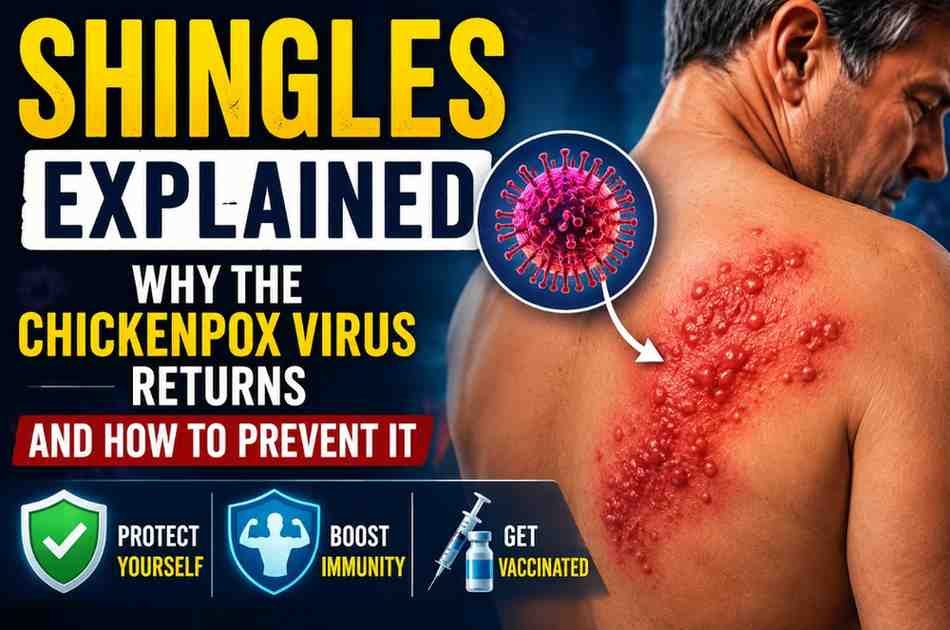
Imagine recovering from an illness as a child, feeling completely cured, and moving on with your life only for that same virus to re-emerge 40 or 50 years later, this time causing a painful, burning rash that can last for weeks and leave lasting nerve damage. That is exactly what shingles does.
Shingles, clinically known as herpes zoster, is a viral infection caused by the reactivation of the varicella-zoster virus (VZV) the same pathogen responsible for chickenpox. It affects nearly 1 in 3 people in the United States over their lifetime, according to the Centers for Disease Control and Prevention (CDC). Yet despite its prevalence, shingles remains widely misunderstood, often dismissed as “just a rash,” when in reality it can cause severe complications that significantly impact quality of life.
This article explains what shingles is, why the virus reactivates, who is most at risk, what to expect if you develop it, and most importantly what you can do to prevent it.
What Is Shingles? The Biology Behind the Reactivation
To understand shingles, you first need to understand what happens when chickenpox resolves. When a person contracts chickenpox, the immune system eventually clears the active infection. However, the varicella-zoster virus is not completely eliminated from the body. Instead, it retreats into the sensory nerve ganglia clusters of nerve cells located along the spinal cord and near the brain and enters a dormant, or latent, state.
Think of it as a house guest who refuses to fully leave. They go quiet, stay in the back room, and for decades, you may forget they are even there. But under the right (or rather, wrong) conditions, they can re emerge.
This re-emergence is shingles. When the immune system weakens due to aging, stress, illness, or medications the virus seizes the opportunity to reactivate. It travels down the nerve fibers toward the skin, causing inflammation, pain, and a characteristic blistering rash that typically appears in a stripe or band on one side of the body.
Key Biological Mechanisms
- Latency site: The virus remains dormant in the dorsal root ganglia of the spine or the trigeminal ganglion near the face.
- Trigger for reactivation: A decline in VZV specific T cell immunity allows the virus to escape immune suppression.
- Neural pathway: Upon reactivation, the virus replicates and travels along the sensory nerve to the skin, causing dermatomal pain and rash.
- Dermatomal distribution: The rash typically affects a single dermatome a strip of skin served by one spinal nerve which explains why it appears in a band-like pattern on one side.
Who Gets Shingles? Risk Factors You Should Know
Shingles can technically occur in anyone who has had chickenpox, which means the vast majority of adults over 40 in developed countries are at baseline risk. However, several factors significantly increase the likelihood of reactivation.
Age: The Biggest Risk Factor
Age is by far the most significant risk factor for shingles. The immune system undergoes a natural, gradual decline with age a process scientists call immunosenescence. This weakening of immune function reduces the body’s ability to keep the dormant varicella zoster virus in check. As a result, approximately half of all shingles cases occur in adults aged 60 and older. The risk continues to climb with each passing decade.
Immune Suppression
People whose immune systems are compromised for reasons other than age are also at elevated risk. This includes:
- Individuals undergoing chemotherapy or radiation therapy for cancer
- Organ transplant recipients taking immunosuppressive drugs
- People living with HIV/AIDS
- Patients on long-term corticosteroid therapy
- Those with autoimmune conditions like lupus or rheumatoid arthritis
Psychological and Physical Stress
Chronic stress is a well documented immune suppressant. Studies have found that periods of intense psychological stress grief, burnout, major life upheaval can temporarily weaken VZV-specific immunity enough to allow reactivation. Physical trauma, surgery, or severe illness can have the same effect.
Sex and Genetics
Women appear to develop shingles at slightly higher rates than men, though researchers are still investigating the reasons. Certain genetic factors influencing immune response may also play a role in individual susceptibility.
| Risk Factor | Level of Risk Increase | Why It Matters |
|---|---|---|
| Age 60+ | High | Immunosenescence reduces VZV-specific immunity |
| HIV/AIDS | Very High | Severely compromised T-cell function |
| Cancer treatment | High | Chemo/radiation suppresses immune response |
| Chronic stress | Moderate | Stress hormones impair immune surveillance |
| Organ transplant | High | Anti-rejection drugs suppress immunity |
| Autoimmune disease | Moderate to High | Disease itself and treatments weaken immunity |
Symptoms of Shingles: What It Actually Feels Like
Shingles does not announce itself quietly. The condition typically progresses through distinct phases, and understanding them can help with early recognition and faster treatment.
Phase 1: The Prodrome (Days 1–5)
Before any visible rash appears, most people experience a prodromal phase characterized by unusual sensations in the affected area. This can include burning, tingling, itching, or a deep, aching pain often without any visible skin change. Some people also experience fatigue, headache, light sensitivity, or low-grade fever during this stage.
This phase is particularly tricky because the pain can mimic other conditions kidney stones, heart problems, or a pulled muscle leading to misdiagnosis before the rash appears.
Phase 2: The Rash (Days 3–5 Onward)
The hallmark shingles rash emerges as a cluster of small red spots that rapidly develop into fluid-filled blisters. This rash almost always appears on one side of the body, following the path of the affected nerve. Common locations include:
- The torso, wrapping around one side of the chest or abdomen
- The face, particularly around one eye (a serious form called herpes zoster ophthalmicus)
- The neck or shoulder
- The lower back or buttocks
The blisters typically break open, crust over, and heal within 2 to 4 weeks. However, the pain can persist long after the rash resolves.
Phase 3: Post-Herpetic Neuralgia (PHN)
The most feared complication of shingles is post-herpetic neuralgia (PHN) persistent nerve pain that continues for months or even years after the rash heals. PHN occurs because the virus damages nerve fibers during reactivation, leaving them hypersensitive and misfiring. The pain can be described as burning, stabbing, or electric-shock-like, and even light touch the brush of clothing against skin can trigger agony.
PHN affects approximately 10–18% of shingles patients overall, but the risk rises dramatically with age. In people over 60, nearly one third who develop shingles will go on to experience PHN. This is not a minor inconvenience PHN is one of the most debilitating chronic pain conditions in older adults and can severely impair sleep, daily function, and mental Health.
Other Complications: When Shingles Gets Serious
While PHN is the most common complication, shingles can cause other serious health consequences depending on where the reactivation occurs and the patient’s overall health status.
- Herpes Zoster Ophthalmicus: Shingles affecting the eye can lead to corneal damage, vision loss, or even blindness if not promptly treated with antiviral medication.
- Ramsay Hunt Syndrome: When the virus reactivates in the facial nerve near the ear, it can cause facial paralysis, hearing loss, and severe ear pain.
- Bacterial Superinfection: Open blisters can become secondarily infected with bacteria, requiring antibiotic treatment.
- Pneumonia and Encephalitis: In immunocompromised individuals, the virus can disseminate beyond the skin, affecting the lungs or brain rare but life-threatening outcomes.
- Stroke Risk: Emerging research suggests that shingles particularly when it affects the face and head may modestly increase the short term risk of stroke due to inflammation of blood vessels.
Treatment: Antivirals, Pain Management, and Timing
There is no cure for shingles, but antiviral medications can significantly reduce its severity and duration provided they are started early. The three primary antivirals used are acyclovir, valacyclovir, and famciclovir. For best results, treatment should begin within 72 hours of rash onset.
This is why recognizing the prodromal phase matters enormously. Someone who identifies the early burning and tingling and seeks care quickly has a far better chance of a milder course and lower risk of PHN than someone who waits until the rash is well-established.
Pain management during the active rash phase may involve over-the-counter analgesics, prescription pain relievers, topical anesthetics, or in severe cases, nerve blocks. For PHN, options include gabapentin, pregabalin, tricyclic antidepressants, and capsaicin patches.
Prevention: The Case for Vaccination
The most powerful tool available against shingles is vaccination, and the scientific evidence in its favor is compelling. The recombinant zoster vaccine (RZV), marketed as Shingrix, is currently recommended by the CDC for all adults aged 50 and older, as well as younger adults with weakened immune systems.
Clinical trials have shown Shingrix to be more than 90% effective at preventing shingles in healthy adults aged 50 and above a remarkable efficacy rate for a vaccine against a reactivating virus. Importantly, its effectiveness against PHN exceeds 85%, meaning it dramatically reduces the risk of the most disabling complication even if breakthrough shingles does occur.
The vaccine is administered as a two dose series given 2 to 6 months apart. Even individuals who have already had shingles are recommended to get vaccinated to reduce the risk of recurrence yes, you can get shingles more than once.
Despite the availability of this highly effective vaccine, uptake remains suboptimal. Cost, access barriers, and lack of awareness continue to leave millions of older adults unvaccinated and at preventable risk.
Shingles vs. Chickenpox: Understanding the Relationship
A common misconception is that shingles is contagious in the same way chickenpox is. The distinction is important. Shingles itself is not directly contagious a person cannot catch shingles from someone who has it. However, the fluid in shingles blisters contains live varicella-zoster virus, and a person who has never had chickenpox or been vaccinated against it can contract chickenpox (not shingles) through direct contact with those blisters.
This is why shingles patients are advised to keep their rash covered and avoid contact with newborns, pregnant women who have not had chickenpox, and immunocompromised individuals.
Conclusion: A Preventable Disease That Deserves More Attention
Shingles is far more than a temporary inconvenience. It is a painful, potentially disabling disease affecting millions of older adults each year — one that carries a real risk of long-term nerve damage, vision loss, and neurological complications. And yet it is also one of the most preventable conditions in this demographic, thanks to a highly effective, widely available vaccine.
The core message is straightforward: if you are 50 or older, have had chickenpox, and have not been vaccinated with Shingrix, now is the time to speak with your healthcare provider. If you are caring for an aging parent or loved one, put this conversation on your list.
Looking ahead, researchers continue to investigate the broader implications of varicella-zoster reactivation including its potential links to cardiovascular events and cognitive decline in older adults. As the global population ages, shingles will become an increasingly important public health priority. Prevention today is far easier and far less painful than treatment tomorrow.
Bottom line: The virus never forgets you. But with the right knowledge and the right vaccine, you can stop it from making a devastating comeback.
For breaking news and live news updates, like us on Facebook or follow us on Twitter and Instagram. Read more on Latest Health on thefoxdaily.com.




COMMENTS 0