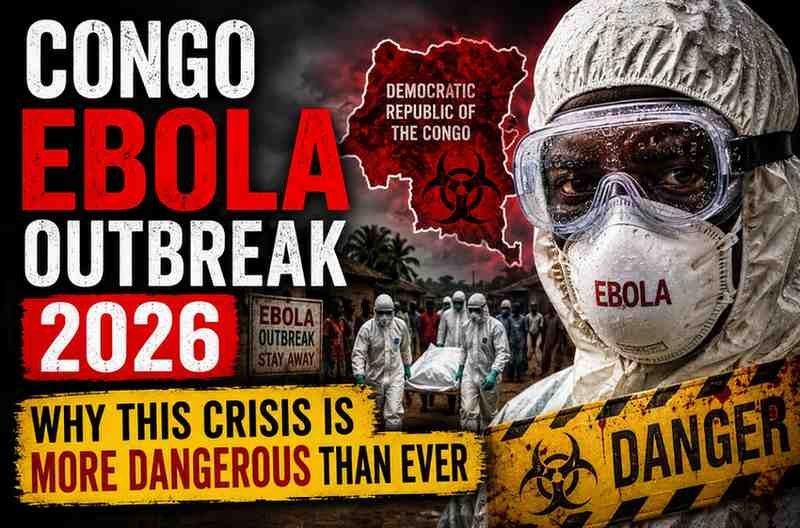
In the northeastern corner of the Democratic Republic of Congo, a familiar horror has returned only this time, the conditions surrounding it are arguably worse than ever before. As of 24 May 2026, Congolese health authorities confirmed more than 900 suspected Ebola cases, with the toll climbing rapidly toward 1,000 in the span of days. At least 220 people are confirmed dead, and WHO Director General Tedros Adhanom Ghebreyesus has acknowledged that “more than 900 suspected cases have been identified so far, including 101 confirmed cases.” Health workers on the ground, however, believe the true infection count is substantially higher.
This is Congo’s 17th Ebola outbreak since the virus was first identified in the country in 1976 and it arrives just five months after the previous outbreak ended. It has already crossed an international border, with seven confirmed cases now reported in Uganda’s capital, Kampala. The WHO declared it a Public Health Emergency of International Concern (PHEIC) on 16 May 2026. The United States followed with enhanced airport screening, travel restrictions, and public health measures announced on 18 May. What makes this outbreak uniquely dangerous, however, is not just the case count. It is everything happening around it.
What Makes the 2026 Ituri Outbreak Different and More Dangerous
Not all Ebola outbreaks are equal, and this one carries a particularly alarming set of characteristics that set it apart from the crises that came before.
The virus responsible for this outbreak is the Bundibugyo ebolavirus not the more commonly known Zaire strain that has driven most of DRC’s prior outbreaks and which the existing approved vaccines target. There is currently no licensed vaccine or approved treatment for the Bundibugyo strain. The Zaire based Merck vaccine (rVSV ZEBOV), which was a critical tool in containing the devastating 2018–2020 North Kivu outbreak, is effectively useless here. Africa CDC has been pointed in its assessment of why: the Bundibugyo virus was identified nearly two decades ago, yet no targeted medical countermeasures exist because the disease has disproportionately threatened poor African communities rather than wealthy nations. As Africa CDC stated directly: “If this disease had predominantly threatened wealthier regions of the world, medical countermeasures would likely already be available.”
Without a vaccine, health workers are relying entirely on the classic pillars of outbreak containment: rapid case identification, rigorous contact tracing, isolation, and safe burial practices. These methods work but only when communities cooperate, infrastructure holds, and security allows responders to operate. In eastern Congo right now, all three are under severe strain.
Timeline: How the Outbreak Evolved
| Date | Development |
|---|---|
| 24 April 2026 | First known case a nurse in Bunia, Ituri Province presents symptoms and dies shortly after |
| Throughout April | Cluster of unexplained deaths in Mongbwalu, including four health workers in one week, go uninvestigated |
| 15 May 2026 | DRC Ministry of Health officially confirms the outbreak in Ituri Province |
| 15–16 May 2026 | Two confirmed cases with no apparent link to each other reported in Kampala, Uganda within 24 hours |
| 16 May 2026 | WHO declares the outbreak a Public Health Emergency of International Concern (PHEIC) |
| 18 May 2026 | CDC and DHS announce US travel screening and entry restrictions for DRC and Uganda |
| 21 May 2026 | Arson attacks burn Ebola treatment centres in Rwampara and Mongbwalu |
| 24 May 2026 | Case count surpasses 900 suspected cases; at least 220 deaths confirmed |
| 24 May 2026 (night) | Armed men storm Mongbwalu hospital demanding return of bodies; patients evacuated |
One of the most alarming details buried in the official timeline is that the outbreak was almost certainly spreading for weeks possibly months before health authorities detected it. By the time the first case was officially confirmed on 15 May, Mongbwalu had already experienced an unexplained cluster of deaths throughout April, including four health workers who died within a single week. The late detection is not an accident or an oversight. It is a direct consequence of what international aid cuts have done to disease surveillance infrastructure in one of the world’s most vulnerable regions.
The Invisible Accelerant: What Aid Cuts Actually Mean on the Ground
Health experts have been consistent in identifying the collapse of international aid as a critical factor in why this outbreak has grown so quickly and why the response has been so difficult. Before the outbreak was declared, Doctors Without Borders (MSF) conducted an assessment of health facilities in the Ituri outbreak zone and found them in a severely degraded state the direct result of funding cuts by the United States and other high-income donor nations the previous year.
What aid cuts look like in practice in a place like Ituri is not an abstract budget line. It means community health workers who were trained and paid to identify unusual illness clusters are no longer employed. It means surveillance networks that would flag four dead health workers in a single week as a potential outbreak signal have been shut down. It means health centres that were once basic but functional are now operating without reliable supplies of personal protective equipment, diagnostic materials, or even electricity. The virus does not wait for funding to be restored. It moves through the gaps.
Ituri Province currently hosts over 920,000 internally displaced people, according to the United Nations a population of extraordinary vulnerability, living in crowded conditions without stable access to healthcare, clean water, or security. In parallel, ISIS linked militants carried out an attack on a village in Ituri just this week, killing at least 17 people. The Congolese government largely controls Ituri, unlike the contested areas of North Kivu to the south, but the region’s fragility is not primarily a military problem. It is a governance and investment problem, years in the making.
Burning Clinics: When Community Anger Becomes a Public Health Crisis
Perhaps the most distressing dimension of this outbreak and the one most competitors’ coverage tends to reduce to a single paragraph is the community violence directed at the very people trying to contain the virus.
Last week, Ebola treatment centres in Rwampara and Mongbwalu the two towns with the highest case counts were set on fire by local residents. An Associated Press journalist witnessed people breaking into one centre and setting fire to both the structure and what appeared to be the body of a suspected Ebola victim stored inside. Aid workers evacuated in vehicles. On Sunday night, young men stormed the Mongbwalu hospital itself, demanding that the bodies of two relatives be handed over to them. The hospital director, Dr. Richard Lokudu, reported that patients had to be scrambled to safety as gunfire rang out nearby.
It would be easy and wrong to read this violence as irrational. Colin Thomas-Jensen, director of impact at the Aurora Humanitarian Initiative, framed it more accurately: the attacks likely reflect the deeply embedded anger of people in eastern Congo over how their region has been treated for decades. Armed rebel groups have killed and displaced their families. Their government has repeatedly failed them. International peacekeepers have been unable to protect them. And now, the same international community that cut their health funding is sending aid workers to take away their dead and tell them they cannot hold funerals.
Safe burial is one of the most critical interventions in Ebola containment the virus remains infectious in corpses and traditional funeral practices involving close contact with the body have historically driven transmission. But safe burial also means telling grieving families that they cannot touch, wash, or keep vigil over their loved ones. In communities already primed for distrust of outside institutions, this demand however medically necessary lands as another act of dispossession. Authorities in northeastern Congo have now banned funeral wakes and gatherings of more than 50 people, with armed soldiers and police guarding some burials carried out by aid workers. The tension between epidemiological necessity and community dignity is not a communications problem. It is one of the deepest structural challenges in outbreak response.
The Cross-Border Threat: Why Uganda’s Seven Cases Are a Warning Sign
The spread of confirmed cases to Kampala, Uganda’s capital city, triggered the WHO’s formal PHEIC declaration and has raised concern across the region. The outbreak has now been confirmed across three provinces of DRC Ituri, Nord-Kivu, and Sud Kivu with an additional imported case in Tshopo Province. Seven confirmed cases in Uganda as of late May, with at least one death, demonstrate that the virus is moving along population corridors and, critically, reaching urban centres.
Urban Ebola is categorically more difficult to contain than rural Ebola. Dense populations, high volume transport hubs, overburdened hospitals with limited infection-control capacity, and the anonymity of city life all create conditions for accelerated spread. The appearance of two confirmed Kampala cases within 24 hours of each other, with no apparent epidemiological link between them, is precisely the kind of signal that justifies a PHEIC declaration. WHO’s guidance is explicit: there should be no international travel of Bundibugyo virus contacts or confirmed cases unless part of a formal medical evacuation. Ten countries in the region have been identified as being at elevated risk of importation.
The Vaccine Gap: A Structural Injustice With Deadly Consequences
The absence of an approved vaccine or therapeutic for the Bundibugyo strain is the central medical tragedy of this outbreak and it is not a scientific failure. It is a market failure.
The Bundibugyo ebolavirus was first identified during a 2007 outbreak in western Uganda. It has been known to science for nearly two decades. The tools to develop a vaccine existed. The precedent of the Zaire vaccine’s development dramatically accelerated during the 2014–2016 West African epidemic proved that rapid vaccine development for Ebola is achievable. But the Zaire strain killed more people in wealthier adjacent contexts, attracted more global media attention, and ultimately reached American and European health workers. The Bundibugyo strain has largely remained a disease of rural, impoverished, conflict-affected communities in central Africa communities without the economic or political weight to pull pharmaceutical R&D resources in their direction.
The CDC has been clear that the proven tools for Bundibugyo containment remain contact tracing, case identification, isolation, and safe burials. These methods are effective. But they depend entirely on a functioning health system, community trust, and security for health workers three things that are all simultaneously compromised in Ituri right now.
What Needs to Happen Now
The path forward requires action on several fronts simultaneously, none of which can substitute for the others.
- Immediate humanitarian resourcing health workers on the ground have been explicit: they need more supplies, more staff, and more logistical support. The gap left by international aid cuts cannot be papered over with goodwill. Concrete financial commitments from donor governments are required now, not after the case count reaches 2,000.
- Accelerated Bundibugyo vaccine research Africa CDC has called for this directly. Candidate vaccines exist in early development; the global community needs to fund and fast-track them with the same urgency that was applied to the Zaire vaccine post-2014.
- Community engagement, not community enforcement the violence against treatment centres is a feedback signal. Heavy-handed enforcement of burial protocols without genuine community dialogue and culturally respectful engagement will continue to generate resistance. The 2018–2020 North Kivu outbreak offered painful lessons on this; they must not be forgotten.
- Cross-border coordination with seven cases already confirmed in Uganda and ten countries at elevated risk, the regional response infrastructure needs to be activated at a level commensurate with a PHEIC, not a localised outbreak.
Conclusion: Congo’s 17th Outbreak Is the World’s Problem Now
The Ebola crisis unfolding in eastern Congo in May 2026 is the predictable consequence of predictable failures the systematic defunding of surveillance infrastructure, the abandonment of communities already battered by armed conflict and displacement, and the global pharmaceutical community’s decades long indifference to a virus that only threatened people who lacked political leverage.
The case count has now crossed 900 and is rising. The virus has reached an African capital city. There is no approved vaccine. Treatment centres are being burned. And the health workers trying to contain the outbreak are doing so in a war zone, with dwindling supplies, against the distrust of the very communities they are trying to protect.
If there is a lesson in Congo’s 17th Ebola outbreak, it is the same lesson that its 16 predecessors tried to teach: disease surveillance is not a charitable investment. It is a collective security measure. What the world chose not to spend on health infrastructure in Ituri before April 2026 is now costing multiples of that amount in emergency response and an uncountable human toll that no budget line will ever fully capture.
For breaking news and live news updates, like us on Facebook or follow us on Twitter and Instagram. Read more on Latest Health on thefoxdaily.com.



COMMENTS 0