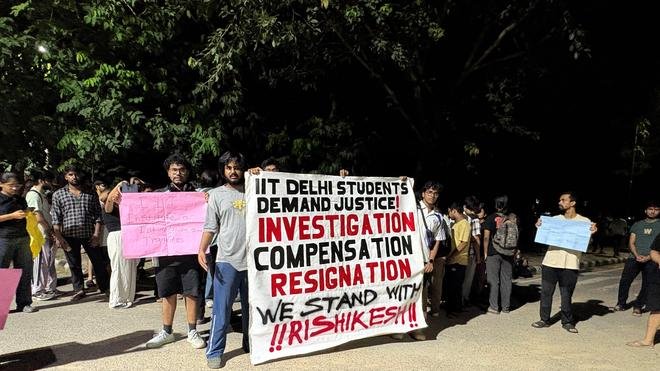
An unusually large student protest at IIT Delhi has brought the issue of Student Mental Health into sharp focus. Classes have reportedly been largely called off as students continue a sit-in following the death by suicide of an MSc student last week. The scale of the mobilisation is being described as unprecedented for the institute, turning an individual tragedy into a wider conversation about how India’s premier educational institutions respond to psychological distress.
The immediate events at IIT Delhi are unfolding amid a broader national concern over student suicides and mental health. While the circumstances surrounding any individual death require careful investigation and should not be reduced to a single explanation, the protest has prompted questions about whether students feel adequately heard, supported and protected when they experience severe distress.
The episode also highlights a difficult reality of elite academic institutions: academic achievement and institutional prestige do not make students immune to anxiety, loneliness, burnout or other mental-health challenges.
What is happening at IIT Delhi?
Students at IIT Delhi have been holding a sit-in at the location associated with the death of the MSc student. Classes have been largely disrupted, while student participation has grown to a level described as unprecedented in the institute’s history of campus agitation.
The scale of the protest is significant because it suggests that students are using collective action to raise concerns extending beyond the immediate incident.
At its core, the protest is about grief. But student mobilisation can also become a way for a campus community to demand answers about systems, policies and support structures that students believe need greater attention.
Those concerns need to be separated carefully from speculation about the circumstances of an individual death. A suicide is complex and can involve multiple interacting factors. It would be irresponsible to attribute such a death to one examination, one academic decision, one person or one institutional policy without evidence.
Why student suicide has become a national concern
Student suicide is not confined to IITs or other elite institutions.
Across India, concerns about academic pressure, competitive examinations, career uncertainty, financial stress, family expectations, social isolation and mental health have repeatedly entered public discussion.
Competitive academic environments can create an unusual combination of pressures. Students may enter institutions after years of intense preparation and suddenly find themselves surrounded by peers who were also among the strongest performers in their previous environments.
A student who was accustomed to being near the top of a class may discover that the same level of performance is much harder to achieve in a highly competitive peer group.
That transition can affect confidence and identity, particularly when academic performance has become closely connected with a student’s sense of self-worth.
The hidden pressure of studying among high achievers
Prestigious campuses can look like environments of opportunity from the outside. From inside, however, the experience can be considerably more complicated.
Students are expected to manage demanding coursework, research, examinations, projects and career decisions. Postgraduate students may also face uncertainty around research progress, supervisors, funding, publications and future employment.
The pressure is not always visible.
A student attending classes, submitting assignments and appearing socially functional may still be struggling privately. This is one reason mental-health intervention cannot depend solely on visible academic decline or a student’s willingness to approach a counselling centre.
For institutions, the challenge is therefore not simply providing a counselling service. It is creating a campus environment in which seeking help is normal, accessible and free from fear of judgment.
Why the IIT Delhi protest matters beyond one campus
The unusual scale of the mobilisation gives the episode significance beyond IIT Delhi.
Students across India’s universities are watching how institutions respond when a campus experiences a suicide. The response can influence whether students believe their concerns will be taken seriously.
A strong institutional response requires more than issuing condolences.
Students may want clarity about existing mental-health systems, grievance mechanisms, emergency support, academic flexibility and procedures for responding when someone shows signs of serious distress.
The central question is not simply whether an institution has a counselling centre. It is whether a student in crisis can realistically access meaningful support when they need it.
A counselling centre alone cannot solve the problem
Universities often present counselling services as the primary solution to student mental-health concerns. Counselling is important, but it is only one component of a larger support system.
A comprehensive campus mental-health framework can include professional counselling, psychiatric referral where necessary, peer-support programmes, faculty training, residential support, emergency response systems and mechanisms for academic accommodations.
Equally important is prevention.
Students should not have to reach a severe crisis before the institution notices that they are struggling.
Regular wellbeing check-ins, accessible mental-health education and trained faculty or residential staff can help create earlier opportunities for intervention.
The role of faculty and supervisors
For postgraduate students in particular, academic relationships can become extremely important.
Research scholars and master’s students may spend long periods working closely with faculty members or supervisors. When academic progress slows, communication breaks down or expectations become unclear, the student can experience considerable stress.
This does not mean academic supervisors are responsible for diagnosing mental illness. They are not mental-health professionals.
But faculty members can play an important early-warning role by knowing how to recognise significant changes in behaviour and where to refer students for professional help.
Training faculty and administrative staff in basic mental-health awareness could therefore form part of a broader institutional strategy.
Academic pressure is only one piece of the puzzle
It is tempting to explain student suicide entirely through academic pressure because examinations, grades and deadlines are visible.
That approach can be misleading.
Mental-health crises can arise from combinations of personal, psychological, social, financial and academic circumstances. Two students facing the same examination may experience completely different levels of distress.
This is why investigations and institutional reviews need to avoid simplistic conclusions.
The goal should be to identify preventable weaknesses in the support system without claiming that one factor explains an individual death.
The importance of reducing stigma
One of the biggest barriers to mental-health support remains stigma.
Students may worry that seeking help will make them appear weak, incapable or unsuitable for demanding academic environments. Some may fear that classmates, faculty members or future employers will judge them.
That perception can delay help-seeking.
Elite institutions have a particular opportunity to challenge this culture because they can redefine what academic strength means. Asking for professional help should not be treated as evidence that someone is incapable of handling a demanding environment.
Just as students are encouraged to seek help when they develop a physical illness, psychological distress should be treated as a legitimate reason to access appropriate support.
What institutions can do differently
The events at IIT Delhi provide an opportunity to examine campus mental-health systems more broadly.
- Make counselling easier to access: Students should be able to seek professional support without unnecessary administrative barriers.
- Strengthen emergency pathways: Institutions need clear procedures for responding to students facing an acute mental-health crisis.
- Train faculty and staff: Professors, hostel staff and administrative personnel can be taught how to recognise warning signs and make appropriate referrals.
- Protect confidentiality: Students are more likely to seek help when they understand what information will remain private and when confidentiality can legally or ethically be limited.
- Provide academic flexibility where appropriate: Temporary adjustments can sometimes prevent a mental-health crisis from becoming compounded by academic consequences.
- Build peer-support networks: Students often notice changes in friends before institutions do. Properly trained peer-support programmes can complement professional services.
- Evaluate services regularly: Universities should measure whether students are actually using and benefiting from available mental-health resources rather than simply counting the number of programmes offered.
The post-crisis period is just as important
When a suicide occurs on a campus, the immediate response receives most of the attention. But the weeks and months afterward can also be critical.
Students may experience grief, shock, anger, fear or guilt. Some may struggle to concentrate academically or may become anxious about their own wellbeing or that of friends.
Institutions therefore need a sustained postvention strategy — a coordinated approach to supporting people affected by a suicide and reducing further risk.
Such a response can include access to professional counselling, communication with students, support for those closely affected and careful monitoring of vulnerable individuals.
The objective should be to create a supportive environment without sensationalising the death or turning the deceased student’s story into speculation.
Why responsible reporting matters
Student suicide requires particularly careful communication.
Detailed descriptions of the method or location of a suicide can increase harm and should not become the focus of coverage. Responsible reporting should instead concentrate on verified facts, available support systems, institutional responses and the broader prevention challenge.
The same principle applies on social media. Unverified claims can spread rapidly after a death, potentially causing additional distress to friends and family and making an already difficult situation harder for the campus community.
A useful measure of institutional success is whether students ask for help early
Universities often evaluate mental-health infrastructure by counting counsellors, workshops or awareness campaigns.
A more meaningful question is whether students feel safe approaching those services before reaching a crisis point.
If students regularly use counselling services, participate in peer-support programmes and openly discuss wellbeing, that should not necessarily be interpreted as evidence that a campus has a mental-health problem. It may instead indicate that students trust the support system enough to use it.
The goal should not be to create a campus where nobody ever experiences psychological distress. That is unrealistic.
The goal should be to create a campus where distress is recognised early, support is easy to access and students do not feel that they have to face severe struggles alone.
The bigger lesson for India’s higher-education system
The IIT Delhi protests raise questions that extend across universities, colleges and coaching environments.
India’s education system places enormous value on academic achievement. That ambition can produce exceptional opportunities, but it can also create environments where failure feels catastrophic.
A healthier academic culture does not require lowering standards.
It means recognising that high standards and strong mental-health support can coexist.
Students can be challenged academically while also being given reasonable access to professional support, opportunities to recover from setbacks and reassurance that one poor grade does not define their entire future.
What happens next at IIT Delhi?
The immediate focus will remain on the student protest and the concerns raised by those participating in it. The institution’s response will be closely watched by its own students as well as by the wider higher-education community.
For the university, the challenge is to address legitimate student concerns while ensuring that any investigation into the death is based on evidence rather than speculation.
For students, the protest demonstrates the power of collective action to place mental health and institutional responsibility at the centre of campus discussions.
For other universities, it is a reminder that mental-health policy cannot remain a document sitting on an administrative website. It has to function when a student is struggling at 2 a.m., when a friend notices something is wrong, when academic pressure becomes overwhelming or when a crisis suddenly develops.
Conclusion: The conversation cannot end when the protest does
The unprecedented mobilisation at IIT Delhi following the death by suicide of an MSc student has placed student mental health, academic pressure and institutional support under an intense spotlight.
The circumstances of an individual suicide should never be reduced to a single cause. But every such tragedy can prompt institutions to examine whether students have adequate opportunities to seek help and whether warning signs are being recognised early enough.
The most meaningful response will not be measured only by how the current protest is resolved. It will be measured by what changes afterward.
If the episode leads to stronger counselling systems, better crisis-response mechanisms, more approachable faculty, reduced stigma and a campus culture where asking for help is treated as a sign of responsibility rather than weakness, the conversation will have produced something constructive from an extremely painful event.
India’s premier institutions are built to develop exceptional academic talent. They must also become places where students can struggle without feeling that they have failed, seek help without shame and understand that their lives matter far beyond their grades.
For breaking news and live news updates, like us on Facebook or follow us on Twitter and Instagram. Read more on Latest Health on thefoxdaily.com.






COMMENTS 0