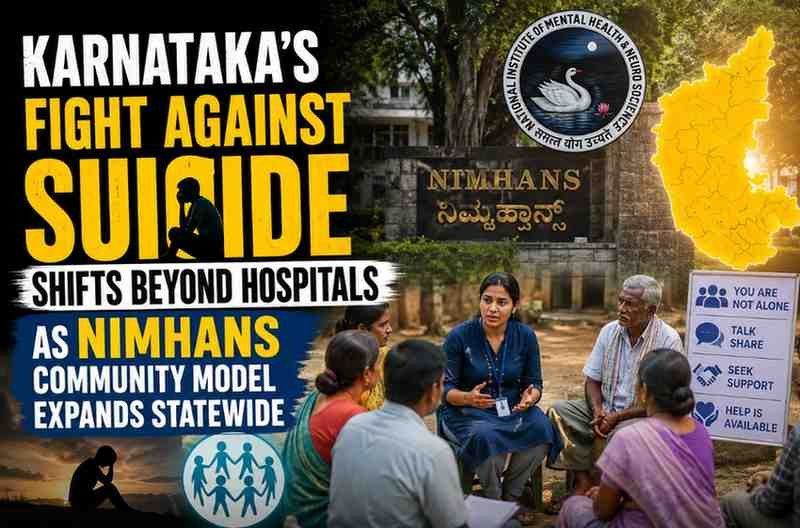
Suicide prevention has traditionally been viewed through the lens of hospitals, psychiatrists and crisis interventions. But in Karnataka, where suicide rates remain among the highest in India, a different approach is taking shape one that recognizes that support systems extend far beyond clinics.
Emerging evidence from initiatives led by the National Institute of Mental Health and Neurosciences (NIMHANS) suggests that schools, primary healthcare centres, village panchayats and community networks may be just as crucial in identifying distress and preventing suicide.
The model, which is set to be scaled up across the State from July, reflects a growing understanding that suicide prevention is not solely a medical challenge but also a social and community responsibility.
Why Karnataka Is Rethinking Suicide Prevention
Karnataka has consistently reported a significant suicide burden, underscoring the need for interventions that go beyond psychiatric care.
Experts note that many individuals experiencing emotional distress:
- Never seek specialised mental health services.
- May first approach teachers, family members or primary healthcare workers.
- Often remain undetected until a crisis emerges.
- Benefit from early support within their communities.
This has prompted a shift from reactive treatment to proactive prevention.
The NIMHANS Community-Based Model
Instead of relying exclusively on hospitals, the initiative seeks to create multiple layers of support.
The approach involves:
- Schools and colleges.
- Gram panchayats.
- Primary health centres.
- Community volunteers.
- Frontline healthcare workers.
- Local support networks.
The aim is to identify emotional distress early and provide timely assistance before problems escalate.
Schools Can Become Protective Spaces
Young people often spend much of their lives in educational institutions.
Teachers and school staff may be among the first to notice:
- Social withdrawal.
- Academic decline.
- Behavioural changes.
- Signs of anxiety or depression.
- Expressions of hopelessness.
Training educators to recognize and respond to these signals can create an important safety net.
| Traditional Approach | Community-Based Model |
|---|---|
| Hospitals and specialists | Schools, panchayats and local networks |
| Crisis intervention | Early identification and prevention |
| Limited access points | Multiple community touchpoints |
| Focus on treatment | Focus on support and awareness |
| Mental health professionals only | Shared responsibility across society |
Primary Health Centres Have a Critical Role
Primary healthcare workers often serve as the first point of contact for many people.
Training these professionals enables them to:
- Recognize warning signs.
- Offer basic counselling.
- Refer patients appropriately.
- Reduce stigma surrounding mental health.
- Provide continuity of care.
This strengthens the bridge between communities and specialised services.
An Overlooked Insight: Suicide Prevention Is a Social Issue, Not Just a Medical One
One of the most important lessons emerging from the NIMHANS initiative is that emotional crises rarely exist in isolation.
Factors contributing to suicide often include:
- Financial stress.
- Relationship difficulties.
- Academic pressure.
- Social isolation.
- Substance use.
- Mental illness.
Addressing these issues requires coordinated action from families, schools, communities and healthcare systems—not hospitals alone.
Panchayats and Communities Can Reduce Stigma
Stigma remains one of the biggest barriers to seeking help.
By involving panchayats and local leaders, the initiative aims to:
- Promote awareness.
- Encourage open conversations.
- Reduce misconceptions about mental illness.
- Build supportive environments.
- Increase help-seeking behaviour.
Community ownership is considered central to long-term success.
A Model That Could Influence Other States
Public health experts are increasingly emphasizing that suicide prevention must become integrated into everyday life.
If Karnataka’s approach proves successful at scale, it may offer lessons for other States facing similar challenges.
The model highlights that effective prevention depends not only on expanding psychiatric services but also on strengthening ordinary human connections.
Conclusion
Karnataka’s evolving strategy marks an important shift in how suicide prevention is understood. Guided by NIMHANS, the State is moving beyond a hospital-centric approach and placing schools, panchayats, primary health centres and communities at the heart of intervention.
The message behind the initiative is both simple and profound: preventing suicide is not the responsibility of psychiatrists alone. It is a collective effort rooted in awareness, compassion and the everyday networks that connect people to one another.
For breaking news and live news updates, like us on Facebook or follow us on Twitter and Instagram. Read more on Latest Health on thefoxdaily.com.






COMMENTS 0