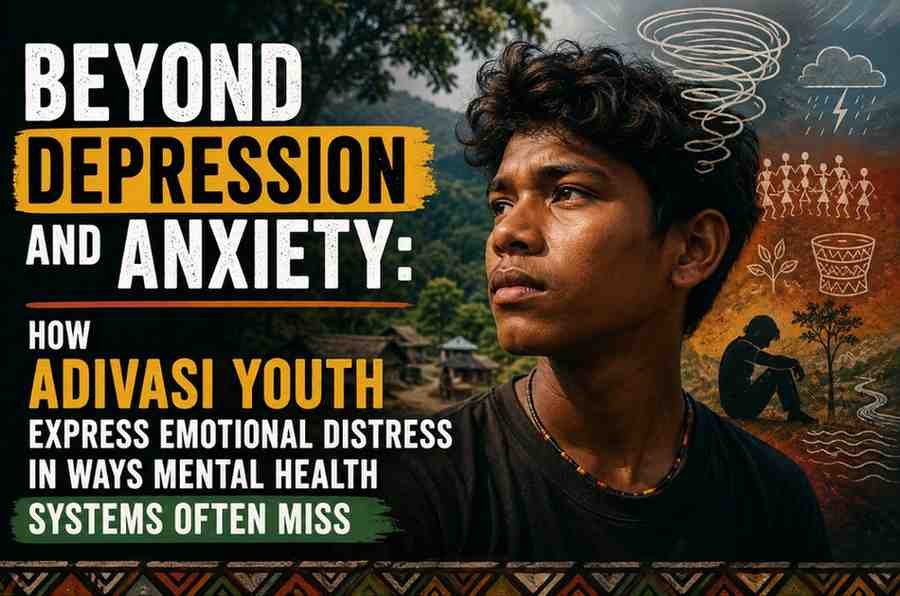
When discussions about Mental Health arise, terms such as depression, anxiety, and stress disorders dominate the conversation. These categories, rooted largely in clinical psychiatry, have helped millions access treatment. But they can also create blind spots, particularly when emotional suffering is experienced and expressed through entirely different cultural frameworks.
Among many Adivasi communities in India, distress may not be described as “depression” or “anxiety” at all. Instead, it can emerge through stories, metaphors, physical complaints, changes in behaviour, withdrawal from community life, or expressions of spiritual imbalance. Mental health experts and anthropologists warn that when healthcare systems fail to recognize these forms of communication, the communities themselves are wrongly perceived as “silent” or unwilling to seek help.
The reality is more complex. Adivasi young people are speaking—but often in languages and cultural forms that conventional mental health systems are not trained to understand.
Why Mental Health Is Not Experienced the Same Way Everywhere
Modern psychiatry relies on diagnostic categories developed largely through Western medical traditions. While these frameworks are valuable, they do not always capture the diverse ways in which emotional distress is understood across cultures.
In many indigenous and tribal communities, mental suffering is intertwined with:
- Relationships and social harmony.
- Connection with land and environment.
- Community identity.
- Spiritual beliefs and traditions.
- Collective experiences rather than individual symptoms.
As a result, emotions may be expressed differently from the language used in hospitals or psychology textbooks.
How Adivasi Youth Communicate Distress
Researchers have found that emotional pain among Adivasi adolescents and young adults is often conveyed indirectly.
Instead of saying “I am depressed,” a young person may:
- Withdraw from social gatherings.
- Become unusually quiet.
- Use metaphors and stories to describe suffering.
- Express distress through physical symptoms.
- Show changes in behaviour or daily routines.
- Speak about loss of connection or purpose.
These expressions are meaningful within their communities, but they may not fit neatly into conventional diagnostic frameworks.
The Danger of Mistaking Difference for Silence
One of the greatest challenges, experts say, is that healthcare professionals sometimes interpret unfamiliar expressions of distress as reluctance to talk or lack of awareness.
In reality, the issue may lie in a mismatch between how suffering is experienced and how mental health systems expect it to be described.
When symptoms do not conform to clinical expectations, communities risk being misunderstood or excluded from care.
| Clinical Mental Health Language | Possible Expressions Among Adivasi Communities |
|---|---|
| “I feel depressed” | Withdrawal from social life |
| “I am anxious” | Stories or metaphors describing unease |
| Mood symptoms | Changes in behaviour and routine |
| Emotional vocabulary | Physical complaints and fatigue |
| Individual distress | Community and relationship-based concerns |
An Overlooked Factor: Historical and Social Stress
Emotional distress among Adivasi youth cannot be understood in isolation from broader social realities.
Many indigenous communities face challenges such as:
- Displacement and loss of traditional lands.
- Economic insecurity.
- Educational barriers.
- Social discrimination.
- Rapid cultural change.
- Migration and identity conflicts.
These pressures can profoundly affect mental well-being, particularly among younger generations navigating multiple worlds simultaneously.
Yet conventional mental health models often focus narrowly on individual symptoms while overlooking these structural influences.
Why Cultural Context Matters in Mental Healthcare
Mental health experts increasingly emphasize the importance of culturally sensitive care.
This means understanding that:
- Different communities have different emotional vocabularies.
- Healing practices vary across cultures.
- Family and community play important roles.
- Traditional knowledge can complement modern treatment.
- Trust is essential for effective care.
Without cultural understanding, even well-intentioned interventions may fail to reach those who need support.
The Role of Stories and Metaphors
In many indigenous cultures, stories serve as powerful tools for expressing experiences that are difficult to describe directly.
Metaphors may communicate sadness, loneliness, fear, or loss in ways that feel more natural and socially acceptable than clinical language.
Rather than dismissing such expressions as vague, experts argue that healthcare workers should learn to interpret them as meaningful narratives of emotional suffering.
Young People Caught Between Two Worlds
Adivasi youth today often navigate a complex intersection of tradition and modernity.
Many are exposed to mainstream education, social media, and urban lifestyles while also maintaining ties to ancestral customs and community values.
This balancing act can create tensions involving:
- Identity and belonging.
- Educational pressures.
- Employment uncertainty.
- Cultural expectations.
- Generational differences.
These experiences shape mental health in ways that standard diagnostic categories may not fully capture.
How Mental Health Systems Can Become More Inclusive
Experts recommend several approaches to bridge cultural gaps:
- Training healthcare workers in cultural competence.
- Involving community leaders and elders.
- Using local languages and culturally relevant examples.
- Respecting traditional healing practices where appropriate.
- Building trust through community-based services.
Such approaches can improve access to care and ensure that emotional suffering is recognized rather than overlooked.
A Broader Lesson for Mental Health Care
The experiences of Adivasi young people challenge a common assumption: that emotional distress always appears in universally recognizable forms.
Human suffering is deeply shaped by culture, relationships, and history. Recognizing this diversity does not weaken psychiatry—it enriches it.
Listening carefully to how communities express pain may be just as important as applying diagnostic criteria.
Conclusion
For many Adivasi young people, emotional distress may not be described using terms like depression or anxiety. Instead, it may emerge through stories, silence, withdrawal, behaviour, or cultural metaphors that carry profound meaning within their communities.
The challenge facing mental health systems is not that these voices are absent, but that they are often speaking in languages and forms that medicine has yet to fully learn to hear. True inclusion begins not with imposing categories, but with listening more carefully to the many ways human beings express suffering.
For breaking news and live news updates, like us on Facebook or follow us on Twitter and Instagram. Read more on Latest Health on thefoxdaily.com.






COMMENTS 0