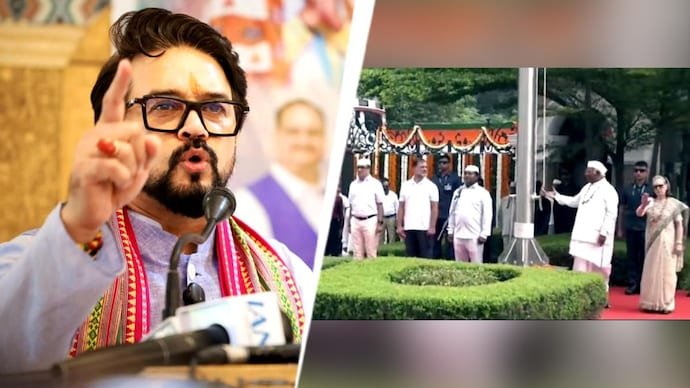
Former Union minister Anurag Thakur on Saturday launched a sharp attack on the Congress over its decision to sing only the first two verses of Vande Mataram, accusing the party’s leadership of treating itself as being above the Constitution and the rules of the country.
Speaking in Indore, the Bharatiya Janata Party leader questioned why the Congress could not spare the roughly three minutes and ten seconds he said were required to sing the full national song. He specifically targeted the Gandhi family, referring to Congress leaders Sonia Gandhi, Rahul Gandhi and Priyanka Gandhi Vadra.
Thakur’s comments came amid a broader political confrontation between the BJP and Congress over nationalism, the Constitution, the legacy of the Emergency and the role of the Opposition in Indian public life.
During his visit to Indore, Thakur also criticised Rahul Gandhi’s upcoming student outreach programme, “Chhatron Ki Goonj”, scheduled in the city on September 19. Later, while addressing young people at another event, he shifted the focus toward India‘s development ambitions, entrepreneurship and the goal of building a developed India by 2047.
What did Anurag Thakur say about Vande Mataram?
Thakur’s central criticism focused on the Congress decision to sing only the opening two verses of Vande Mataram rather than the full song.
He questioned why the party’s leadership could not devote the few minutes required for the complete national song and suggested that the decision reflected a deeper attitude toward national symbols and constitutional principles.
Thakur alleged that the Gandhi family considers itself above the country’s rules and the Constitution. His comments were framed as a political attack on the Congress leadership rather than a neutral discussion about the historical or cultural dimensions of Vande Mataram.
The controversy over the song has once again brought questions about the political use of national symbols into the spotlight. Vande Mataram has a distinctive place in India’s history, having been closely associated with the freedom movement and later recognised as the country’s national song.
Why Vande Mataram remains politically sensitive
Vande Mataram, written by Bankim Chandra Chattopadhyay, occupies an important place in India’s nationalist history. It became a rallying song during the freedom movement and has remained closely connected with the country’s political and cultural identity.
At the same time, debates around the song have periodically generated disagreement over which verses should be performed and how its religious imagery should be interpreted in a diverse constitutional democracy.
That history is important to understanding why disputes over Vande Mataram can quickly become politically charged.
When political parties differ over how the song should be performed, the disagreement often extends beyond the duration or selection of verses. It can become a larger argument over nationalism, secularism, cultural identity and the meaning of national symbols.
Thakur targets the Gandhi family
Thakur’s criticism was directed specifically at the Gandhi family, which remains central to the Congress leadership structure and political identity.
He referred to Sonia Gandhi and her children, Rahul Gandhi and Priyanka Gandhi Vadra, while accusing them of believing they were above the Constitution and national rules.
The allegation forms part of a recurring BJP criticism of the Congress, in which the party’s leadership is portrayed as having exercised excessive political privilege during earlier periods of Indian politics.
By invoking the Gandhi family’s political prominence, Thakur sought to transform what could otherwise have remained a disagreement over the performance of a national song into a wider argument about political accountability.
Congress-BJP battle over the Constitution
The reference to the Constitution was also significant because constitutional politics has become a major theme in the country’s political discourse.
Thakur invoked Dr BR Ambedkar, saying that although Ambedkar gave India its Constitution, the Congress had insulted him. He also referred to the Emergency as a “dark chapter” in the country’s history.
The Emergency, imposed in 1975 by the then Congress government led by Prime Minister Indira Gandhi, remains one of the most frequently cited examples in BJP criticism of the Congress.
For the BJP, the period represents an important historical argument about the dangers of concentrated political power and the suspension of civil liberties.
Congress leaders have historically defended themselves against such criticism by pointing to the party’s broader role in the freedom movement, institution-building and India’s democratic development.
Why the Emergency remains a political weapon
The Emergency continues to carry considerable symbolic weight in Indian politics because fundamental rights were curtailed, political opponents were detained and press freedoms were restricted during the period.
Over the decades, political parties have repeatedly invoked the Emergency to make broader arguments about their opponents’ commitment to democracy and constitutional institutions.
Thakur’s decision to connect the present Vande Mataram controversy with the Emergency therefore reflects a familiar BJP strategy: placing a current political disagreement within a larger historical narrative about Congress rule.
It also allows the BJP to present itself as the defender of constitutional democracy while portraying Congress’s past and present decisions as evidence of a different political philosophy.
Thakur attacks Rahul Gandhi’s student programme
Thakur also targeted Congress MP Rahul Gandhi over his upcoming student outreach programme, “Chhatron Ki Goonj”, scheduled to be held in Indore on September 19.
Rather than focusing on the programme’s stated objectives, Thakur used the occasion to criticise Gandhi’s wider political positions.
He said young people would take Rahul Gandhi more seriously only when he stopped what Thakur described as insulting the country, criticising Sanatan traditions and pursuing appeasement politics.
Those comments reflect the BJP’s broader criticism of Rahul Gandhi, particularly over questions involving nationalism, religion and the Congress’s outreach to minority communities.
The remarks also indicate how youth-focused political programmes have become important arenas for competing narratives between India’s major political parties.
The battle for young voters
Rahul Gandhi’s student outreach initiative is significant because younger voters represent an increasingly important political constituency.
Political parties across India are competing for the attention of students and first-time voters on issues including education, employment, technology, entrepreneurship and economic opportunity.
The BJP has increasingly emphasized youth participation through themes such as start-ups, digital India, manufacturing and self-employment. The Congress, meanwhile, has sought to frame youth politics around jobs, educational opportunities, social justice and institutional concerns.
Thakur’s criticism suggests that the BJP intends to challenge Rahul Gandhi directly on this terrain rather than allowing student outreach to remain an uncontested Congress space.
From political attack to development message
Later in the day, Thakur shifted from attacking Congress to addressing the larger question of India’s development trajectory.
He urged young people to play an active role in achieving the goal of a developed India by 2047, a long-term national objective frequently highlighted by the central government.
The target is linked to the centenary of India’s independence in 2047. It envisions an Economy and society with significantly higher levels of income, infrastructure, technological capability and human development.
For the BJP, young Indians are expected to be central to that transformation because today’s students will constitute much of India’s workforce, entrepreneurial community and professional leadership by the time the country reaches 100 years of independence.
Why the start-up ecosystem became part of Thakur’s speech
Thakur also highlighted the rapid expansion of India’s start-up ecosystem, presenting entrepreneurship as evidence of changing economic opportunities.
He said India had about 500 recognised start-ups in 2014 and that the number has now risen to more than 2.23 lakh.
The growth reflects the expansion of India’s technology and entrepreneurship ecosystem over the past decade. Government recognition programmes, easier digital payments, expanding internet access, venture investment and a large domestic consumer market have contributed to the wider Environment in which start-ups can develop.
The change is important because India’s development strategy increasingly seeks to move beyond traditional employment models and encourage entrepreneurship, innovation and technology-driven businesses.
From 500 start-ups to more than 2.23 lakh
The contrast in start-up numbers is one of the strongest examples used by Thakur to demonstrate economic transformation.
A start-up ecosystem is about more than the number of companies registered. It also includes venture capital, incubators, accelerators, technology infrastructure, skilled workers and customers willing to adopt new products.
India’s digital transformation has significantly lowered some of the barriers to launching and scaling businesses, particularly in financial services, software, e-commerce, education technology and other technology-driven sectors.
However, the rapid increase in the number of start-ups does not necessarily mean every company is successful. Many young businesses fail, while others struggle to secure funding, achieve profitability or scale beyond the domestic market.
The health of the start-up ecosystem should therefore be judged through multiple indicators rather than registrations alone.
Youth entrepreneurship is becoming a political theme
The BJP’s emphasis on start-ups reflects a broader political attempt to connect economic policy with the aspirations of India’s younger population.
For many young Indians, employment remains one of the most important economic concerns. Encouraging entrepreneurship offers another pathway, although it cannot substitute entirely for the creation of large numbers of stable jobs.
Start-ups tend to concentrate in certain sectors and urban centres, meaning access to entrepreneurial opportunities is not evenly distributed across the country.
The next stage of India’s start-up story will therefore involve expanding innovation beyond major metropolitan areas and ensuring that young people from smaller cities and rural regions can participate in the digital economy.
What “developed India by 2047” means
Thakur’s appeal to young people to help build a developed India by 2047 connects the political speech to one of the central long-term themes of the present government.
Becoming a developed economy involves more than increasing GDP. It requires improvements in productivity, education, healthcare, infrastructure, living standards, technological capacity and institutional quality.
It also requires creating enough productive employment for a large working-age population.
This makes the youth component particularly important. India’s demographic advantage can produce significant economic gains if young people are healthy, educated and productively employed. If skills and employment opportunities fail to keep pace, the same demographic structure can create economic and social pressures.
Political messaging around nationalism and growth
Thakur’s comments in Indore combined two themes that frequently feature in BJP political messaging: nationalism and economic development.
The attack on Congress over Vande Mataram was framed around national symbols, the Constitution and the Gandhi family’s political legacy. The later discussion of start-ups and the 2047 development goal shifted the focus toward economic opportunity and India’s future.
The combination is politically useful because it allows the BJP to appeal simultaneously to voters concerned about national identity and those focused on jobs, entrepreneurship and economic growth.
For Congress, the challenge is to counter that narrative while maintaining its own emphasis on constitutional rights, social welfare, pluralism and employment.
Congress is likely to face more scrutiny over national symbols
The Vande Mataram controversy could continue to generate political debate because national symbols occupy a particularly sensitive position in Indian politics.
Political parties are generally expected to demonstrate respect for national institutions and symbols, but disagreements can emerge over how those symbols should be used in public and political settings.
The Congress decision to focus on the first two verses provides the BJP with an opportunity to question the party’s nationalist credentials.
Whether that criticism has lasting political impact will depend on how the Congress explains its decision and whether voters see the issue as significant compared with more immediate concerns such as inflation, employment and economic opportunity.
The Gandhi family remains a central BJP target
Thakur’s remarks also demonstrate that the BJP continues to use the Gandhi family’s prominence as a central line of attack against Congress.
The family remains closely associated with the Congress’s national political identity, making Sonia Gandhi, Rahul Gandhi and Priyanka Gandhi Vadra frequent targets in BJP campaigns.
Criticism of the family allows BJP leaders to link current political disputes with historical arguments concerning dynastic politics, the Emergency and institutional power.
Congress, on the other hand, has sought to emphasize the individual political roles and electoral mandates of its current leaders rather than treating the party as a family-controlled organization.
What Thakur’s remarks reveal about the political debate
The speech in Indore was not limited to one issue. It combined criticism of Congress over Vande Mataram, attacks on Rahul Gandhi, references to the Emergency and Ambedkar, and a pitch for youth participation in India’s economic future.
That range reflects the way contemporary political speeches often combine historical narratives with current policy themes.
The BJP’s argument is that India’s present economic trajectory should be understood as a transformation from the conditions of earlier Congress-led periods. The Congress’s response is likely to focus on whether economic growth is adequately improving people’s everyday lives and protecting democratic institutions.
Both sides are therefore competing not only over policies but also over the story Indians tell themselves about the country’s past and future.
Why the youth vote matters in this contest
India has a very large young population, making students and first-time voters a crucial political audience.
Political parties know that young voters are interested in education, career opportunities, technology and entrepreneurship, but they are also influenced by questions of identity, governance and national politics.
That is why Thakur’s speech moved from Vande Mataram and the Constitution to start-ups and the 2047 development vision.
The message attempts to present the BJP as a political force that combines national confidence with economic ambition.
Rahul Gandhi’s student outreach effort indicates that Congress is simultaneously trying to build a stronger connection with young Indians.
What could matter more than the Vande Mataram row?
While national-symbol controversies can generate intense political debate, young voters will ultimately evaluate governments and political parties on a broader range of issues.
Employment, education quality, household incomes, entrepreneurship, infrastructure and opportunities for upward mobility are likely to remain central concerns.
The political importance of the start-up figures Thakur cited is therefore tied to a larger question: can India’s entrepreneurship boom translate into sustained employment and productivity gains for a much wider section of the population?
Likewise, the significance of the Vande Mataram dispute will depend on whether voters regard it as a meaningful question of national identity or as another episode in the ongoing political contest between BJP and Congress.
Thakur’s two-track message in Indore
Anurag Thakur’s visit to Indore produced a distinctly two-track political message.
On one side, he launched an aggressive attack on the Congress and the Gandhi family, accusing them of placing themselves above constitutional rules and questioning their decision over Vande Mataram. He also targeted Rahul Gandhi’s upcoming student event and revived BJP criticisms involving the Emergency and the Congress’s record.
On the other side, he presented a forward-looking narrative centred on India’s youth, start-ups and the ambition of building a developed India by 2047.
The combination is significant because it reflects the BJP’s broader electoral strategy of connecting criticism of the Opposition with a positive account of India’s economic transformation.
Vande Mataram dispute becomes another political flashpoint
The latest confrontation over Vande Mataram is unlikely to remain limited to the question of how many verses should be sung. Thakur has turned it into a broader argument about constitutional responsibility, nationalism and the political legacy of the Gandhi family.
His criticism of Rahul Gandhi adds another layer to the dispute, particularly as Congress seeks to strengthen its engagement with students and younger voters.
At the same time, Thakur’s emphasis on India’s expanding start-up ecosystem and the goal of becoming a developed country by 2047 shows that the BJP wants the political conversation to extend beyond accusations and historical controversies.
For Congress, the immediate challenge is to defend its position on the national song while keeping attention on issues it considers more important to voters. For the BJP, the challenge is to convert economic claims and nationalist messaging into a broader argument about measurable improvements in jobs, incomes and opportunity.
Ultimately, the political contest goes beyond three minutes and ten seconds of Vande Mataram. It is a fight over competing visions of India one shaped by arguments about nationalism, constitutional history and political legacy, and the other centred on economic growth, entrepreneurship and the promise of a developed India by 2047.
For breaking news and live news updates, like us on Facebook or follow us on Twitter and Instagram. Read more on Latest India on thefoxdaily.com.






COMMENTS 0