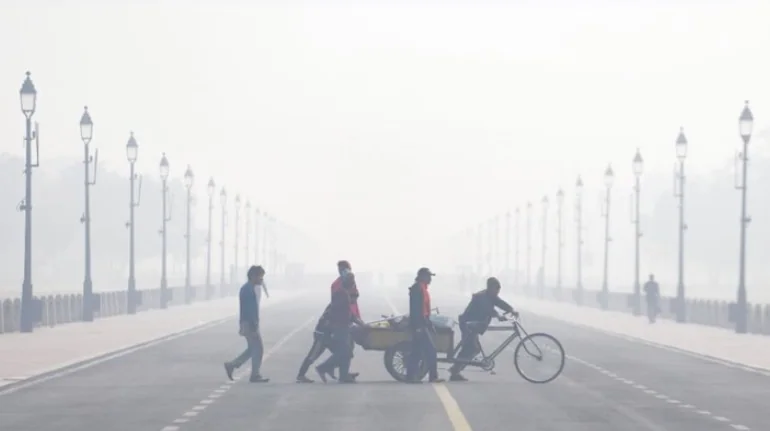
The Centre has directed government and private offices in Delhi and five neighbouring National Capital Region (NCR) districts to ensure that at least half their employees Work From Home from November 5 to November 20, as authorities intensify measures to control winter air pollution. Under the new arrangement, physical attendance will be capped at 50% in covered workplaces, with the remaining employees required to work remotely.
The directive was issued by the Commission for Air Quality Management (CAQM) and covers the National Capital Territory of Delhi, along with Gurugram, Faridabad, Sonipat, Ghaziabad and Gautam Buddha Nagar. The measure is intended to reduce pollution associated with daily commuting during a period when air quality across the region typically deteriorates.
The order does not cover every district in the NCR. It specifically identifies five neighbouring districts, while industrial establishments and essential services where remote working is not feasible are excluded from the arrangement.
50% physical attendance limit from November 5
Under the CAQM directive, government and private offices in the six covered areas must restrict the number of employees physically attending workplaces to no more than half their workforce. The remaining staff members are expected to work from home during the November 5–20 period.
The instruction makes remote working an organisational requirement for employers covered by the order, rather than leaving the decision entirely to individual employees. Government departments and private companies will need to organise staffing and work schedules to comply with the attendance limit.
The exemption for industrial establishments and essential services recognises that some operations require employees to be physically present. Services that cannot reasonably function through remote working are therefore outside the general restriction.
The CAQM measure also extends the geographical reach of the work-from-home arrangement beyond Delhi. Offices in Gurugram, Faridabad, Sonipat, Ghaziabad and Gautam Buddha Nagar will face the same attendance cap during the specified period.
Construction and demolition activities restricted across NCR
The work-from-home directive is part of a wider package of preventive measures announced by CAQM for November 5–20. The Commission has also ordered a halt to dust-generating demolition and outdoor construction activities across the NCR during the same period.
The construction restrictions cover more than building sites. They also extend to linear public infrastructure projects, including highways, roads, flyovers, overbridges, power transmission lines, pipelines and telecommunications work. These activities can generate dust, adding to the pollution burden when weather conditions limit the dispersion of pollutants.
Several essential projects have been exempted. These include work related to railways, metro services, airports, inter-state bus terminals, hospitals, water supply and sanitation, national security and defence-related activities, as well as projects of national importance. The exemptions are intended to allow critical infrastructure and public services to continue while other dust-generating work is paused. :chatgpt-content-reference{index=”0″}
Why authorities are introducing restrictions before mid-November
CAQM has cited historical air-quality data to explain why the restrictions are being introduced in advance. The Commission’s analysis found that pollution levels in Delhi-NCR have repeatedly increased during early and mid-November, with the Air Quality Index (AQI) reaching the ‘Severe’ and ‘Severe+’ categories on some days.
The seasonal deterioration is linked to a combination of local emissions, crop-residue and biomass burning, and unfavourable weather conditions. During winter, low wind speeds and limited atmospheric mixing can prevent pollutants from dispersing effectively, allowing pollution to accumulate near the surface.
In its order, the Commission said the recurring pattern highlighted the need for preventive action before and during peak pollution episodes. The November 5–20 measures are therefore designed to reduce emissions during a period considered particularly vulnerable, rather than waiting for air quality to reach the most hazardous categories. :chatgpt-content-reference{index=”1″}
Delhi government already has a separate work-from-home arrangement
The CAQM order comes alongside a separate winter pollution framework announced by the Delhi government. Under that arrangement, government and private offices in the national capital are required to limit physical attendance to 50% between November 1 and January 31, with the remaining employees working from home.
The Delhi government’s measures also call on private establishments to introduce staggered working hours wherever possible and encourage employees to use carpooling, ride-sharing and public transport. Essential and emergency services, including hospitals, fire services, public transport, electricity, water supply, sanitation and disaster management agencies, are exempt from the work-from-home restrictions.
Office timings have also been staggered to reduce congestion during peak commuting hours. Municipal Corporation of Delhi offices are scheduled to operate from 8:30 am to 5 pm, while Delhi government offices will function from 10 am to 6:30 pm between November 1 and February 28.
The two arrangements have different geographical and time limits. The Delhi government’s framework applies to offices within the capital over a longer winter period, while the CAQM directive extends the 50% physical-attendance cap to five neighbouring NCR districts from November 5 to November 20. :chatgpt-content-reference{index=”2″}
Restrictions on older vehicles entering Delhi
Vehicle emissions are another major focus of the national capital’s winter pollution response. The Delhi government has announced restrictions on the entry of vehicles registered outside the capital that do not meet BS-VI emission standards. The measure is scheduled to remain in force from November 1 to January 31.
Vehicles powered by compressed natural gas (CNG) or electricity are exempt, along with emergency vehicles such as ambulances, fire tenders and police vehicles. The restrictions could affect a substantial number of commuters travelling into Delhi from neighbouring cities and districts.
Transport Department estimates cited in reports suggest that more than 10 lakh vehicles from Gurugram, Faridabad, Noida, Greater Noida and Ghaziabad could be affected. The measure is intended to reduce emissions from older vehicles entering the capital during the winter pollution season.
The vehicle restrictions are separate from the CAQM’s November 5–20 work-from-home order. Together, however, the measures target two sources of pollution associated with urban activity: emissions from road transport and dust or emissions generated by construction and demolition work. :chatgpt-content-reference{index=”3″}
Construction curbs in Delhi will run for a longer period
Delhi also has a separate schedule for controlling construction-related dust. Dust-generating demolition and outdoor civil construction activities in the capital are scheduled to remain restricted from November 1 to January 31, except for specified essential public infrastructure projects.
Some finishing activities, including plumbing and electrical work inside construction sites, are permitted subject to compliance with dust-control requirements. A stricter period of restrictions is also scheduled later in the winter, when a broader halt to construction and demolition activities is planned.
These city-level restrictions operate alongside the CAQM’s temporary NCR-wide order. The latter specifically covers dust-generating demolition and outdoor construction between November 5 and November 20, including certain linear infrastructure projects that may otherwise continue under ordinary construction schedules.
Higher parking charges proposed to discourage private vehicle use
The Delhi government has also proposed doubling parking charges at authorised parking sites from November 1 to February 28. The proposed increase is intended to discourage unnecessary use of private vehicles and encourage commuters to consider public transport and shared travel options.
Parking facilities owned and managed by the Delhi Metro Rail Corporation are exempt from the proposed hike. However, implementation at parking sites managed by the Municipal Corporation of Delhi has faced uncertainty because some facilities operate under existing contracts with private operators.
The parking measure is part of the wider effort to reduce vehicle movement during the winter months. Its effectiveness will depend partly on how consistently the revised charges are implemented and whether commuters have practical alternatives for travelling across the city.
Industrial units violating pollution rules face possible closure action
Industrial emissions are also under scrutiny. According to an IANS report cited in coverage of the pollution measures, the Central Pollution Control Board (CPCB) has directed pollution control boards in Delhi, Haryana, Uttar Pradesh and Rajasthan to issue five-day show-cause notices for closure to industrial units in the NCR found violating pollution-control norms.
The action is intended to strengthen enforcement against industrial sources that fail to meet prescribed environmental standards. The notices give authorities a mechanism to initiate closure-related proceedings against units found to be non-compliant.
Industrial pollution controls are particularly important because the region’s air quality is affected by multiple sources. Reducing commuting emissions or construction dust alone cannot address the full pollution burden if industrial units and other sources continue to release pollutants in violation of applicable standards.
Delhi’s recent AQI improvement may offer only temporary relief
Delhi recorded a temporary improvement in air quality on October 30, when its AQI moved into the ‘Moderate’ category after remaining in the ‘Poor’ category on October 28 and 29. Rainfall associated with Cyclone Arnab brought down temperatures and helped clear some pollutants from the atmosphere.
However, the improvement was not expected to last. The Air Quality Early Warning System for Delhi forecast that air quality could remain in the ‘Moderate’ category until October 31 before slipping into the ‘Poor’ category from November 1. The forecast also indicated the possibility of further deterioration over the following six days.
A temporary improvement following rainfall does not necessarily indicate that the underlying pollution sources have been controlled. Weather conditions can influence how quickly pollutants disperse, but emissions from transport, construction, industry and other activities continue to affect the region’s air quality.
What the November 5 work-from-home order means for employees
Employees working in government and private offices across Delhi, Gurugram, Faridabad, Sonipat, Ghaziabad and Gautam Buddha Nagar should expect their employers to organise work schedules around the 50% physical-attendance limit during the specified period.
For covered offices, the remaining workforce will need to work remotely. Employers may have to coordinate attendance rotations, remote access to office systems, communication arrangements and work allocation to ensure that regular operations continue.
Employees in industrial establishments and essential services where remote working is not feasible are outside the general arrangement. The order does not mean that every workplace in the wider NCR must close or that all employees can independently decide whether to work from home.
A coordinated attempt to reduce winter pollution
The CAQM’s November 5–20 directive brings together office attendance restrictions and construction-related controls for a period when Delhi-NCR has historically experienced worsening air quality. The measures complement the Delhi government’s longer winter framework, which includes vehicle restrictions, staggered office timings, construction curbs and proposed higher parking charges.
The work-from-home requirement is intended to reduce commuting-related emissions, while the construction restrictions target dust generated by demolition and outdoor civil work. Vehicle and industrial enforcement measures address additional sources of pollution across the region.
Whether these steps produce a sustained improvement will depend on compliance by employers, construction agencies, vehicle owners and industrial operators, as well as weather conditions during November. For now, the immediate requirement is clear: covered offices must limit physical attendance to 50% from November 5 to November 20, while authorities enforce the accompanying pollution-control measures across Delhi-NCR.
For breaking news and live news updates, like us on Facebook or follow us on Twitter and Instagram. Read more on Latest India on thefoxdaily.com.




COMMENTS 0