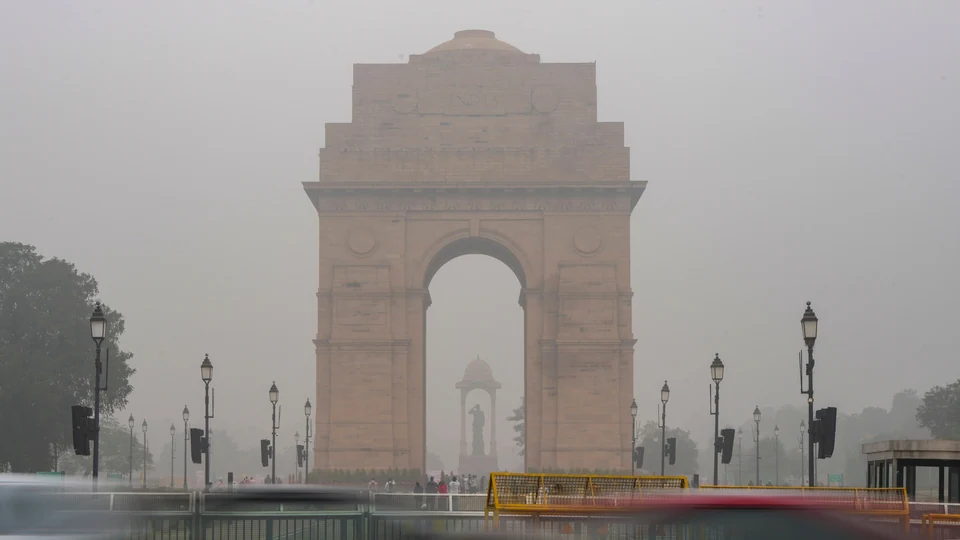
A thick haze covered Delhi and several parts of the National Capital Region (NCR) on Tuesday morning as Air Quality remained in the ‘very poor’ category, days ahead of Diwali. Reduced visibility was reported across large parts of the region as pollution levels continued to rise.
Delhi’s Air Quality Index (AQI) stood at 331 at 7:05 am on Tuesday, placing the national capital in the very poor category. The 24-hour average AQI on Monday was 324, marking the worst reading in 271 days and a sharp increase from Sunday’s 261. The AQI had been 60 on Friday, when air quality was classified as ‘satisfactory’.
Bawana, Narela and Punjabi Bagh Among 8 Areas in Severe Category
Monitoring data from 58 of Delhi’s 59 air quality stations showed that eight stations recorded severe pollution levels on Tuesday morning. Bawana, Narela and Punjabi Bagh were among the affected areas.
Only one monitoring station, located at IGNOU in Maidangarhi, recorded moderate air quality.
According to the Central Pollution Control Board (CPCB), AQI readings are classified into six categories:
- Good: 0–50
- Satisfactory: 51–100
- Moderate: 101–200
- Poor: 201–300
- Very Poor: 301–400
- Severe: 401–500
The readings indicate that Delhi’s overall air quality remained very poor, while several local monitoring stations recorded pollution levels in the severe category.
PM2.5 Remains the Main Pollutant Across Delhi
PM2.5 was identified as the main pollutant at 53 of the 58 reporting monitoring stations on Tuesday morning, while PM10 was the primary pollutant at five stations.
A day earlier, PM2.5 was the main pollutant at 51 stations, compared with seven stations reporting PM10 as the primary pollutant.
PM2.5 refers to fine particulate matter that can enter deep into the lungs, while PM10 consists of larger inhalable particles. The dominance of PM2.5 across most monitoring locations highlights the extent of fine-particle pollution in the capital.
NASA Detects 1,561 Farm Fires in Punjab and Haryana
Satellite observations from NASA detected 1,561 farm fires in Punjab and Haryana between October 1 and November 2. Punjab accounted for 1,406 fires, while 155 were recorded in Haryana. A total of 167 fires were detected on November 2.
During the same period last season, satellite data counted 2,068 farm fires. However, the figures require careful interpretation because the timing of stubble burning has increasingly shifted towards later hours.
In 2025, around 98% of the fire heat recorded by Meteosat occurred after 3 pm, compared with 94% in 2024. Satellite counts may therefore differ because of changes in the timing of agricultural fires.
The available figures also represent an undercount, as much of the burning now takes place after the satellite passes over the region at approximately 1:30 pm.
GRAP Stage 2 Measures Imposed Across Delhi-NCR
With air quality deteriorating, the Commission for Air Quality Management (CAQM) invoked Stage 2 of the Graded Response Action Plan (GRAP) across Delhi-NCR on Monday.
Under the measures, the Delhi government and NCR state governments have been directed to stagger office timings for government and municipal employees. The directions cover Delhi and the districts of Gurugram, Faridabad, Ghaziabad and Gautam Buddha Nagar.
Other measures include increasing parking fees to discourage the use of private vehicles and asking resident welfare associations (RWAs) to provide electric heaters to security staff. The heaters are intended to prevent open burning for warmth during colder hours.
These measures are also included in Delhi’s winter action plan, which came into effect on November 1.
Delhi Faces Rising Pollution Ahead of Diwali
Delhi’s worsening AQI comes as the national capital approaches Diwali, a period when pollution levels can become an additional concern. The combination of high particulate pollution, farm fires and local emission sources has kept attention focused on air quality across the region.
With eight monitoring stations recording severe conditions and the overall AQI remaining very poor, authorities have activated additional pollution-control measures across Delhi-NCR. The effectiveness of these steps will be important as the capital moves further into the winter pollution season.
For breaking news and live news updates, like us on Facebook or follow us on Twitter and Instagram. Read more on Latest India on thefoxdaily.com.



COMMENTS 0