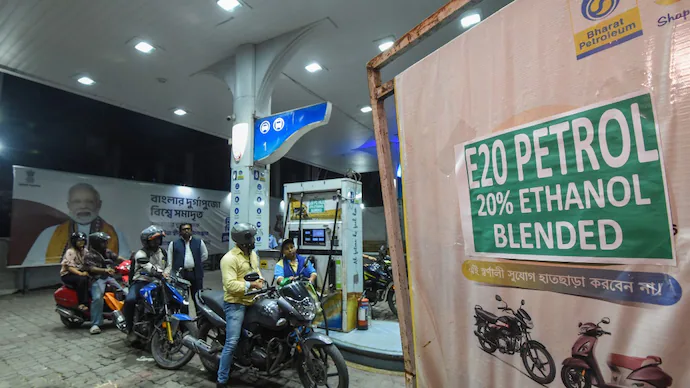
India is expanding its ethanol-based transport fuel strategy by allowing vehicle manufacturers to seek certification for flex-fuel vehicles designed to run on E85 and E100. The Ministry of Road Transport and Highways, headed by Nitin Gadkari, notified amendments to the Central Motor Vehicles Rules, 1989, on October 26, 2026, bringing E100 within the emission certification framework alongside E85.
The change marks another step in the government’s effort to reduce dependence on imported crude oil and expand the use of domestically produced fuel. It also introduces a new dimension to an increasingly contentious debate over ethanol-blended petrol, particularly E20, which contains 20 per cent ethanol and is intended for compatible petrol vehicles.
For motorists, the distinction between the two developments is essential. The new rules do not require existing petrol cars to switch to E85 or E100, nor do they make these fuels suitable for vehicles that have not been designed and certified to use them. Instead, they create a regulatory pathway for a different category of vehicles engineered to operate with much higher ethanol concentrations.
The policy’s long-term success will depend on more than regulatory approval. Vehicle availability, fuel distribution, operating costs, engine compatibility and the environmental impact of ethanol production will all influence whether high-ethanol fuels become practical alternatives for Indian consumers.
What India’s E85 and E100 notification actually changes
The October 26 amendment updates the Central Motor Vehicles Rules, 1989, to explicitly accommodate E100 in the emission certification framework alongside E85. This enables manufacturers to pursue the necessary certification for vehicles designed to operate on these high-ethanol fuels.
E85 is a fuel blend containing up to 85 per cent ethanol, while E100 refers to fuel consisting predominantly of ethanol. Both represent a substantial increase in ethanol concentration compared with E20 petrol, which has become a major focus of India’s existing blending programme.
The notification is a regulatory development rather than a declaration that E85 and E100 are immediately available nationwide. The amendment does not, by itself, guarantee the launch of new vehicles, establish a timetable for fuel availability or require petrol stations to introduce high-ethanol blends.
Manufacturers must design vehicles for the relevant fuel and meet applicable certification requirements. Fuel suppliers must also consider production, storage, transportation and dispensing arrangements before these fuels can become widely accessible to consumers.
The immediate significance is that India’s regulatory framework is making room for vehicles capable of using much higher ethanol concentrations. The next challenge is translating that permission into commercially available vehicles and a dependable fuel supply.
E20 vs E85 vs E100: What motorists need to know
Fuel labels provide a simple way to understand the differences between ethanol blends. The number following the letter E indicates the approximate proportion of ethanol in the fuel by volume.
- E20 petrol: Contains 20 per cent ethanol. It is part of India’s existing petrol-blending programme and has generated debate over mileage, compatibility and the availability of lower-ethanol alternatives.
- E85 fuel: Contains up to 85 per cent ethanol. It is intended for vehicles specifically designed and certified to operate on this blend or the applicable range of fuels.
- E100 fuel: Consists predominantly of ethanol. Vehicles using it require suitable engineering and certification for the fuel’s characteristics.
These fuels should not be treated as interchangeable simply because they are all used in internal-combustion engines. A vehicle designed for E20 is not automatically compatible with E85 or E100.
Higher ethanol concentrations affect the requirements of an engine and its fuel-delivery system. A manufacturer developing a vehicle for E85 or E100 must account for the properties of those fuels when designing the relevant components and engine controls.
For existing vehicle owners, the practical rule is straightforward: follow the manufacturer’s approved fuel specifications. The new notification does not override those specifications or authorise motorists to use high-ethanol fuel in an ordinary petrol vehicle.
Why flex-fuel vehicles are different from conventional petrol cars
Flex-fuel vehicles are engineered to operate on different approved proportions of petrol and ethanol. Depending on the model, a single vehicle can accommodate varying fuel blends without requiring the driver to make mechanical adjustments each time the fuel composition changes.
The technology depends on compatible fuel-system materials and engine-management systems capable of adjusting operation to the fuel being used. These design features help a vehicle operate within the range of blends for which it has been developed and certified.
Conventional petrol vehicles may not have the same capability. Their fuel systems and engine controls are designed around specified fuel requirements, and those requirements can differ substantially from those associated with high-ethanol blends.
This is why compatibility cannot be determined solely by the vehicle’s age, its engine size or whether its manufacturer describes it as suitable for ethanol-blended petrol. Compatibility with E20 does not establish compatibility with E85 or E100.
Motorists should consult the owner’s manual and the manufacturer’s official fuel guidance before choosing a blend. Using fuel outside the vehicle’s approved specifications can create operating and compatibility risks.
Why E20 petrol has triggered debate across India
Much of the public discussion surrounding Ethanol Blending has focused on E20 because it affects the existing petrol vehicle fleet. The government has promoted the blend as a way to reduce crude-oil imports and support domestic agricultural supply chains, while some motorists have raised concerns about mileage and the suitability of the fuel for older vehicles.
Complaints of reduced fuel efficiency have been particularly prominent among owners of vehicles originally designed for lower ethanol concentrations. The government has acknowledged that some cars developed for E10 may experience lower mileage when using E20, while maintaining that the impact is limited.
The Centre has also pointed to ethanol’s higher octane rating, which can benefit engine performance when the engine is designed to make use of that characteristic. However, octane rating and energy content are different properties. A higher octane rating does not mean that a litre of ethanol-blended fuel necessarily contains as much energy as a litre of conventional petrol.
That distinction helps explain why mileage remains a concern even when a fuel offers other technical advantages. A vehicle’s fuel economy depends on its design, engine calibration, driving conditions and the characteristics of the fuel being used.
The government has maintained that technical testing supports the E20 programme and that there is no verified evidence of widespread engine damage attributable to the blend. Automobile manufacturers have also publicly assured consumers that their newer vehicles are E20-compliant.
These assurances do not mean that every vehicle will deliver identical mileage or performance. Differences in engine design, vehicle condition and fuel specifications can affect individual outcomes. Motorists should therefore distinguish between reported fuel-efficiency changes and evidence of actual engine damage.
Why the availability of lower-ethanol petrol matters
One of the most persistent points of disagreement concerns consumer choice. Motorists with older vehicles may prefer a lower-ethanol blend if their cars were designed around that fuel, but the availability of such alternatives has become a source of criticism as E20 use has expanded.
The government has resisted demands to restore lower-ethanol petrol as a widely available alternative. Its stated argument is that maintaining separate supplies of different petrol blends across India’s extensive network of filling stations would increase logistical complexity and costs.
There is also a policy trade-off. A nationwide blending programme becomes more complicated if fuel distributors must consistently maintain multiple blends and ensure that motorists can identify the correct option. At the same time, limited choice can create difficulties for consumers whose vehicles have different fuel requirements.
The E85 and E100 rules do not settle this disagreement. Those fuels are intended for specifically designed flex-fuel vehicles, not as replacement options for all motorists who have concerns about E20.
As the programme develops, clear labelling and accurate information about vehicle compatibility will remain important. Consumers need to know not only which fuel is available but also which blends their vehicles are approved to use.
The economic case: Reducing crude-oil imports and supporting farmers
India’s ethanol programme is closely connected to its dependence on imported crude oil. Replacing a portion of petroleum consumption with domestically produced ethanol can reduce the volume of crude oil required for transport fuel and help limit foreign-exchange outflows.
Figures cited by the Ministry of Petroleum and Natural Gas indicate that ethanol blending has saved India more than Rs 1.97 lakh crore in foreign exchange since the 2014-15 supply year. The programme has also reportedly substituted nearly 31.6 million tonnes of crude oil and generated payments exceeding Rs 1.66 lakh crore to farmers.
These figures illustrate the scale of the government’s existing blending strategy. They should not, however, be interpreted as guaranteed savings from the introduction of E85 or E100 vehicles. The financial effects of a higher-ethanol fuel system will depend on production costs, fuel prices, vehicle efficiency and the scale of adoption.
The agricultural connection is another major part of the policy. Ethanol can be produced from agricultural feedstocks, creating a market for eligible crops and supporting businesses involved in processing them. Increased demand may provide additional opportunities for farmers and ethanol producers, although the benefits can vary according to feedstock prices, procurement arrangements and production capacity.
The government has argued that ethanol production can support rural incomes without compromising food security. That objective requires careful management of the relationship between fuel demand and agricultural resources, particularly when crops may have competing uses.
For motorists, the economic distinction is important: national savings on imported crude oil do not automatically translate into lower personal fuel expenses. The cost of driving a flex-fuel vehicle will depend on how much fuel it consumes, the price of that fuel and the vehicle’s purchase and maintenance costs.
Will E85 and E100 make driving cheaper?
Higher-ethanol fuels could provide additional options for vehicles designed to use them, but their price per litre alone will not determine whether they are economical.
Ethanol has a lower energy content per unit of volume than petrol. As a result, a vehicle using a high-ethanol blend may require more fuel by volume to travel the same distance, although the actual difference depends on the engine and its calibration.
Flex-fuel technology allows an engine to adjust to approved fuel blends, but it does not eliminate the underlying difference in energy content. A fuel that appears cheaper at the pump may not necessarily deliver a lower cost per kilometre.
Consumers considering a future E85- or E100-compatible vehicle should compare the purchase price, fuel costs, real-world efficiency and servicing requirements. A meaningful assessment will require reliable information about the particular model and the fuel available to it.
Until high-ethanol vehicles and fuels become commercially accessible on a meaningful scale, it would be premature to assume that the new options will automatically be cheaper for Indian motorists.
Environmental benefits depend on how ethanol is produced
The environmental argument for ethanol blending extends beyond reducing petroleum consumption. Higher ethanol blends can reduce certain exhaust pollutants, including carbon monoxide and some hydrocarbons, when used in appropriately designed engines.
However, the overall greenhouse-gas benefit depends partly on the source of the ethanol and the processes used to produce it. Crop cultivation, processing, energy consumption and transportation all influence the environmental footprint of the fuel.
Consequently, increasing the proportion of ethanol in a vehicle’s fuel does not, by itself, establish the size of the overall emissions reduction. A fuller assessment must consider the entire production chain alongside the vehicle’s energy efficiency and emissions during use.
Food security is another consideration. Greater demand for fuel ethanol can influence agricultural markets, especially when food crops are used as feedstocks. The government has maintained that the programme can support farmers without undermining food supplies, but the outcome depends on production choices and how competing demands on agricultural resources are managed.
India has linked its wider ethanol strategy to reducing imported crude-oil dependence, promoting domestic fuel production and its broader climate objectives, including the target of achieving net-zero emissions by 2070. The contribution of E85 and E100 to those goals will depend on how the fuels are produced, distributed and used.
What India can learn from Brazil and the United States
Flex-fuel technology is already established in countries such as Brazil and the United States. Their experience demonstrates that vehicles can be engineered to use different petrol-ethanol blends, provided the relevant fuel and vehicle systems are compatible.
India’s move creates an opportunity for domestic manufacturers to develop or introduce specialised automotive components and flex-fuel models. It may also encourage investment in ethanol production and the services required to distribute high-ethanol fuels.
However, experience in overseas markets does not guarantee that the same commercial model will work in India without adaptation. The economics depend on local fuel prices, feedstock availability, production costs, consumer demand and the distribution network.
For the technology to gain traction, vehicle manufacturers and fuel suppliers will need to move in step. A flex-fuel vehicle offers limited practical value if the approved fuel is difficult to obtain, while investment in high-ethanol distribution infrastructure depends partly on whether enough compatible vehicles are available.
What existing car and two-wheeler owners should do
The new rules do not require current petrol vehicle owners to make any immediate changes. Owners should continue to use fuels approved by their vehicle manufacturers and should not switch to E85 or E100 unless their vehicles are specifically designed and certified for the relevant fuel.
Motorists who are concerned about E20 should consult the manufacturer’s guidance for their specific model rather than relying on general claims about all petrol vehicles. A vehicle’s stated compatibility, maintenance requirements and fuel specifications are more useful than assumptions based on its age alone.
Consumers should also avoid treating every reported mileage reduction as proof of engine damage. Fuel economy and mechanical condition are separate questions, and an assessment of a particular vehicle should account for its specifications and operating history.
For used-car buyers, checking the approved fuel types is especially important. Claims that a vehicle can use ethanol-blended petrol do not establish that it is suitable for every ethanol concentration.
What happens next in India’s ethanol fuel transition?
The October 26 notification establishes a regulatory route for E85 and E100 flex-fuel vehicles, but it does not set out a nationwide timetable for their availability. The next stage will depend on manufacturers’ product decisions, certification, fuel-distribution arrangements and consumer demand.
Clear information will be essential as more fuel options emerge. Motorists will need reliable guidance about which vehicles can use each blend, while transparent pricing and practical fuel-efficiency information will help consumers evaluate the financial case.
The broader policy will also have to balance energy security and agricultural benefits against consumer concerns, production costs and environmental considerations. These factors will influence whether higher-ethanol fuels become a significant part of India’s transport system or remain a limited option for specialised vehicles.
India’s move towards E85 and E100 is therefore an expansion of its ethanol strategy, not an immediate replacement of E20 or conventional petrol across the existing vehicle fleet. The new rules make high-ethanol vehicles possible within the regulatory framework. Their real-world significance will depend on whether compatible vehicles, dependable fuel supplies and convincing economic benefits follow.
For breaking news and live news updates, like us on Facebook or follow us on Twitter and Instagram. Read more on Latest India on thefoxdaily.com.






COMMENTS 0