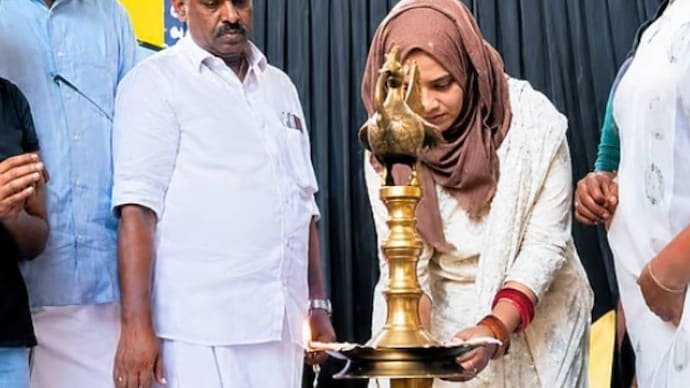
A seemingly routine inauguration ceremony in Kerala has evolved into a wider socio-Political Debate after Indian Union Muslim League (IUML) MLA Fathima Thahliya lit a traditional
The incident has once again highlighted a recurring question in India‘s multicultural democracy: where should the line be drawn between cultural participation and religious practice? The debate is particularly significant because it involves Kerala, a state often celebrated for its relatively harmonious coexistence among different religious communities.
Who Is Fathima Thahliya and Why the Incident Matters
Fathima Thahliya occupies a unique place in Kerala’s political landscape. She became the first woman legislator elected to the Kerala Legislative Assembly on an IUML ticket, marking a historic moment for a party traditionally perceived as conservative and male-dominated.
A lawyer by profession, Thahliya rose through student Politics and youth leadership roles before entering mainstream electoral politics. Her victory in Perambra was viewed as a significant breakthrough, particularly because she defeated a senior Communist Party of India (Marxist) leader in a constituency long considered a Left stronghold.
As one of the most visible Muslim women politicians in Kerala, her actions often attract greater scrutiny than those of many other elected representatives. This context helps explain why the lamp-lighting ceremony generated such intense discussion.
What Is a Nilavilakku and Why Is It Controversial?
The nilavilakku is a traditional oil lamp widely used across Kerala during inaugurations, cultural programs, educational events, government functions, and religious ceremonies.
For many Keralites, lighting the lamp symbolizes knowledge, prosperity, and the removal of darkness. It has become so embedded in public life that government events, university programs, and business inaugurations frequently begin with the ritual regardless of the religious background of participants.
However, some religious scholars view the practice differently. They argue that because the tradition has roots in Hindu religious customs, participation by followers of other faiths can create theological concerns.
This difference in interpretation lies at the heart of the current Controversy.
Why Islamic Scholars Raised Objections
The criticism came primarily from Samastha Kerala Jamiyyathul Ulama, one of Kerala’s most influential Sunni Muslim scholarly organizations.
The body argued that Muslims should avoid participating in rituals that originate from religious traditions outside Islam. According to its position, maintaining friendly relations with followers of other faiths is encouraged, but adopting religious practices associated with those faiths crosses a theological boundary.
The organization’s statement emphasized a distinction that many religious scholars frequently make: respect for other religions does not necessarily imply participation in their rituals.
From this perspective, the debate is not about communal harmony but about preserving religious doctrine and identity.
The Larger Question: Cultural Symbol or Religious Ritual?
The controversy highlights a question that has emerged repeatedly in modern India.
Is lighting a ceremonial lamp primarily a religious act, or has it evolved into a broader cultural tradition?
Many historians and cultural experts argue that practices often undergo transformation over time. Rituals that may have originated within one religious framework can eventually become part of a region’s shared cultural identity.
Examples exist throughout India:
- People from various faiths participate in regional harvest festivals.
- Public officials routinely attend celebrations of different religious communities.
- Educational institutions often incorporate local cultural customs regardless of religious affiliation.
- National events frequently feature symbols drawn from diverse traditions.
Supporters of Thahliya argue that the lamp-lighting ceremony falls into this category of cultural practice rather than religious worship.
Kerala’s Unique Model of Cultural Integration
Kerala presents a particularly interesting case because its social History differs from many other regions.
The state has long witnessed extensive interaction among Hindus, Muslims, Christians, and various smaller communities. Shared cultural practices have emerged through centuries of coexistence, trade, Education, and social reform movements.
Several public customs in Kerala are often practiced across religious boundaries. Community festivals, literary events, educational functions, and civic ceremonies frequently include participants from multiple faith backgrounds.
This blending of cultural traditions has often been cited as one of Kerala’s strengths.
However, critics argue that increasing religious polarization globally has made such cultural overlaps more contentious than they were in previous decades.
Social Media Reaction Reveals a Generational Divide
The response on social media exposed a noticeable divide between traditional religious interpretations and contemporary public opinion.
Many users defended the MLA, arguing that lamp lighting has become a secular ceremonial act in Kerala rather than an explicitly religious ritual.
Others pointed out that lamps are commonly seen in historical mosques, dargahs, and community spaces throughout South Asia, suggesting that illumination itself carries no exclusive religious meaning.
Younger generations, particularly urban voters, often view such symbolic gestures through a cultural lens rather than a theological one. This shift reflects broader changes in how identity is understood in modern India.
How Political Leaders Navigate Religious Sensitivities
Public representatives in India frequently face the challenge of balancing religious beliefs with the expectations of diverse constituencies.
An MLA, MP, or minister may attend dozens of events each month involving communities from different backgrounds. Actions that appear routine in a political context can sometimes be interpreted differently by religious organizations.
For politicians, this creates a complex balancing act:
- Respecting personal faith.
- Representing all constituents equally.
- Participating in local cultural traditions.
- Avoiding unnecessary controversies.
The Thahliya episode illustrates how difficult this balance can be in practice.
Women Leaders Often Face Greater Scrutiny
Another aspect often overlooked in discussions of this controversy is the role of gender.
Female political leaders frequently face a level of public scrutiny that exceeds what their male counterparts encounter. Their actions, appearances, and public conduct are often subjected to intense examination.
As the first woman MLA from the IUML, Fathima Thahliya represents both political change and evolving gender dynamics within the party. This visibility inevitably amplifies reactions to her public decisions.
Political analysts note that trailblazing women leaders often become symbolic figures in debates that extend far beyond the specific incidents involved.
Religious Identity in an Increasingly Connected World
The controversy also reflects broader global trends.
Across many countries, communities are re-examining questions of identity, tradition, and cultural participation. Social media has accelerated these discussions by allowing local events to become national or international debates within hours.


Practices that once remained largely unexamined are now scrutinized through religious, political, and ideological lenses.
This phenomenon is visible not only in India but also across Europe, the Middle East, Southeast Asia, and North America, where questions about cultural accommodation and religious expression continue to evolve.
Comparison: Then and Now
| Earlier Public View | Contemporary Public View |
|---|---|
| Local cultural practices often accepted without widespread debate. | Actions are analyzed instantly through social media and political commentary. |
| Religious and cultural distinctions were frequently less publicly contested. | Identity-based discussions receive significant public attention. |
| Community leaders primarily shaped public opinion. | Influencers, social media users, and online platforms influence narratives. |
| Controversies remained local. | Local incidents rapidly become national conversations. |
Why This Debate Matters Beyond Kerala
At first glance, the issue may appear limited to a single event involving a local MLA. In reality, it touches upon several larger questions facing modern democracies.
- Can cultural practices evolve beyond their religious origins?
- How should public officials engage with traditions outside their faith?
- Where is the boundary between cultural participation and religious endorsement?
- Can diverse societies maintain shared symbols without creating conflict?
The answers vary depending on personal beliefs, religious interpretations, and social perspectives.
What makes the discussion significant is that it reflects ongoing negotiations about identity and coexistence in an increasingly diverse and interconnected society.
The Future of Such Debates in India
As India becomes more urbanized, educated, and digitally connected, similar debates are likely to become more common.
Younger generations often prioritize inclusivity and shared civic identity, while religious institutions continue emphasizing doctrinal clarity and preservation of tradition. Neither perspective is likely to disappear.
The challenge for policymakers, community leaders, and public representatives will be finding ways to respect religious convictions while preserving social cohesion.
Kerala’s experience may offer important lessons because the state has historically demonstrated an ability to accommodate multiple identities within a shared public space.
Conclusion
The controversy surrounding Fathima Thahliya’s lamp-lighting ceremony is about much more than a symbolic inauguration ritual. It sits at the intersection of religion, culture, politics, gender, and public representation.
For critics, the issue concerns adherence to religious principles and maintaining clear theological boundaries. For supporters, it represents participation in a broader cultural tradition that transcends religious divisions.
The incident has reopened a conversation that many diverse societies continue to grapple with: how to balance faith, identity, and coexistence in public life.
Regardless of where one stands on the issue, the debate underscores an important reality. In modern India, symbols matter. They carry historical meanings, cultural significance, and political implications all at once. As the country continues to evolve, conversations like these will likely shape how future generations define both religious identity and shared citizenship.
For breaking news and live news updates, like us on Facebook or follow us on Twitter and Instagram. Read more on Latest India on thefoxdaily.com.






COMMENTS 0