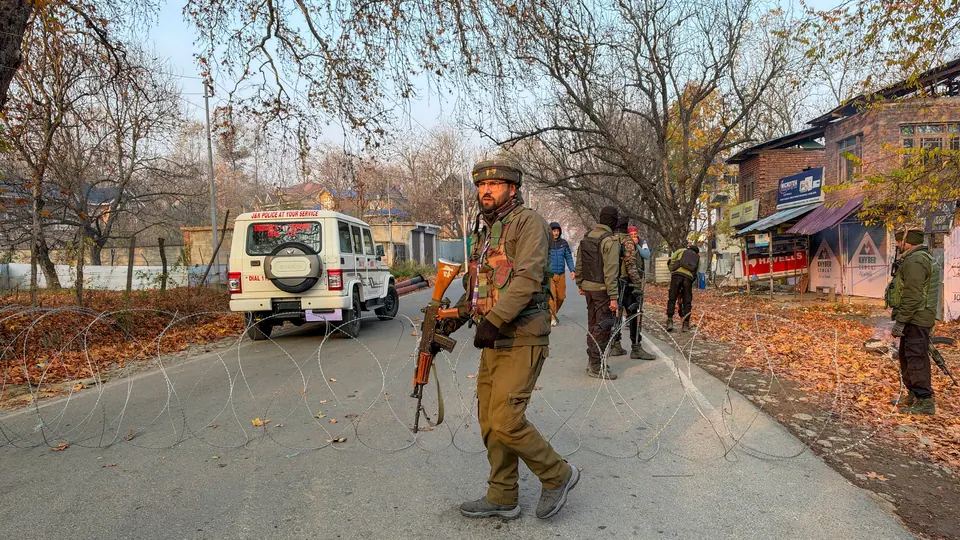
Security forces killed Mohammed Lateef Bhat in an encounter in Kulgam district of Jammu and Kashmir on Wednesday, bringing an end to an extensive operation to track down one of the Valley’s most wanted local terrorists. Officials identified Bhat as a Lashkar-e-Taiba (LeT) commander and said he was believed to be the last active local terrorist commander operating in South Kashmir.
The 23-year-old had been surrounded inside a mosque in Zangalgam village after security forces launched an operation on Wednesday morning. The village was cordoned off, and personnel attempted to persuade him to surrender. However, he reportedly refused, leading to an exchange of fire that ended with his death.
The encounter came two days after security forces killed his associate, Umar Nisar Dar, in a gunfight near the Laroo bypass in Kulgam. Bhat had managed to escape during that operation, prompting security agencies to intensify their search across the surrounding areas.
His killing is being viewed by security officials as a significant development in efforts to dismantle local terrorist networks in South Kashmir. Bhat had allegedly been involved in several attacks targeting migrant workers and police personnel and was also suspected of planning attacks on Amarnath Yatra pilgrims.
Who Was Lateef Bhat? A Carpenter Who Allegedly Joined Terrorist Ranks
Mohammed Lateef Bhat was a resident of Khrewan village in Kulgam district. Before his disappearance, he worked as a carpenter and was not publicly known as an active terrorist commander.
According to the information provided by security agencies, Bhat was reported missing by his family in November 2025. His family filed a missing-person complaint at Kulgam police station on November 19, after he stopped returning home.
Around the same period, photographs circulated on social media reportedly showing him joining the Kashmir Revolution Army (KRA), described in security accounts as a proxy outfit of Lashkar-e-Taiba. His alleged transition from civilian life into militancy marked the beginning of a year-long search by security agencies.
Security records subsequently identified him as the only active trained local terrorist operating in Jammu and Kashmir. His alleged involvement in attacks across South Kashmir and his ability to evade repeated security operations made him a high-priority target.
The case also drew attention to the recruitment of local residents by terrorist organisations. Bhat’s disappearance and alleged recruitment showed how individuals from ordinary backgrounds can become part of militant networks operating in the region.
Lateef Bhat Linked to Attacks on Migrant Workers and Police Personnel
Investigators linked Bhat to several violent incidents in South Kashmir following his disappearance. The alleged targets included migrant workers, police personnel and security installations.
Killing of Two Migrant Workers in Kulgam
One of the most serious incidents linked to Bhat was the killing of two migrant workers from Chhattisgarh at a brick kiln in Kulgam on July 31. The attack highlighted the vulnerability of migrant labourers working in parts of Kashmir and raised concerns about targeted violence against people from outside the Union Territory.
Investigators suspected Bhat’s involvement in the incident as part of a broader pattern of attacks attributed to local terrorist networks. His alleged role further intensified efforts to locate him.
Police Head Constable Killed in July
Bhat was also linked to the killing of a Jammu and Kashmir Police head constable on July 22. Attacks on police personnel have remained a major concern for security agencies because they can undermine local law enforcement and create fear among personnel operating in vulnerable areas.
His alleged involvement in the killing placed him among the key suspects being pursued by counter-terrorism teams in South Kashmir.
Suspected Attack on CRPF Post in November
Bhat and his associate Umar Nisar Dar were also suspected of involvement in the November 11 attack on a Central Reserve Police Force (CRPF) post in Akhran village, Kulgam. Three personnel were injured in the incident.
Investigators reportedly examined CCTV footage showing the movements of Bhat and Dar in several locations a day before the attack. The footage was said to show the two moving around Mir Bazar, Akhran, Hablish and Kilam on November 10.
According to investigators, the movements suggested that the two had conducted reconnaissance at multiple locations before the attack. Such surveillance can help attackers identify security arrangements, movement patterns and potential vulnerabilities.
Alleged Plans to Target Amarnath Yatra Pilgrims
Security agencies also suspected Bhat of planning attacks targeting pilgrims travelling for the Amarnath Yatra. The annual pilgrimage attracts thousands of devotees and involves extensive security arrangements along routes leading to the cave shrine.
Any threat to pilgrims is treated seriously because an attack could endanger civilians and disrupt one of the region’s major religious events. However, the reported plans attributed to Bhat should be understood as allegations by investigators rather than a confirmed attack.
How Lateef Bhat Escaped Security Forces Multiple Times
One of the factors that made Bhat difficult to track was his ability to escape security cordons during earlier operations. Officials said his familiarity with the local terrain and ability to blend into crowds helped him avoid arrest or capture.
He reportedly escaped at least two major operations before Wednesday’s encounter in Kulgam.
July Encounter in Anantnag Forests
On July 8, security forces trapped Bhat and other suspected terrorists in the forests of Anantnag district during an operation. Lashkar-e-Taiba terrorist Zakir Ahmed Ganei, who was believed to have recruited and trained Bhat, was killed in the encounter.
Bhat, however, managed to escape. His ability to get away despite the security operation made him a continuing target for intelligence and counter-terrorism teams.
December Escape After CCTV Tracking
Bhat had also reportedly escaped a security cordon in Anantnag in December 2025. Security forces had traced his movements using CCTV footage, but he managed to avoid being captured.
These escapes contributed to his reputation among security agencies as a difficult target. Investigators believed that his knowledge of the area and ability to move without attracting attention helped him remain on the run.
Operation in Zangalgam: How Security Forces Tracked Bhat
The final operation began after security forces intensified efforts to locate Bhat following the killing of his associate Umar Nisar Dar near the Laroo bypass. Dar’s death on Monday was followed by an extensive search for Bhat, who had escaped the earlier encounter.
On Wednesday morning, security personnel launched an operation in Zangalgam village after receiving information about his presence. The area was cordoned off to prevent his escape, and security forces established a perimeter around the suspected location.
Bhat was eventually trapped inside a mosque. Personnel attempted to convince him to surrender, but he reportedly refused to come out. The operation continued until an exchange of fire resulted in his death.
The presence of a mosque made the operation particularly sensitive. Security forces had to deal with the challenge of conducting an operation in a religious structure while maintaining control over the surrounding area.
His death ended the immediate search for the commander, although security agencies are likely to continue investigating his associates, alleged support networks and connections with other terrorist operatives.
Local Terrorist Numbers in Jammu and Kashmir Have Declined Sharply
Bhat’s killing comes against the backdrop of a significant decline in the number of local terrorists operating in Jammu and Kashmir, according to security assessments.
Officials estimated that around 50 to 60 local terrorists were active in the region approximately five years ago. By May 2025, that number had fallen to 17, including 14 in Kashmir and three in the Jammu region.
By August 2026, reports indicated that Bhat was the only active local terrorist remaining in Jammu and Kashmir. Security forces had been conducting intensive operations to locate him, particularly after a series of attacks in South Kashmir.
The decline has been attributed by security officials to sustained counter-terror operations, the targeting of local commanders and efforts to disrupt recruitment networks. However, the reduction in the number of active local terrorists does not mean the broader security threat has disappeared.
Foreign terrorists, cross-border infiltration attempts, local support networks and the possibility of fresh recruitment remain challenges for security agencies. A small number of active operatives can still carry out attacks if they receive logistical support or access to weapons.
Why Bhat’s Killing Matters for Security in South Kashmir
The killing of Bhat is significant because security officials had identified him as the last active trained local terrorist operating in the region. His alleged involvement in attacks against migrant workers and police personnel had made him a central target of counter-terror operations.
His death may weaken the immediate operational capabilities of the local network with which he was associated. It also removes a commander whom investigators linked to reconnaissance activities and multiple attacks in South Kashmir.
However, the long-term impact will depend on whether security agencies can identify and disrupt the wider network that supported him. Terrorist organisations can attempt to replace eliminated commanders by recruiting new members, rebuilding local contacts or relying on operatives from outside the region.
The reported decline in local recruitment is therefore an important indicator, but preventing a revival of terrorist activity will require continued intelligence gathering, community cooperation and action against those providing logistical assistance.
Security Operations Likely to Continue Despite Bhat’s Death
Officials have described the encounter as a major success in the ongoing effort to dismantle terrorist networks in South Kashmir. Yet the killing of an individual commander does not automatically eliminate the threat posed by the organisation or its wider network.
Security agencies are expected to remain focused on identifying possible associates, tracing the support structures used by active operatives and preventing new recruitment. Investigations into the attacks linked to Bhat and Dar may also provide information about the network’s movements and methods.
For residents, migrant workers and security personnel in the region, the priority remains preventing further attacks and maintaining stability. The recent incidents have shown that even a reduced number of active terrorists can create serious security challenges.
Lateef Bhat’s death brings an end to a year-long hunt for one of South Kashmir’s most wanted local commanders. It marks an important moment in the security forces’ campaign against local militancy, but sustained efforts will be necessary to ensure that the networks behind the violence do not regain strength.
For breaking news and live news updates, like us on Facebook or follow us on Twitter and Instagram. Read more on Latest India on thefoxdaily.com.






COMMENTS 0