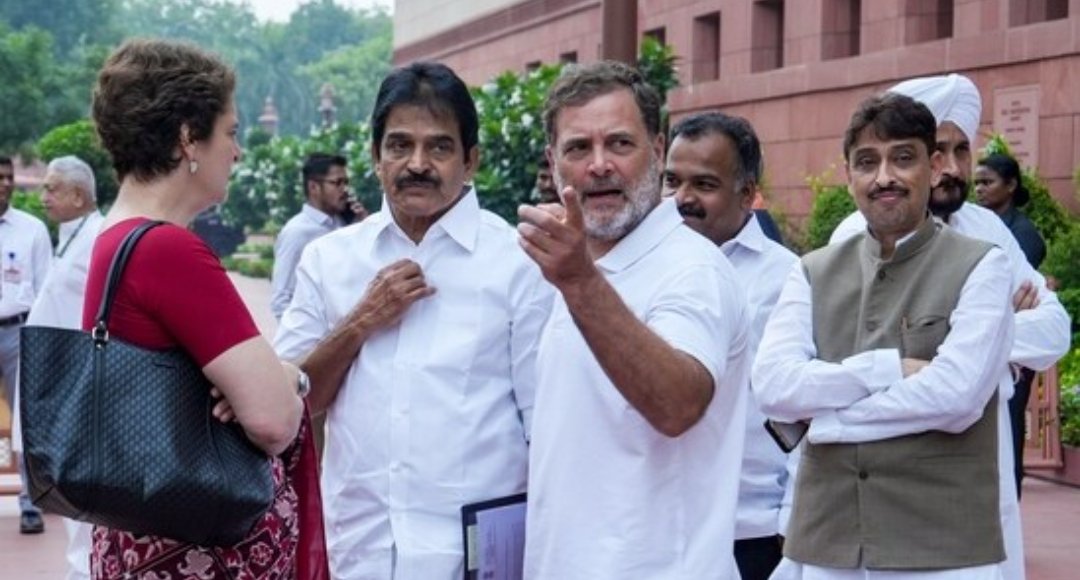
Leader of the Opposition Rahul Gandhi launched a sharp attack on the Central government following the Cockroach Janta Party (CJP) march towards Parliament, alleging that students protesting over examination-related issues were subjected to excessive police action instead of receiving answers to their concerns. His remarks came amid heightened political tensions during the Monsoon Session of Parliament, where education reforms and examination integrity have emerged as major issues.
The protest, led by supporters of education activist Sonam Wangchuk, has grown into a nationwide movement demanding greater accountability in India’s public examination system. As thousands of demonstrators gathered in Delhi, police imposed heavy security measures, resulting in clashes, detentions, and disruption around central parts of the capital.
Rahul Gandhi’s comments have added further political significance to the ongoing debate, with the Congress positioning itself firmly alongside protesters demanding reforms in the country’s examination process.
What Rahul Gandhi Said
In a statement posted on social media, Rahul Gandhi accused the government of failing India’s students and criticised its handling of repeated examination controversies.
“Prime Minister Modi is the most youth-hostile Prime Minister in India’s history. Students who raised legitimate questions about education were dragged, beaten and detained, while those responsible for examination irregularities continue to escape punishment.”
He argued that students seeking accountability should have been heard through democratic dialogue rather than facing police action during their protest.
The Context Behind His Remarks
Rahul Gandhi’s statement followed the CJP’s ‘Chalo Sansad’ march, which sought to bring attention to demands for examination reforms, transparency, and accountability. The protest also called for action against those responsible for alleged irregularities in public examinations and sought political responsibility from the Union Education Ministry.
Supporters attempted to march towards Parliament, prompting extensive security arrangements across central Delhi. Police used barricades, detained protesters, and restricted movement in several areas, citing security requirements during Parliament’s Monsoon Session.
Why Examination Reforms Have Become a National Political Issue
Competitive examinations affect millions of students across India each year, determining admission to higher education institutions and influencing future career opportunities. As a result, any controversy involving examination integrity quickly becomes a matter of national concern.
Student organisations and education experts have consistently argued that transparent examination systems are essential for maintaining public trust. Calls for stronger digital security, faster investigations into alleged irregularities, and greater institutional accountability have gained momentum in recent years.
The CJP movement has amplified these concerns by framing examination reforms as a broader issue of governance rather than a single administrative controversy.
Political Reactions Continue to Intensify
Rahul Gandhi’s intervention follows a series of reactions from opposition leaders who have expressed support for the protesters and demanded parliamentary discussion on examination reforms.
At the same time, the government has maintained that security measures were implemented to ensure law and order around Parliament. Authorities have stated that policing decisions were taken in accordance with legal and administrative requirements while Parliament was in session.
Earlier in the day, Union Minister and BJP President JP Nadda held the first formal meeting with CJP representatives. While the protesters submitted a written charter of demands, the government said it would discuss the proposals internally before communicating its response.
Key Issues Raised by the Protest Movement
- Greater transparency in national competitive examinations.
- Improved accountability for examination-related irregularities.
- Stronger protection of students’ interests.
- Institutional reforms to restore public confidence.
- Enhanced oversight of public examination processes.
Timeline of Recent Developments
| Event | Development |
|---|---|
| Hunger Strike | Sonam Wangchuk launched an indefinite fast demanding education reforms. |
| Hospitalisation | He was shifted to Safdarjung Hospital following health concerns. |
| Parliament March | Thousands gathered in Delhi demanding examination reforms. |
| Government Talks | JP Nadda met CJP representatives for the first formal dialogue. |
| Rahul Gandhi’s Response | The Congress leader criticised police action against protesters and backed students’ concerns. |
Why the Debate Extends Beyond Politics
The controversy surrounding the CJP protest reflects broader concerns about the credibility of India’s education system. For millions of students, competitive examinations represent years of preparation and significant financial and emotional investment by families.
Experts argue that maintaining public confidence requires not only secure examination systems but also transparent communication, prompt investigations, and visible accountability whenever irregularities are alleged.
The ongoing debate therefore extends beyond immediate political disagreements and touches on long-term education policy, institutional trust, and opportunities for future generations.
What Happens Next?
The focus now shifts to Parliament, where education-related issues are expected to remain part of political discussions during the Monsoon Session. The government is also expected to respond to the demands submitted by the CJP delegation following its meeting with JP Nadda.
Meanwhile, political parties are likely to continue debating examination reforms, student welfare, and accountability measures as public attention remains fixed on the issue.
Conclusion
Rahul Gandhi’s remarks have added another political dimension to the ongoing CJP movement, framing the protests as a struggle for student rights and educational accountability. His criticism of the government’s response underscores the growing significance of examination reforms in India’s political discourse.
As Parliament debates key national issues and discussions between the government and protest representatives continue, the demand for a more transparent and trustworthy examination system is likely to remain at the centre of public debate. Whether these discussions translate into meaningful policy reforms will be closely watched by students, educators, and policymakers across the country.
For breaking news and live news updates, like us on Facebook or follow us on Twitter and Instagram. Read more on Latest India on thefoxdaily.com.




COMMENTS 0