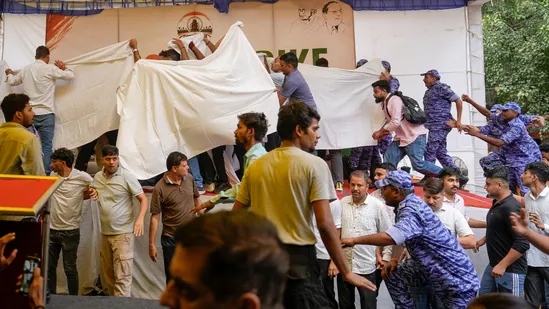
The removal of climate activist and education reform advocate Sonam Wangchuk from New Delhi’s Jantar Mantar has intensified political debate across the country. Wangchuk, who had been on an indefinite hunger strike for 21 days in support of students protesting alleged irregularities in competitive examinations, was shifted to Safdarjung Hospital by Delhi Police after concerns about his deteriorating health.
While the authorities said the decision was taken to ensure continuous medical care and comply with court-directed health monitoring, opposition leaders described the action as an attack on democratic rights and peaceful protest. The contrasting narratives have transformed what began as a public health intervention into a wider political controversy over civil liberties, protest rights, and government accountability.
Why Was Sonam Wangchuk Removed?
According to Delhi Police, Wangchuk was moved to Safdarjung Hospital after his prolonged hunger strike raised serious medical concerns.
Authorities stated that the decision was intended to:
- Ensure continuous medical supervision.
- Protect Wangchuk’s health as his condition weakened.
- Comply with directions relating to health monitoring.
- Prevent potential medical emergencies at the protest site.
Officials emphasized that the transfer was a health-related measure rather than an attempt to suppress the protest.
Background of the Hunger Strike
Wangchuk began his indefinite fast in support of students demanding greater accountability over alleged irregularities in competitive examinations, including the NEET paper leak controversy.
Throughout the protest, medical updates indicated that he had experienced significant weight loss while remaining under regular observation by doctors.
As the fast entered its third week, concerns over his physical condition increased, prompting judicial and medical attention.
Opposition Leaders Criticise the Action
The removal immediately drew criticism from several opposition parties, which argued that peaceful democratic protests should be protected rather than disrupted.
Leader of Opposition Rahul Gandhi said the action against Wangchuk was wrong and linked the protest to broader concerns over paper leaks, rising education costs, and student welfare.
Congress president Mallikarjun Kharge accused the government of suppressing dissent, while Congress leader Pawan Khera questioned the timing of the police operation and described it as inconsistent with democratic values.
Several opposition leaders argued that dialogue should have been prioritised over police intervention.
AAP’s Response
Aam Aadmi Party national convener Arvind Kejriwal also criticised the government’s handling of the situation.
He argued that authorities should have engaged directly with Wangchuk instead of removing him from the protest site and called for reforms in the education and examination system rather than confrontation with protesters.
The party maintained that constructive dialogue would have been a more appropriate response.
Other Opposition Reactions
Leaders from multiple political parties also expressed concern over the developments.
- Trinamool Congress leaders questioned the manner in which the operation was conducted.
- Mamata Banerjee called for dialogue and emphasized the importance of transparency and democratic rights.
- Samajwadi Party chief Akhilesh Yadav demanded greater transparency regarding the police operation and sought judicial oversight of Wangchuk’s medical care.
Although their political perspectives differed, many opposition leaders shared concerns about the treatment of a peaceful protest.
BJP Defends the Police Action
The Bharatiya Janata Party rejected allegations that Wangchuk’s removal was politically motivated.
BJP leaders stated that the police acted primarily to safeguard the activist’s health after prolonged fasting.
Party leaders also pointed to medical concerns and court-related directions regarding health monitoring as justification for shifting Wangchuk to hospital.
According to the BJP, protecting a protester’s life and well-being remained the immediate priority.
Anna Hazare Calls for Dialogue
Veteran social activist Anna Hazare adopted a conciliatory position, urging the government to engage in discussions with Wangchuk.
Hazare said authorities should clearly communicate whether they accept or reject the demands but argued that dialogue itself should not be avoided.
His remarks reflected a broader call for resolving disagreements through discussion rather than prolonged confrontation.
Health Concerns Remain Central
Medical reports issued before Wangchuk’s transfer indicated that he had lost substantial body weight during the hunger strike.
Doctors had continued monitoring:
- Blood pressure.
- Blood sugar levels.
- Weight loss.
- Overall physical condition.
Prolonged fasting carries significant medical risks, making continuous observation increasingly important as the strike extended beyond three weeks.
Timeline of Key Events
| Event | Development |
|---|---|
| June 28 | Sonam Wangchuk begins indefinite hunger strike. |
| Following weeks | Health monitoring continues as weight loss increases. |
| Day 21 | Delhi Police shift Wangchuk to Safdarjung Hospital. |
| Same day | Opposition parties criticize the removal. |
| Government response | BJP states the action was taken to protect Wangchuk’s health. |
Why the Incident Has Become Politically Significant
The controversy extends beyond the immediate question of Wangchuk’s medical treatment.
It touches upon broader issues including:
- The right to peaceful protest.
- Government handling of public demonstrations.
- Student concerns regarding examination integrity.
- The balance between public safety and civil liberties.
- Political accountability during periods of public dissent.
These wider themes explain why leaders from multiple political parties have become involved in the debate.
The Legal and Administrative Perspective
When hunger strikes extend for prolonged periods, authorities often face competing responsibilities.
On one hand, individuals have the constitutional right to peaceful protest. On the other, governments and law enforcement agencies may have legal and administrative obligations to respond if a protester’s health reaches a critical stage.
Balancing these responsibilities frequently becomes one of the most sensitive aspects of managing long-duration public protests.
Expert Insight: Dialogue Often Prevents Political Escalation
Historically, prolonged hunger strikes tend to become politically significant when they shift from individual acts of protest to symbols of broader public concerns. In such situations, sustained communication between governments and protest representatives often plays an important role in reducing tensions and preventing further polarization.
Regardless of political positions, early dialogue can sometimes prevent disagreements over procedure from overshadowing the substantive issues that initially prompted the protest.
What Happens Next?
Several developments will determine the next phase of the controversy:
- Updates on Wangchuk’s health while under medical care.
- Possible dialogue between protest representatives and the government.
- Continuation of demonstrations by supporters.
- Further political reactions from ruling and opposition parties.
- Any future administrative or judicial developments relating to the protest.
The situation remains dynamic as political debate continues alongside medical monitoring of the activist.
Conclusion
Sonam Wangchuk’s removal from Jantar Mantar has evolved into a major political controversy, with opposition parties describing it as an infringement on peaceful democratic protest and the BJP maintaining that the decision was driven by urgent health considerations. The differing interpretations reflect broader debates over protest rights, government responsibility, and public accountability.
As Wangchuk receives medical care and political leaders continue exchanging criticism, the focus is likely to remain on two parallel questions: his recovery and whether meaningful dialogue can address the concerns that led to the hunger strike in the first place.
For breaking news and live news updates, like us on Facebook or follow us on Twitter and Instagram. Read more on Latest India on thefoxdaily.com.





COMMENTS 0