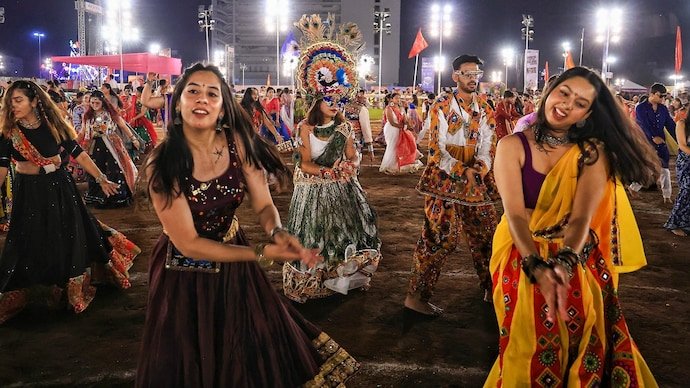
The Vishva Hindu Parishad (VHP) has issued a controversial set of guidelines for Garba and Dandiya events during the upcoming Navratri festival in Maharashtra, calling for Muslims to be prevented from participating and asking organisers to verify the identity of attendees.
The organisation’s Maharashtra leadership has suggested that organisers check Aadhaar cards and apply tilak on the foreheads of participants. The recommendations have triggered sharp criticism from Opposition leaders, who have questioned the constitutional validity of excluding people from public cultural events on the basis of religion.
VHP spokesperson and joint secretary Shriraj Nair said the organisation had taken the decision because Garba and Dandiya are connected to the worship of the Hindu goddess and should retain what the VHP considers their religious and cultural character.
At the same time, Nair described the proposed restrictions as precautionary measures and said they were not intended as hostility toward any particular community. The contrasting claims have become the centre of a larger debate over religious identity, public celebrations and the limits of private event organisers in a legally plural society.
What are the VHP’s Maharashtra Garba-Dandiya guidelines?
The VHP has called on organisers of Navratri Garba and Dandiya events in Maharashtra to prevent Muslims from participating in the festivities.
It has also urged organisers to verify the identity of attendees. Among the measures suggested are checking Aadhaar cards and applying tilak to participants.
These recommendations go beyond ordinary event-security procedures because they seek to establish the religious identity of people attending a cultural and devotional event.
The VHP’s position is that organisers should ensure the events remain aligned with their Hindu religious character. Critics, however, argue that asking people to prove their religion in order to participate raises serious questions about discrimination and individual rights.
Why does the VHP want Muslims excluded?
According to Nair, the organisation’s reasoning is rooted in the religious nature of Navratri.
He argued that the festival is not merely a programme involving Music and dance but is fundamentally connected with the worship of the goddess. From that perspective, he questioned why people who do not share those religious beliefs should participate in Garba and Dandiya celebrations.
Nair said the decision was taken to prevent what the VHP believes is a dilution of the cultural character of Hindu festivals.
He also linked the position to the organisation’s broader ideological agenda, saying festivals form an important part of the cultural legacy of Hindus.
The VHP has therefore framed the guidelines as an effort to preserve religious identity rather than as a prohibition directed at Muslims for reasons unrelated to the festival.
Navratri is both a religious festival and a social celebration
The controversy partly arises because modern Garba and Dandiya events occupy more than one space.
Traditionally, Garba is associated with worship and community celebrations during Navratri. Over time, especially in urban areas, large commercial and cultural events have developed around the dance forms.
These events can attract thousands of people and may combine devotional elements with music, Entertainment, food stalls and ticketed performances.
As a result, not every Garba or Dandiya event functions in exactly the same way. Some are organised around explicit religious worship, while others are primarily cultural or entertainment-oriented celebrations that draw participants from different communities.
This distinction is relevant to the debate because the legal and social question can change depending on whether an event is a private devotional gathering or a large public cultural programme.
VHP says the move is “precautionary”
While Nair defended the exclusion policy, he also insisted that the VHP’s objective was not to target Muslims as a community.
He described the measures as precautionary steps intended to preserve the cultural identity of Hindu festivals.
That explanation has not prevented criticism. Opponents argue that a rule explicitly excluding a religious community is inherently communal regardless of how it is described.
The dispute therefore turns on a fundamental question: can preserving the religious character of an event justify restrictions based on the religious identity of potential attendees?
The answer may depend on the nature of the event, who organises it, whether it is publicly accessible and what legal rules apply to participation and discrimination.
Sanjay Raut questions VHP’s position
Shiv Sena (UBT) MP Sanjay Raut criticised the VHP and questioned how its position fits with recent remarks by RSS chief Mohan Bhagwat on Hindu-Muslim relations.
Raut pointed to Bhagwat’s recent public message in New York, where the RSS chief spoke about human dignity, social unity and the coexistence of Hindus and Muslims.
The contrast has become politically significant because the VHP and RSS belong to the broader Sangh Parivar ecosystem, even though they are separate organisations with their own leadership and structures.
Raut’s question effectively asks whether the VHP’s proposed restrictions represent the position of the wider ideological family or whether the organisation is advancing its own specific approach to religious participation.
What did Mohan Bhagwat say in New York?
During his New York visit, Mohan Bhagwat delivered remarks emphasizing the idea of human unity.
He said that a person who believes Muslims should not be present in India cannot be considered a true Hindu and stressed that every human being possesses dignity.
He also spoke about the idea that different paths can lead toward the same broader goal.
Those comments were widely interpreted as an emphasis on coexistence and social harmony. That is why Bhagwat’s remarks are now being brought into the debate over the VHP’s Garba-Dandiya guidelines.
Nair, however, declined to comment on Bhagwat’s specific statement, saying the VHP would not respond to the RSS chief’s remarks.
VHP maintains that it supports social harmony
Despite defending the exclusionary guidelines, Nair said the VHP does not oppose social harmony and peace.
He maintained that his organisation was not against anyone but questioned why it should relax its own festival-related rules for people who do not follow the associated religious practices.
That position attempts to draw a distinction between opposing a person’s participation in a particular religious event and opposing the person or community more generally.
Critics argue, however, that the distinction becomes difficult to maintain when the proposed rule is specifically based on religious identity.
The political debate is therefore likely to continue around whether these measures are genuinely about religious practice or whether they amount to community-based exclusion.
VHP suggests Muslims organise separate celebrations
Nair went further by suggesting that Muslims who want to participate in Navratri-related activities should attend with their families or organise their own celebrations near their homes or at mosques.
The statement has attracted additional criticism because it effectively proposes separate spaces for members of different religious communities.
Opponents argue that Indian festivals have often developed through cultural interaction and that people from different communities can participate in one another’s celebrations without necessarily adopting the underlying religion.
The VHP’s position is based on the opposite principle: religious festivals should retain clearly defined boundaries around the community whose beliefs they represent.
Congress calls the proposed rules unconstitutional
congress MLA Amin Patel rejected the VHP’s position and described the move as unconstitutional.
Patel said festivals have traditionally played a role in bringing different communities together. He pointed out that members of different religions frequently invite one another to cultural and religious events as a gesture of goodwill.
He cited the example of Muslims inviting people from other communities to participate in Eid and Ramzan-related gatherings while noting that Hindus also invite members of other communities to Navratri and Dandiya celebrations.
That argument reflects a broader understanding of festivals as social occasions that can strengthen community relations even when the underlying religious beliefs are different.
NCP (SP) asks what the Maharashtra government will do
Clyde Crasto, spokesperson for the Nationalist Congress Party (Sharadchandra Pawar), also criticised the guidelines.
Crasto questioned whether the BJP-led Maharashtra government would intervene or remain silent while a non-government organisation issued what he described as a diktat concerning law and order and public events.
His criticism focuses on the state’s constitutional and administrative responsibility rather than only on the religious argument.
The question being raised is whether government authorities will allow private or ideological groups to establish religious screening rules at public-facing events without official scrutiny.
That could become particularly important if the proposed guidelines lead to confrontation at large Garba or Dandiya venues.
Maharashtra Minority Commission objects to blanket exclusion
Pyare Khan, chairman of the Maharashtra State Minority Commission, also criticised the proposed exclusion of Muslims.
Khan said people have the right to celebrate festivals according to their faith but objected to a blanket rule preventing Muslims from attending public celebrations.
He argued that many cultural organisations invite people from different communities and that festivals can serve as a bridge between social groups rather than becoming mechanisms for separation.
His position was that participation should primarily depend on whether an individual is invited rather than on an organisation imposing a community-wide exclusion.
This argument introduces an important practical distinction: an organiser of a private religious ceremony may have considerable control over its format, but a broader public event may raise different legal and constitutional considerations.
Can organisers legally ask for Aadhaar at Garba events?
The VHP’s recommendation to check Aadhaar cards has created a separate concern about privacy and the appropriate use of identity documents.
Aadhaar is primarily an identity and authentication system, and using it to determine a person’s religion is a different matter from using it to establish identity.
An Aadhaar card does not itself function as a certificate declaring religious identity. Therefore, an organiser seeking to use the document for religious screening would need some other basis for making such a determination.
The proposal consequently raises practical questions about how event organisers would actually establish a participant’s religion without relying on assumptions, names or other potentially unreliable indicators.
It also raises questions over what information organisers would collect and how that information would be stored and used.
Why the tilak requirement is controversial
The recommendation that attendees wear a tilak has also become contentious.
A tilak can have religious, cultural or personal significance, but requiring one as a means of proving that someone belongs to a particular religion transforms a symbolic practice into a form of identity screening.
That is very different from simply asking participants to dress in a traditional style or encouraging them to follow a ceremonial practice voluntarily.
Opponents argue that participation in a cultural event should not require people to demonstrate religious identity through a visible marker unless the event is structured specifically as a closed religious ceremony.
The issue is particularly sensitive because a visible marker can expose an attendee’s perceived religious identity to everyone around them.
The legal question is bigger than Garba
The controversy raises a much broader issue about religious discrimination in public spaces.
India’s Constitution guarantees equality before the law and prohibits discrimination by the state on specified grounds, including religion. At the same time, Indian law recognises the freedom of individuals and religious communities to practise and propagate religion subject to constitutional limits.
The legal position becomes more complex when a private organisation organises an event that is religious in character but takes place in a public or commercially accessible Environment.
The precise legality of an exclusion rule would depend on the circumstances, including who owns the venue, who is organising the event, whether tickets are publicly sold and whether the action violates any applicable law or local regulation.
Simply issuing a guideline does not automatically give an organisation the legal authority to enforce every restriction it announces.
Garba’s evolution makes the debate more complicated
Garba and Dandiya have changed significantly as they have spread from traditional community settings into large urban events.
In cities such as Mumbai, Ahmedabad and Delhi, the dance forms are now performed at commercial venues, college events, corporate celebrations, clubs and large-ticket festivals.
These events may contain religious symbolism while also functioning as mainstream cultural entertainment.
That evolution makes a blanket distinction between “religious” and “non-religious” Garba events difficult to apply consistently.
A small devotional gathering organised by a temple may operate very differently from a large commercial Dandiya event open to thousands of ticket-holders.
The VHP’s proposed rules have therefore reopened an older debate about how much a modern cultural festival can be separated from its religious roots.
The VHP says cultural identity is at stake
The organisation’s argument is that Hindu festivals are part of a broader cultural inheritance and should not be diluted through indiscriminate participation.
This view reflects a larger ideological emphasis on protecting Hindu cultural practices and traditions from what the VHP considers excessive commercialisation or outside influence.
Supporters of that approach may argue that communities should have the freedom to preserve the character of their religious festivals.
Critics respond that cultural participation does not necessarily imply religious conversion or acceptance of every theological belief associated with a festival.
People routinely participate in cultural activities rooted in traditions different from their own without treating that participation as a statement of religious belief.
Political parties see the issue differently
The response from Opposition parties has been broadly critical of the VHP’s proposed restrictions.
Congress, Shiv Sena (UBT) and NCP (SP) leaders have questioned the constitutional implications and the potential impact on communal harmony.
Their criticism also seeks to put pressure on the state government to clarify whether it supports or rejects the proposed guidelines.
That question may become increasingly important as Navratri approaches, particularly if event organisers begin attempting to enforce religious identity checks.
Any confrontation at a major event could quickly turn a cultural controversy into a law-and-order issue.
Why the Maharashtra government’s position matters
The VHP is a private organisation, not a government authority. Its announcement therefore does not by itself create a state-wide law governing who can legally attend Garba and Dandiya events.
This distinction is central to the controversy.
Private organisers may set rules for their own events within the boundaries of applicable law, but an ideological organisation cannot automatically impose its recommendations on all Garba and Dandiya programmes throughout Maharashtra.
If organisers adopt the VHP’s guidelines, questions about their legality and enforcement could arise on a case-by-case basis.
The state government’s response will therefore help determine whether the issue remains a political controversy or develops into a broader administrative and legal dispute.
What could happen at Garba venues during Navratri?
If organisers attempt to implement the VHP’s proposed identity checks, several practical problems could emerge.
Large events would need staff to examine identity documents, determine religious eligibility and decide how to handle people who refuse to comply.
This could create long queues, disputes at entry gates and potentially confrontations between attendees and security personnel.
Organisers could also face complaints from people who believe they have been unfairly excluded.
The larger the event, the harder it would be to apply such a system consistently without causing disruption.
The social harmony argument
Critics of the VHP’s position have emphasized the traditional role of festivals in bringing communities together.
In India’s diverse society, religious festivals often have a cultural dimension that extends beyond followers of the faith in question. Non-Muslims may attend Eid celebrations, while non-Hindus may participate in Holi, Diwali or Garba events as guests, friends, neighbours or colleagues.
Such participation does not necessarily erase religious differences. Instead, it can create social familiarity and shared experiences.
The VHP’s position challenges that model by arguing that some festivals should maintain stricter religious boundaries.
The resulting debate is therefore also about what Indian pluralism should look like in everyday public life.
RSS and VHP differences may attract more attention
The controversy is especially notable because it has emerged soon after Bhagwat’s statements emphasizing coexistence and human dignity.
Although the RSS and VHP are separate organisations, their ideological proximity means that public differences in tone can attract significant political attention.
Raut’s criticism attempts to highlight that apparent contrast.
The VHP, however, has avoided directly engaging with Bhagwat’s remarks and has instead continued to defend its own position on Hindu festival participation.
Whether this develops into a sustained debate within the broader Sangh ecosystem remains to be seen.
The difference between a private religious ceremony and a public event
One of the most important distinctions likely to emerge is the nature of the event itself.
A closed religious ceremony conducted within a place of worship may have rules connected to religious practice. A commercial Garba event held in a large public venue and advertised through ticket sales presents a different set of considerations.
Organisers may have greater control over the format of private gatherings, but they still operate within the law.
Once an event is marketed broadly and becomes a major public cultural occasion, blanket community-based exclusion can attract greater scrutiny.
The practical and legal outcome could therefore vary significantly from one event to another.
What organisers should consider
Regardless of their position on the VHP’s guidelines, organisers face the practical responsibility of maintaining safe and orderly events.
Security checks are common at large gatherings because of concerns about weapons, crowd control and emergency safety.
However, security procedures based on religious identity are fundamentally different from ordinary safety checks.
Organisers considering the proposed guidelines would need to understand their legal obligations, protect personal information and ensure that their procedures do not create avoidable confrontation or discrimination.
They would also need to distinguish clearly between voluntary religious practices and mandatory entry conditions.
The controversy could intensify as Navratri approaches
With Navratri beginning on October 11, the debate is likely to receive greater attention as event organisers finalise arrangements across Maharashtra.
Large cities such as Mumbai, Pune, Nagpur and Nashik host numerous Garba and Dandiya programmes during the festival season, ranging from neighbourhood gatherings to major commercial events.
The degree to which individual organisers adopt or reject the VHP’s recommendations could determine whether the controversy remains largely rhetorical or produces actual disputes at entry points.
Political parties are also likely to continue using the issue to draw broader contrasts over secularism, religious identity and the role of community organisations in public life.
What the VHP’s announcement means for Maharashtra
The VHP’s call to keep Muslims out of Garba and Dandiya events has created a debate that goes beyond Navratri itself.
At its centre is a difficult question: where should the line be drawn between preserving the religious character of a festival and excluding people because of their faith?
The VHP says its objective is to protect Hindu cultural identity and insists that its guidelines are precautionary rather than anti-Muslim. Its critics argue that the proposed religious screening system is inherently exclusionary and threatens the tradition of festivals functioning as spaces for social interaction.
The recommendation to check Aadhaar cards and apply tilak has made the controversy even more sensitive because it turns religious identity into an entry requirement.
At the same time, the statement has no automatic force of law. Whether organisers can legally impose such conditions will depend on the nature of each event and the laws applicable to it.
Garba-Dandiya row becomes a test of cultural boundaries
The Maharashtra Garba controversy highlights how India’s cultural festivals can sit at the intersection of religion, entertainment, business and community life.
The VHP wants Navratri celebrations to remain firmly rooted in Hindu religious identity. Opposition leaders and the Maharashtra Minority Commission argue that such festivals can also promote social harmony and participation across communities.
Mohan Bhagwat’s recent remarks about Hindu-Muslim coexistence have added another layer to the debate, particularly because critics are asking whether the VHP’s position is consistent with that message.
As Navratri approaches, the practical question will be whether organisers actually attempt to enforce the proposed restrictions and, if they do, how authorities respond.
The controversy ultimately goes beyond Garba and Dandiya. It raises fundamental questions about religious freedom, cultural participation, private event rules, constitutional equality and the meaning of communal harmony in contemporary India.
How Maharashtra handles those questions during the festival season could set an important precedent for future disputes involving religious identity and access to public cultural celebrations.
For breaking news and live news updates, like us on Facebook or follow us on Twitter and Instagram. Read more on Latest India on thefoxdaily.com.





COMMENTS 0