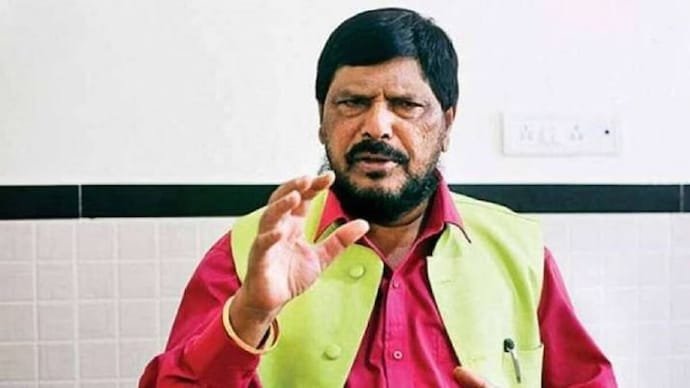
Union minister Ramdas Athawale has opposed calls to exclude Muslims from garba and dandiya events during Navratri, arguing that India’s Constitution protects people of all religions and that communities should be able to participate in each other’s festivals.
Athawale’s remarks came after the Vishva Hindu Parishad (VHP) called for Muslims to be barred from garba and dandiya events across Maharashtra during the upcoming Navratri celebrations. Maharashtra minister and BJP leader Nitesh Rane subsequently backed the demand and called for identity checks at such events.
The disagreement has opened a notable political fault line within the broader ruling alliance. Athawale, who heads the Republican Party of India (A), is a Union minister in the Narendra Modi government and a member of the National Democratic Alliance. His position contrasts with Rane’s support for the VHP campaign.
The dispute is not simply about entry rules at festive venues. It has quickly developed into a wider argument over constitutional equality, religious participation, identity verification and allegations of so-called “love jihad”.
Athawale says barring Muslims from garba is not right
Speaking to reporters in Raipur on September 9, Athawale said the proposal to prevent Muslims from attending garba events was inappropriate because India is governed by the Constitution.
He stressed that the constitutional framework protects people belonging to different religions and argued that Indians should be free to take part in one another’s cultural and religious celebrations.
Athawale specifically rejected the idea that Muslims should be prohibited from attending garba events simply because they are Muslims.
His argument was based on the principle that India is a religiously diverse democracy rather than a society in which public festivals must necessarily be restricted to members of one faith.
The minister also appealed for greater social cooperation between Hindu and Muslim communities, saying that both should come together and work for the country.
Why Athawale invoked the Constitution
Athawale’s response frames the controversy primarily as a question of constitutional rights and religious equality.
India’s Constitution guarantees equality before the law and prohibits discrimination by the state on specified grounds, including religion. It also protects freedom of conscience and the right to profess, practise and propagate religion, subject to constitutional limitations.
At the same time, the legal position surrounding entry into private events can be more complicated than a simple statement that every festival must be open to everyone. Organisers can impose rules relating to tickets, venue capacity, security and other legitimate conditions, but a religion-based exclusion can raise significant legal and constitutional questions depending on the circumstances and the role of the state.
Athawale’s position is therefore broader than a question of event management. He is arguing that religious identity should not be used as the basis for a blanket exclusion from a public cultural celebration.
He points to Ajmer Sharif as an example
To make his argument, Athawale referred to Ajmer Sharif Dargah in Rajasthan, saying that Hindus also visit the famous shrine.
His broader point was that religious life in India has historically included forms of participation and cultural exchange that cross community boundaries.
India’s religious traditions contain numerous examples of shrines, fairs and local festivals attracting visitors from different communities. Such participation does not necessarily mean that every individual participating shares the same religious beliefs.
Athawale used this broader social reality to argue against treating Hindu and Muslim cultural life as entirely separate spaces.
His remarks therefore shift the debate from the immediate question of who should enter a garba venue to a larger question about whether India’s festivals should remain spaces where different communities can interact.
What did the VHP demand?
The controversy began when the VHP announced that Muslims should not be allowed to participate in garba and dandiya events across Maharashtra during the upcoming Navratri festival.
The organisation also issued guidelines urging event organisers to verify the identities of attendees. Among the measures it suggested were checking Aadhaar cards and applying a tilak to the foreheads of participants.
The VHP has argued that garba during Navratri is rooted in worship and Hindu religious practice and that event organisers should therefore ensure that participants conform to what it considers appropriate religious participation.
The organisation’s position has generated criticism because Aadhaar is an identity document, not a certificate of religious identity, while a tilak does not constitute a legally recognized test of religious affiliation.
The proposal has consequently raised questions about how private event organisers would implement such rules and what would happen if participants refused or if their religious identity did not fit neatly into the categories being used.
Nitesh Rane backs the VHP position
Maharashtra minister and BJP leader Nitesh Rane has openly supported the VHP’s demand.
Rane argued that Hindu religious festivals should not be treated as unrestricted spaces for everyone if concerns exist about the participation of people who do not follow the religion associated with the celebration.
He also cited allegations relating to “love jihad” and claimed that such festivals can become environments in which Muslim men allegedly approach Hindu women for relationships with the purpose of religious conversion.
Rane has called for identity checks at garba and dandiya venues and went further by suggesting that simply showing an Aadhaar card should not be enough. He proposed that participants should also be asked to recite the Hanuman Chalisa before being allowed into events.
These are Rane’s political assertions and proposals; they are not a general legal requirement for entry to garba events in Maharashtra.
What is “love jihad”?
The phrase “love jihad” is commonly used by Hindu right-wing groups to describe an alleged conspiracy in which Muslim men supposedly enter relationships with Hindu women in order to convert them to Islam.
The expression remains politically contentious because it is often used as a broad label for cases involving interfaith relationships, while critics argue that it can encourage suspicion toward Muslims and stigmatize consensual relationships.
Where individual cases involve fraud, coercion, threats or forced conversion, those actions can be addressed under applicable criminal laws. But an allegation that an entire community is engaged in an organized campaign requires evidence and cannot be established simply through the existence of interfaith relationships.
That distinction is particularly relevant in the garba debate because Rane has connected the proposed restrictions to claims about “love jihad” during festivals.
Athawale, by contrast, has rejected the communal exclusion approach and emphasized constitutional equality.
The disagreement reveals different political approaches within the NDA
Athawale’s opposition is politically significant because he is not an opposition politician challenging the government from outside.
He is a Union minister and an NDA ally.
His public disagreement with the VHP campaign demonstrates that the ruling alliance contains parties and leaders with different political constituencies and ideological priorities.
RPI(A) is historically associated with Ambedkarite Politics and advocacy for Dalit rights and social equality. Athawale has consequently developed a political identity that emphasizes representation and constitutional safeguards for marginalized communities.
That background helps explain why his response focuses on the Constitution and equal treatment rather than on cultural exclusion.
It also means that the controversy cannot easily be reduced to a simple BJP-versus-opposition dispute. The disagreement exists within the broader political ecosystem supporting the current Maharashtra and central governments.
Navratri and garba have both religious and cultural dimensions
Another reason the dispute is complicated is that garba occupies both religious and cultural spaces.
The dance form is traditionally associated with Gujarat and has deep roots in Navratri celebrations dedicated to the goddess. At the same time, modern urban garba and dandiya events have become large public gatherings that attract people from a wide range of backgrounds.
Commercial venues can sell tickets, hire performers, arrange food stalls and create large-scale events that function partly as Entertainment spectacles in addition to their religious origins.
This creates a difficult question for organisers: when a traditional religious celebration becomes a large commercial public event, where should the line be drawn between religious identity and general public participation?
Athawale’s position emphasizes inclusion, while the VHP’s approach emphasizes religious identity and control over participation.
Could private organisers restrict entry?
Event organisers can generally establish reasonable conditions for participation, such as ticketing rules, age limits, security screening and venue-capacity restrictions.
But a rule explicitly designed to exclude people because they belong to a particular religion can raise serious legal questions, particularly where public authorities are involved or where discriminatory practices conflict with applicable laws.
The legal position can also depend on the ownership of the venue, the nature of the event, contractual arrangements and any relevant state regulations.
That is why political demands for a religion-based ban should not automatically be interpreted as an existing government rule.
As things stand, the VHP has announced its own guidelines and called for restrictions. That is different from Maharashtra authorities formally imposing a statewide legal prohibition on Muslims attending garba events.
Aadhaar cannot by itself establish a person’s religion
The demand for Aadhaar verification has also created confusion around what identity documents can actually establish.
Aadhaar is an identity document containing demographic and biometric information. It is not designed as a document certifying a person’s religion.
Even if an organiser checks an Aadhaar card, the document would not ordinarily tell the organiser whether the holder is Hindu, Muslim, Sikh, Christian, Jain or a member of another faith.
That is why the VHP’s proposed combination of Aadhaar checks and religious markers such as tilak has attracted criticism. Such a system would effectively ask organisers to make their own judgment about a participant’s religious identity.
It also raises practical questions about people who belong to one religion but do not wear visible religious markers, people from mixed families and participants who may not wish to disclose their faith at a private entertainment event.
The Hanuman Chalisa proposal is even more controversial
Rane’s suggestion that participants recite the Hanuman Chalisa before entering a garba event takes the identity debate a step further.
The proposal would turn religious participation into a form of screening, requiring attendees to demonstrate familiarity with a Hindu devotional text.
Critics argue that such a requirement could be both discriminatory and impractical. Supporters, however, frame it as a way to ensure that only people genuinely participating in the Hindu festival are admitted.
A major unanswered question is whether a person’s ability or willingness to recite a prayer can legitimately establish religious identity or personal intention.
It could also create situations in which Hindus who do not know the text, or who object to being tested on their faith, are denied entry despite being members of the intended community.
Athawale says communities should participate in each other’s festivals
At the core of Athawale’s response is the idea of reciprocal cultural participation.
He argued that people belonging to different religions should be able to participate in each other’s festivals and cited the example of Hindus visiting Muslim religious sites.
This principle reflects a broader Indian tradition in which religious celebrations can sometimes function as shared cultural events even when their underlying beliefs remain specific to one faith.
Such participation can also create opportunities for communities to interact outside political and social tensions.
Athawale’s argument is therefore not simply that Muslims should be allowed into garba venues. It is that excluding a community from a festival based solely on religion risks undermining the pluralism that he believes is protected by the Constitution.
Why the issue could become a bigger Maharashtra political controversy
Maharashtra is one of India’s most politically competitive states, and religious identity has become an increasingly visible component of electoral and cultural debates.
The garba controversy arrives ahead of Navratri beginning on October 11, meaning the issue has weeks to evolve before the festival itself.
Organisers may now face pressure from different directions Hindu groups calling for stricter entry rules, politicians supporting or opposing those demands, and participants questioning how such rules would actually be implemented.
The debate could also spill into discussions about policing, private-event regulation and the responsibility of local authorities to prevent communal tensions.
The more prominently politicians engage with the issue, the less likely it is to remain a simple question of festival management.
Other Maharashtra leaders have called for inclusion
The debate is not limited to Athawale and Rane.
Maharashtra Cultural Affairs Minister Ashish Shelar has also argued that festivals such as garba should be inclusive and has defended the right of organisations such as the VHP to express their views while emphasizing that celebrations should not be closed on communal grounds.
Meanwhile, Shiv Sena (Uddhav Balasaheb Thackeray) leader Aaditya Thackeray has criticized the VHP’s proposed restrictions and questioned the idea of using identity checks and religious markers to decide who is allowed to attend celebrations.
These responses indicate that the issue cuts across party lines and is becoming a broader debate over how religion, culture and public participation should interact.
What the Constitution says about religious freedom
India’s constitutional structure is built around a secular democratic framework in which citizens have equal legal status irrespective of religion.
Article 14 guarantees equality before the law and equal protection of the laws. Article 15 prohibits discrimination by the state on specified grounds including religion. Article 25 protects freedom of conscience and the right to freely profess, practise and propagate religion, subject to public order, morality and Health and other constitutional limitations.
These provisions do not mean every private gathering must allow unrestricted access to everyone. They do, however, establish strong constitutional principles against state-enforced religious discrimination and protect individual religious freedom.
That is why Athawale has described the blanket exclusion proposed by the VHP as being against the constitutional spirit.
The debate also touches on the difference between faith and security
Supporters of stricter entry rules often frame the issue as one of security rather than discrimination.
Checking identification at large events can have legitimate purposes. Organisers may want to prevent impersonation, violence, theft or other criminal activity.
The difficult question is whether those security checks should be connected to religion.
A neutral identity check that applies to every attendee is fundamentally different from a system designed to identify and exclude one particular religious community.
That distinction may become important if local authorities or courts are asked to examine the practical implementation of the proposed guidelines.
Why a blanket ban is different from individual misconduct
Another key issue is whether allegations concerning individual misconduct should determine access for an entire community.
If a person commits harassment, violence, fraud or any other offence at a festival, police and organisers can take action against that individual. The person’s religion is not necessary to establish whether the act itself was illegal.
A community-wide exclusion works differently. It assumes that members of an entire religious group should be treated differently because some individuals are alleged to have engaged in misconduct.
Athawale’s objection effectively rests on this distinction. He is arguing that individual wrongdoing should not become the basis for excluding everyone belonging to the same faith.
What this means for garba organisers
The controversy puts festival organisers in an unusual position.
They must now consider security, crowd management and the political pressure surrounding their events while also navigating questions about whether proposed identity checks are lawful and practical.
Organisers may choose to implement neutral security measures such as ticket verification, age checks, bag inspections and standard identification procedures without attempting to determine participants’ religious identities.
Such measures can address genuine security concerns without turning a festival entrance into a test of faith.
At the same time, organisers operating in politically sensitive locations may face competing demands from local groups and politicians.
The controversy highlights a larger debate over India’s public festivals
At a deeper level, the Maharashtra garba dispute raises a question that goes well beyond Navratri.
Should religious festivals that have become major public cultural events remain spaces open to anyone who wishes to participate respectfully, or should organisers be able to restrict participation to members of the faith associated with the celebration?
There is no simple answer that applies identically to every event.
A small religious ceremony inside a place of worship is fundamentally different from a ticketed public dance event organized on a large commercial scale.
But even where distinctions exist, a blanket religious exclusion can carry consequences far beyond the venue itself. It can deepen social mistrust and turn ordinary cultural activities into markers of communal identity.
Athawale is clearly warning against that outcome.
Why Athawale’s intervention is politically significant
Athawale’s remarks matter because they demonstrate that opposition to the proposed restrictions is not confined to political parties outside the ruling alliance.
As a Union minister and NDA partner, he is making the case from within the broader governing coalition.
His position is also consistent with his longstanding emphasis on constitutional rights and social equality. That gives his intervention a different political character from criticism coming from opposition parties.
It signals that even within the wider political support base of the Maharashtra and central governments, there are leaders who believe that religious inclusion should remain an important principle.
What happens before Navratri?
With Navratri beginning on October 11, the controversy could intensify as organisers start finalizing event rules and security arrangements.
The key issue will be whether the VHP’s proposals remain voluntary guidelines advocated by the organisation or translate into rules adopted by individual organisers or local authorities.
If organisers introduce religion-based entry restrictions, questions over legality and enforcement could follow.
If authorities instead emphasize neutral security measures, the political dispute may shift toward whether such precautions are sufficient to address the concerns raised by groups supporting restrictions.
The issue could therefore continue to evolve before the festival season begins.
Athawale’s message is about inclusion, not unrestricted access
There is an important nuance in Athawale’s argument. Saying that Muslims should not be excluded because of their religion does not mean that every person must be admitted to every event regardless of conduct.
Festival organisers can still maintain reasonable rules concerning tickets, capacity, safety and behaviour.
The distinction is between neutral rules applied to everyone and rules designed specifically to exclude people because of their faith.
That distinction is central to the political and legal debate that has now emerged in Maharashtra.
The ruling alliance faces an unusual internal disagreement
The garba row has exposed different positions among political figures who otherwise support the same broader governing coalition.
Rane has endorsed the VHP demand and linked it to “love jihad” allegations. Athawale has rejected the exclusion proposal as inconsistent with constitutional principles. Ashish Shelar has argued for inclusivity while saying organisations remain free to express their views.
The divergence shows that debates over religion and public culture do not always divide neatly along the ruling-versus-opposition line.
They can also expose differences within alliances over how strongly politics should influence cultural and religious events.
What the garba controversy ultimately represents
The dispute over who should attend Maharashtra’s garba and dandiya events is now about much more than festival entry.
It has brought together questions of religious freedom, constitutional equality, identity verification, public security and communal politics.
The VHP has called for Muslims to be excluded and has proposed identity-oriented measures for festival organisers. Nitesh Rane has supported that approach and connected it to his claims about “love jihad”.
Ramdas Athawale has taken a sharply different position.
He has argued that India’s constitutional framework protects people of different faiths and that communities should be able to participate in one another’s festivals. His reference to Ajmer Sharif was intended to illustrate the kind of interfaith participation he believes should remain possible in India.
The immediate question now is whether festival organisers will adopt religion-based restrictions or focus on neutral security measures applicable to all attendees.
With Navratri approaching on October 11, the answer could determine whether this remains a political controversy or develops into a broader legal and administrative dispute.
Ramdas Athawale’s stand puts constitutional pluralism at the centre
The most significant takeaway from Athawale’s intervention is that the debate over garba entry is now being framed in constitutional as well as cultural terms.
For the VHP and its supporters, the issue is about preserving the religious character of Navratri celebrations and preventing what they describe as misuse of festival spaces. For Athawale, the issue is whether those concerns justify excluding an entire religious community.
His answer is no.
As an NDA ally and Union minister, Athawale is arguing that security concerns and individual cases of alleged wrongdoing should not become grounds for blanket religious exclusion. He is instead emphasizing equal citizenship and the tradition of communities participating in each other’s cultural life.
The controversy is likely to remain politically charged as Maharashtra prepares for Navratri. But the central legal and social question is clear: can security and festival-specific rules be designed in a way that addresses legitimate concerns without turning religion itself into a condition for participation?
For now, Athawale’s position is that India’s constitutional values should remain the starting point.
For breaking news and live news updates, like us on Facebook or follow us on Twitter and Instagram. Read more on Latest India on thefoxdaily.com.


COMMENTS 0