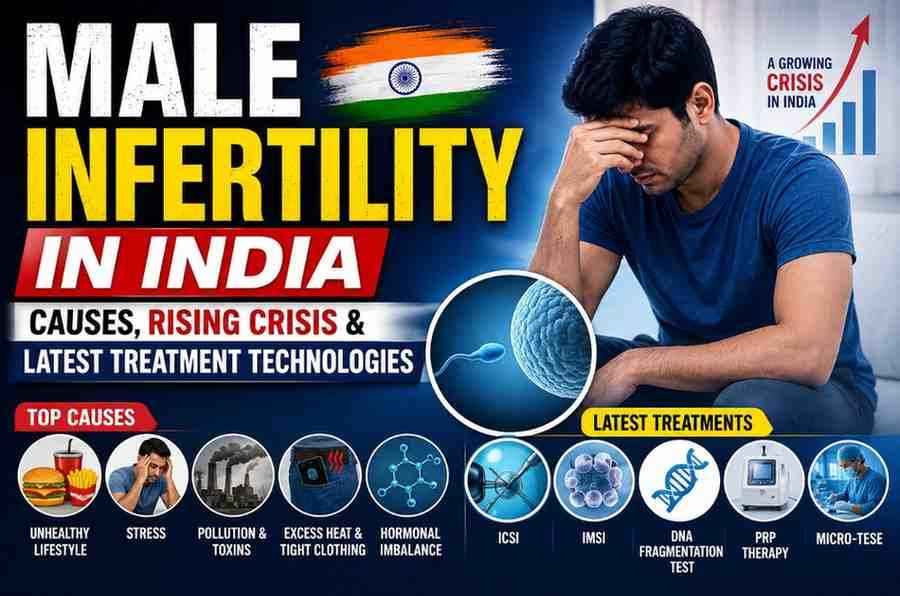
For decades, infertility in India was spoken about almost exclusively as a woman’s problem. The social, cultural, and even medical conversation defaulted to the female partner — her cycles, her hormones, her body, her burden. The reality, backed by a growing body of clinical evidence, tells a very different story. Male infertility contributes to nearly 40 to 50 percent of all infertility cases in India, and in a significant number of couples struggling to conceive, the primary factor is male reproductive health. Yet stigma, silence, and a stubborn cultural narrative have kept this truth largely out of mainstream conversation.
That is beginning to change. Gynaecologists and reproductive medicine specialists across India are increasingly vocal about the scale of the male infertility crisis, its causes, and critically the remarkable technological advances that are reshaping what Fertility care can actually achieve. For couples navigating the deeply personal and often exhausting journey of trying to conceive, understanding what is happening on the male side of the equation is no longer optional. It is essential.
The Scale of the Problem: Male Infertility in India by the Numbers
India is home to one of the world’s largest infertile populations. Estimates suggest that between 10 and 15 percent of Indian couples experience infertility, with the number seeking treatment growing year on year as awareness increases and stigma slowly decreases. Within that population, male factor infertility is a primary or contributing cause in roughly half of all cases.
What makes this particularly significant in the Indian context is the intersection of infertility with social and cultural pressures around parenthood. In a society where the ability to have children remains deeply tied to identity, family honour, and marital stability for many communities, the diagnosis of male infertility carries a psychological weight that extends far beyond the medical. Men are often the last to be tested, the last to acknowledge a problem, and the least likely to seek help which means the condition frequently goes undiagnosed for years while couples and their families quietly assume the issue lies elsewhere.
The Biggest Causes of Male Infertility in India: A Clinical Breakdown
1. Varicocele: The Most Common and Most Treatable Cause
A varicocele an enlargement of the veins within the scrotum, similar in mechanism to varicose veins in the legs is the single most commonly identified cause of male infertility worldwide, and India is no exception. Varicoceles are found in approximately 15 percent of all men and in up to 40 percent of men investigated for infertility. The enlarged veins raise the temperature of the testes, which damages sperm production and quality over time.
The medically important point about varicocele is that it is both diagnosable and treatable. A clinical examination or scrotal ultrasound can identify it, and surgical repair varicocelectomy has well-documented success rates in improving sperm parameters and spontaneous pregnancy rates. The tragedy in India is that many men with varicocele never get examined because the conversation never begins.
2. Oligospermia and Azoospermia: Low and Absent Sperm Count
Oligospermia refers to a sperm count below the threshold required for natural conception — defined by the World Health Organisation as fewer than 15 million sperm per millilitre of semen. Azoospermia is the complete absence of sperm in the ejaculate, affecting approximately one percent of all men and up to 15 percent of infertile men. Both conditions can result from hormonal imbalances, genetic factors, infections, or structural blockages in the reproductive tract.
India’s rising prevalence of these conditions is being linked increasingly to lifestyle and environmental factors a pattern that mirrors global trends but is accelerating in Indian urban populations at a particularly alarming rate.
3. Lifestyle Factors: The Modern Epidemic Driving Decline
The data on lifestyle’s impact on male fertility is now substantial and consistent. Obesity, physical inactivity, chronic stress, poor sleep, smoking, alcohol consumption, and heat exposure all of which have worsened significantly across India’s urban population over the past two decades are independently associated with reduced sperm count, impaired sperm motility, and increased sperm DNA fragmentation.
India’s rapid urbanisation has brought with it sedentary desk-bound work cultures, disrupted sleep patterns driven by screen exposure, dietary shifts toward processed and calorie-dense foods, and chronic psychological stress linked to economic pressures and competitive professional environments. The sperm-damaging effect of these changes is not theoretical. It is measurable in clinics across Mumbai, Delhi, Bengaluru, and Hyderabad, where reproductive specialists report declining semen quality parameters in men presenting for fertility evaluation over successive years.
4. Heat Exposure and Occupational Hazards
Sperm production requires a temperature approximately two degrees Celsius below core body temperature which is precisely why the testes are located outside the body. Chronic heat exposure, whether from sedentary laptop use, prolonged sitting in vehicles, occupational heat environments, or tight clothing, progressively impairs spermatogenesis. In a country where millions of men work in hot industrial, agricultural, or transportation environments, this is a clinically significant and chronically underappreciated risk factor.
5. Hormonal Imbalances and Endocrine Disruption
Testosterone deficiency, elevated prolactin, thyroid dysfunction, and FSH abnormalities all affect sperm production at the hormonal level. Increasingly, Indian reproductive specialists are also raising concerns about endocrine-disrupting chemicals pesticides, plasticisers, industrial pollutants, and compounds found in food packaging that mimic or interfere with hormonal signalling in the male reproductive system. India’s high agricultural chemical load and inconsistent food safety regulation make this a particularly relevant concern in the domestic context.
6. Infections and Sexually Transmitted Diseases
Untreated sexually transmitted infections — particularly chlamydia and gonorrhoea can cause scarring and blockages in the vas deferens and epididymis, leading to obstructive azoospermia. Orchitis (inflammation of the testes) following mumps infection, which remains under-vaccinated against in parts of India, can cause permanent testicular damage. These are preventable causes of male infertility where public health infrastructure failures translate directly into reproductive consequences.
7. Genetic Factors
Klinefelter syndrome (XXY chromosomal abnormality), Y-chromosome microdeletions, and cystic fibrosis gene mutations causing congenital absence of the vas deferens are genetic causes of male infertility that collectively account for a meaningful proportion of severe male factor cases. As genetic testing becomes more accessible in India, these diagnoses are being made with increasing frequency and genetic counselling is becoming a necessary component of fertility care for affected couples.
| Cause | Estimated Prevalence in Infertile Men | Primary Mechanism | Treatability |
|---|---|---|---|
| Varicocele | Up to 40% | Elevated testicular temperature | High — surgical repair effective |
| Oligospermia | 30–40% | Reduced sperm production | Moderate — depends on cause |
| Azoospermia | Up to 15% | Absent sperm obstructive or non-obstructive | Moderate to high with ART |
| Hormonal imbalance | 10–15% | Disrupted spermatogenesis signalling | High hormonal therapy |
| Genetic factors | 5–10% | Chromosomal or gene-level defects | Low managed with donor sperm or ART |
| Lifestyle factors | Rising significantly | Sperm DNA damage, motility impairment | High reversible with lifestyle change |
| Infection / STI | Variable | Structural blockage or inflammation | Moderate early treatment critical |
How Technology Is Transforming Male Fertility Care in India
Advanced Semen Analysis: Beyond the Basic Sperm Count
Traditional semen analysis count, motility, morphology has been the cornerstone of male fertility evaluation for decades. But it tells an incomplete story. A man can have a technically normal sperm count and still have significant fertility impairment if his sperm carry high levels of DNA fragmentation breaks or damage in the genetic material carried by the sperm. High sperm DNA fragmentation is associated with failed IVF cycles, recurrent miscarriage, and poor embryo quality, yet it is invisible on a standard semen analysis.
Tests like the Sperm DNA Fragmentation Index (DFI) and advanced computerised semen analysis systems are now increasingly available in Indian fertility centres, providing a far more granular picture of male reproductive function. This is not a minor upgrade it is a diagnostic revolution that is changing treatment decisions for thousands of couples.
Surgical Sperm Retrieval: Options Where None Existed Before
For men with azoospermia previously a near-absolute barrier to biological fatherhood surgical sperm retrieval techniques have transformed the clinical landscape. Procedures including PESA (Percutaneous Epididymal Sperm Aspiration), TESA (Testicular Sperm Aspiration), and Micro-TESE (Microsurgical Testicular Sperm Extraction) allow specialists to retrieve sperm directly from the epididymis or testicular tissue, even when no sperm are present in the ejaculate.
Micro-TESE, in particular, represents a significant technological advance. Using high-powered surgical microscopy, specialists can identify and extract the small pockets of sperm-producing tissue that exist even in severely affected testes — achieving successful sperm retrieval in patients who would have had no options just a generation ago.
Intracytoplasmic Sperm Injection (ICSI): Precision Fertilisation
ICSI the direct injection of a single sperm into a single egg has become the standard of care for severe male factor infertility worldwide and is now widely available across India’s major fertility centres. By bypassing the natural barriers to fertilisation, ICSI can achieve successful fertilisation even with very low numbers of poor-quality sperm. Combined with surgical sperm retrieval, it has made biological fatherhood possible for men who would previously have had no path to it.
Preimplantation Genetic Testing (PGT): Protecting the Next Generation
For couples where male factor infertility has a genetic basis particularly Y-chromosome microdeletions that can be inherited by male offspring Preimplantation Genetic Testing (PGT) allows embryos created through IVF to be screened for chromosomal abnormalities before transfer. This not only improves the chances of a successful pregnancy but also allows couples to make informed decisions about the genetic health of their future children. The availability of PGT in India has expanded significantly in recent years, bringing world-class genetic medicine within reach of a growing number of patients.
AI and Machine Learning in Sperm Selection
Perhaps the most forward-looking development in male fertility technology is the application of artificial intelligence to sperm selection. Traditional ICSI relies on an embryologist’s visual assessment to select the best available sperm a skill-dependent, subjective process. AI-powered systems can analyse sperm morphology, motility patterns, and structural characteristics at a level of precision and consistency impossible for the human eye, identifying the highest-quality sperm for injection with greater reliability. Several leading Indian fertility centres are already integrating these systems, and the results in terms of fertilisation rates and embryo quality are promising.
The Psychological Dimension: Breaking the Silence Around Male Infertility
Technology can correct a varicocele and retrieve sperm from damaged testes, but it cannot, by itself, address the cultural and psychological barriers that prevent Indian men from seeking diagnosis and treatment in the first place. The silence around male infertility in India is not a footnote it is a primary obstacle to care.
Men who receive an infertility diagnosis frequently report feelings of shame, diminished masculinity, and social anxiety about disclosure in a cultural context where virility and fertility are often conflated in ways that have no biological basis but carry enormous social weight. Partners, families, and even some healthcare providers inadvertently reinforce these dynamics by defaulting to female-centric investigations before the male partner has been properly evaluated.
Reproductive specialists increasingly advocate for simultaneous investigation of both partners from the outset of any fertility evaluation not as a gender-neutral courtesy but as a clinical necessity. Given that male factor is a primary or contributing cause in half of all cases, evaluating only the female partner first is not just culturally biased. It is medically inefficient and delays diagnosis for the couples who need help most urgently.
What Men Can Do Right Now: Practical Steps Toward Better Reproductive Health
The encouraging clinical reality is that a significant proportion of male infertility causes are either preventable or reversible. Lifestyle modifications maintaining a healthy body weight, regular aerobic exercise, reducing alcohol consumption, quitting smoking, managing chronic stress, and avoiding prolonged heat exposure to the groin have documented positive effects on sperm parameters. These are not soft recommendations. They are evidence-based interventions that can meaningfully improve fertility outcomes, often within the three-month window of a full sperm production cycle.
For men whose infertility has structural, hormonal, or genetic causes, early medical evaluation is the single most important step. A basic semen analysis, hormonal blood panel, and scrotal ultrasound provide a foundation for diagnosis that can be completed quickly and affordably in most Indian cities. The earlier the diagnosis, the wider the range of treatment options available.
Conclusion: A Crisis That Technology Can Address If Culture Allows It
Male infertility in India sits at the intersection of a genuine public health crisis and a cultural silence that has historically prevented the crisis from being addressed with the urgency it deserves. The medical profession now has remarkable tools from DNA fragmentation testing and Micro-TESE to AI-assisted sperm selection and preimplantation genetic screening that can help couples navigate even severe male factor infertility toward successful outcomes.
But technology works best when it is sought. For that to happen at the scale India requires, the conversation around male reproductive health needs to change in clinics, in families, in popular culture, and in the way men are taught to think about their own bodies. The science has moved. The culture needs to follow. And for the millions of Indian couples quietly struggling with infertility right now, the most important message is this: the problem may be more common than you think, the causes more treatable than you have been told, and the technology available to help you more powerful than it has ever been.
For breaking news and live news updates, like us on Facebook or follow us on Twitter and Instagram. Read more on Latest Lifestyle on thefoxdaily.com.

COMMENTS 0