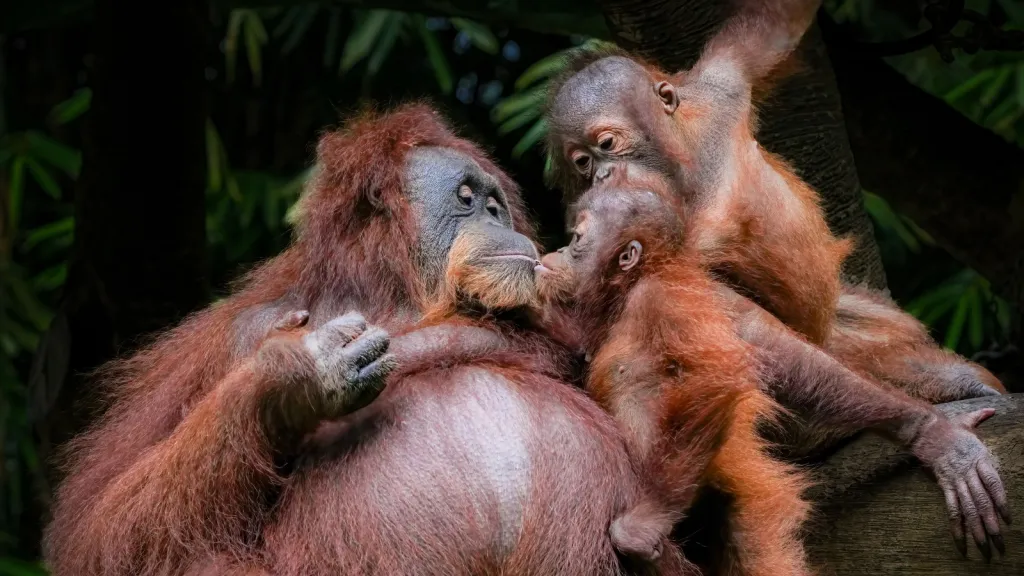
Orangutans are famous for their largely solitary lifestyle, but new research suggests that raising young may involve more social effort than previously understood. Wild orangutan mothers appear to change their travel patterns to give their babies opportunities to meet and play with other young orangutans.
The effort comes with a cost. Researchers found that mothers travelled greater distances and spent less time feeding on days when their infants played with peers. Their movements also changed in the days immediately before and after these encounters, suggesting that the meetings may be part of a broader pattern rather than random forest encounters.
The findings, based on long-term observations of Bornean orangutans in Indonesia, offer a fresh perspective on maternal care in one of the most solitary great ape species. They suggest that a mother’s investment in her offspring may extend beyond food, protection and physical development to include opportunities for social interaction.
The research was published in the journal Proceedings of the National Academy of Sciences (PNAS) on October 20, 2026.
Why socialising is unusual for orangutans
Orangutans have a different social structure from several other great apes. While chimpanzees commonly live in communities with frequent interactions, orangutans generally spend much of their time alone. Adult females typically move through forest areas with their dependent offspring, while encounters with other individuals can be relatively infrequent.
This solitary lifestyle creates a particular challenge for young orangutans. Infants spend much of their early lives close to their mothers, leaving fewer opportunities to interact with animals of a similar age. Peer encounters can therefore be important moments in an otherwise mother-centred childhood.
Social play allows young animals to engage with others beyond their immediate family relationship. For orangutan infants, these interactions may provide opportunities to practise movement, explore social responses and become familiar with other members of their species.
The new research is significant because it suggests that mothers may help create these opportunities despite the demands of finding food and navigating a large forest environment.
How researchers studied orangutan mothers and their infants
The study drew on 15 years of behavioural and movement data collected between 2003 and 2018 at the Tuanan Research Station in Central Kalimantan, Indonesian Borneo.
Researchers followed 31 wild Bornean orangutan mother-offspring pairs and recorded approximately 32,600 hours of observations. They examined the animals’ movements, feeding patterns and social interactions to understand how often infants played with peers and whether their mothers’ behaviour changed around those encounters.
Rather than looking only at the moments when young orangutans played, the researchers considered how mothers moved through the forest before and after those interactions. This helped them investigate whether the encounters were simply accidental or associated with changes in the mothers’ travel patterns.
One important finding involved the ages of the infants. Mothers whose offspring were closer in age tended to use the same forest areas more intensively, and their babies were more likely to play together.
The researchers also accounted for factors that could influence where orangutans gathered, including how closely related the mothers were and the availability of fruit. The association between overlapping forest use and infant play remained after these factors were considered.
This suggests that food availability or family relationships alone may not explain why certain infants had more opportunities to meet. The mothers’ movements appeared to be associated with the possibility of their offspring interacting with age-matched companions.
What do orangutan baby playdates look like?
When young orangutans meet, their interactions can be energetic. They may chase one another, grapple, wrestle and engage in rough physical play. These encounters provide a chance to interact with another young animal rather than spending all their time alongside their mothers.
However, the study found that peer play was relatively uncommon. Researchers recorded infant play with peers on only 6.32 per cent of full observation days. Even when an encounter occurred, the interaction was generally brief, lasting an average of about 21 minutes.
The short duration makes these meetings particularly interesting. A relatively small amount of time spent playing may require considerable movement by the mothers, especially when the animals live in a forest environment where individuals are not constantly together.
Mothers remained nearby during these encounters, maintaining the close association typical of young orangutans and their caregivers. The research therefore highlights a balance between the infants’ need for maternal proximity and their opportunities to interact with other young animals.
Why orangutan mothers travel farther and spend less time feeding
The most striking finding was the apparent cost of these social encounters for the mothers. On days when their infants played with peers, mothers travelled farther and spent less time feeding.
The researchers also observed increased travel distances on the days immediately before and after peer-play encounters. This pattern suggests that the mothers’ movements may change over several days around the opportunity for their infants to socialise.
Movement patterns before and after play
Researchers identified a particularly interesting change in the direction of travel. On the day before an infant play encounter, mothers tended to move towards the core area of another mother. After the interaction, they redirected their movements towards their own core area.
This pattern is important because it provides more detail than simply showing that mothers and infants sometimes meet other orangutans. The movements suggest that mothers may be travelling into areas associated with potential playmates before returning to their usual forest range.
Spending less time feeding also indicates a possible trade-off. Food gathering is an essential part of survival, and time spent travelling can reduce the time available for other activities. The study suggests that mothers may accept some of these costs when their infants have an opportunity to interact with peers.
Researchers describe this behaviour as a form of maternal investment that has received less attention than feeding, carrying and protecting offspring. It points to the possibility that mothers also invest time and energy in their young animals’ social development.
Do orangutan mothers recognise where other mothers are likely to be?
The findings raise an intriguing question about how orangutans understand their surroundings. Researchers suggest that mothers may have knowledge of neighbouring individuals and the areas those animals regularly use.
If mothers are familiar with the movement patterns of other females, they may be able to increase the chances of their infants meeting suitable companions by travelling towards particular forest areas. Their understanding of the landscape could therefore involve not only where food is available but also where other orangutans are likely to be found.
This possibility offers a new way to think about the social lives of a species often described as solitary. Even when individuals spend much of their time apart, they may retain information about neighbouring animals and their usual locations.
However, the findings need to be interpreted carefully. The research tracked movement patterns and associations between mothers and infant play. It did not demonstrate that orangutans consciously arrange meetings in the same way human parents organise playdates.
It is more accurate to say that the observed movements were consistent with mothers adjusting their routes in ways that could increase opportunities for their infants to socialise. Whether they deliberately plan these encounters, and how they make such decisions, requires further investigation.
How peer play may help young orangutans develop
Social play is an important part of development in many animal species. Young animals can use play to practise physical movements, test their abilities and learn how to respond to others. Chasing, wrestling and other forms of interaction can provide opportunities to develop coordination and social skills.
For orangutans, peer play may be especially valuable because their solitary lifestyle limits how often young individuals encounter animals of a similar age. Interactions with other infants can offer experiences that are different from those gained through constant contact with their mothers.
These encounters may also help young orangutans become more familiar with social situations outside their immediate mother-offspring relationship. However, the current study does not establish exactly which developmental benefits the infants receive or how long those benefits last.
What researchers still need to investigate
One important unanswered question is whether infants that experience more peer play develop different social abilities as they grow older. The study documents the association between maternal movements and infant interactions, but it does not establish the long-term consequences of those encounters.
Further research will be needed to determine whether regular access to peers influences offspring survival, later social behaviour or reproductive success. Longer-term observations could also help clarify whether early play experiences affect how orangutans interact with other individuals as adults.
Researchers would also need to investigate how mothers identify potential companions, how much they know about neighbouring individuals and whether the observed movement patterns are consistent across different orangutan populations and forest environments.
What the study reveals about maternal care in wild orangutans
The research offers a broader understanding of what maternal care can involve in a species known for spending much of its time alone. Raising an infant is not limited to providing food, carrying the young animal or keeping it safe. It may also involve creating opportunities for experiences that support development.
For orangutan mothers, these opportunities appear to come with practical trade-offs. Travelling farther can require additional energy, while spending less time feeding may affect how they use their time in the forest. Yet the observed patterns suggest that mothers’ movements are associated with occasions when their infants meet and play with peers.
The findings also challenge a simple interpretation of orangutan solitude. A species can be largely solitary without being completely disconnected from social relationships. Individuals may spend long periods apart while still maintaining knowledge of neighbouring animals and occasionally interacting with them.
Most importantly, the study does not suggest that orangutan mothers behave exactly like human parents. Instead, it reveals a form of maternal investment shaped by the animals’ own ecology and social structure.
For now, the research provides a fascinating glimpse into the hidden social lives of wild orangutans. Even in a species where young animals spend much of their time with their mothers, a little time with peers may matter enough for mothers to travel farther, adjust their routes and sacrifice some feeding time to make those encounters possible.
For breaking news and live news updates, like us on Facebook or follow us on Twitter and Instagram. Read more on Latest Lifestyle on thefoxdaily.com.






COMMENTS 0