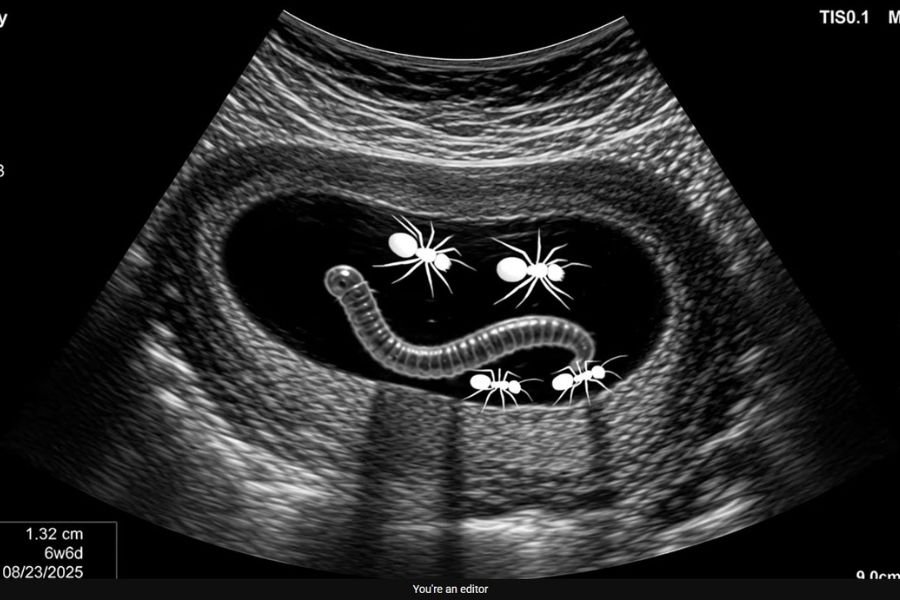
Videos of parents and teachers using fake ultrasound scans to show children imaginary worms inside their stomachs after eating chocolate or junk food have gone viral on social media. The apparent aim is to make children avoid unhealthy food, but child-development and mental-health experts warn that frightening children into changing their eating habits can create anxiety, shame and an unhealthy relationship with food.
Fake ultrasound prank videos are raising a bigger question about parenting
Social media is full of Parenting hacks that promise quick results. Some rely on humour, some on rewards and others on simple explanations. But a recent trend takes a much more alarming route: children are shown a fabricated ultrasound image and told that worms are moving inside their stomach because they ate chocolate, sweets or junk food.
In the videos circulating online, a parent or teacher may first give a child a favourite snack. The child is then taken through a staged ultrasound-like activity. A screen displays manipulated images resembling an ultrasound scan, while a computer mouse or another object is used to imitate an ultrasound transducer. The child is subsequently told that the strange shapes visible on the screen are worms living inside the stomach.
The reactions captured on camera are often the central part of the content. Some children appear confused, while others cry, panic or become visibly distressed after being told that their food has caused the supposed infestation.
The adults involved may have a straightforward intention: discourage children from eating too much junk food. But the trend raises an important question about whether the method is appropriate, particularly when the lesson is built around fear and deception.
Why the prank may seem effective in the moment
Fear is a powerful learning mechanism. When a child believes something dangerous is happening to their body, the emotional response can be immediate. A child who has just been frightened by an imagined medical problem may refuse the food associated with that experience.
That immediate change can make the prank appear successful to adults. A child stops asking for chocolate. They may refuse chips or other processed snacks. Parents may feel that the message has finally reached them.
But changing behaviour in the short term is not necessarily the same as teaching healthy habits.
Children learn not only from the information adults give them but also from the emotional context in which that information is delivered. If healthy eating is introduced through fear, a child may remember the fear more strongly than the nutritional lesson.
This distinction becomes particularly important when the subject is food. Eating is not simply a matter of following rules. Food is connected with hunger, pleasure, family routines, celebrations, culture, social interaction and emotional experiences. Messages that make children associate certain foods with contamination, punishment or bodily harm can become difficult to separate from the food itself.
Could children actually become afraid of food?
A single prank does not automatically mean that a child will develop a long-term eating problem. Children’s reactions vary widely according to age, temperament, previous experiences and the way adults respond afterwards.
However, repeated exposure to frightening food-related messages can potentially contribute to anxiety around eating. A child who is repeatedly told that certain foods contain worms, cause serious illness or are dangerous may begin to distrust those foods.
The concern is not limited to junk food. Young children may not always understand the distinction between a deliberately exaggerated prank and a factual medical explanation. If an adult they trust says that worms are inside their stomach, the child may take the statement literally.
For a young child, the emotional memory can also be stronger than the explanation that follows. Even if the parent later reveals that the ultrasound was fake, the child has already experienced genuine fear.
The central issue is not whether children should eat less junk food. They should learn balanced eating habits. The concern is whether fear and deception are appropriate tools for teaching those habits.
Fear-based food messages can blur the difference between healthy and unhealthy eating
Children benefit from learning that food exists on a spectrum. Some foods provide more nutrients, fibre, protein or essential vitamins, while others are best eaten occasionally because they are high in added sugar, salt or saturated fat.
That is different from teaching children that a particular food is inherently “bad” or dangerous.
A chocolate bar does not suddenly become poisonous because a child eats it. Similarly, an occasional packet of chips does not mean that a child has done something morally wrong. Healthy eating is generally about patterns over time rather than fear of individual foods.
When adults use frightening images to create a strict good-food versus bad-food divide, children may struggle to develop a flexible understanding of eating.
Instead of thinking, “This is something I can enjoy sometimes,” a child may begin thinking, “This food will hurt me.” For some children, that distinction can become particularly difficult if the frightening message is repeated.
The trust factor matters
There is another layer to the prank that goes beyond food: trust.
Children depend on parents, teachers and other trusted adults to explain the world around them. Medical equipment, doctors and ultrasound scans are unfamiliar concepts for many young children. When an adult uses a realistic-looking medical setup to make a child believe that something is wrong inside their body, the deception can feel very real.
That can create confusion when the truth is revealed.
A child may wonder what else the adult has said that is not true. They may also become frightened by genuine medical procedures later because they associate ultrasound equipment with being told that something is wrong.
The risk may be greater when the prank is filmed and shared publicly. A frightened child may not fully understand what it means to have their emotional reaction recorded and posted online. What adults see as funny or educational content may feel embarrassing to the child later.
Why the “worms” message can be especially frightening
The imagery used in these videos is not random. Worms are particularly effective as a fear trigger because they evoke ideas of contamination, disease and something unwanted living inside the body.
For an adult, it may be obvious that the image is fabricated. A young child may not have the cognitive ability to question whether the scan is authentic.
The child may therefore experience a genuine fear response: something is moving inside my body, I caused it by eating something, and the adults around me are confirming that it is real.
That is a very different lesson from explaining that excessive consumption of sugary or highly processed foods can affect health over time.
Children need nutrition education, not food-related fear
Teaching children about nutrition does not have to mean giving them a detailed lecture about calories, sugar or disease. In fact, younger children often respond better to simple and positive explanations.
Parents can explain that different foods help the body in different ways. Fruits and vegetables can be described as foods that provide vitamins and fibre. Pulses, eggs, dairy products and other protein-rich foods can be discussed in terms of helping children grow and stay strong. Water can be presented as an important drink for hydration.
Favourite treats can remain part of the conversation without becoming frightening objects.
A useful message is that some foods are everyday foods and some are foods we enjoy less often. This approach allows children to understand moderation without attaching fear or shame to eating.
What parents can say instead of staging a fake medical test
If a child frequently asks for sweets, biscuits, sugary drinks or fast food, parents can turn the moment into a practical conversation.
- Explain the reason: Tell the child that the body needs a variety of
For breaking news and live news updates, like us on Facebook or follow us on Twitter and Instagram. Read more on Latest Lifestyle on thefoxdaily.com.






COMMENTS 0