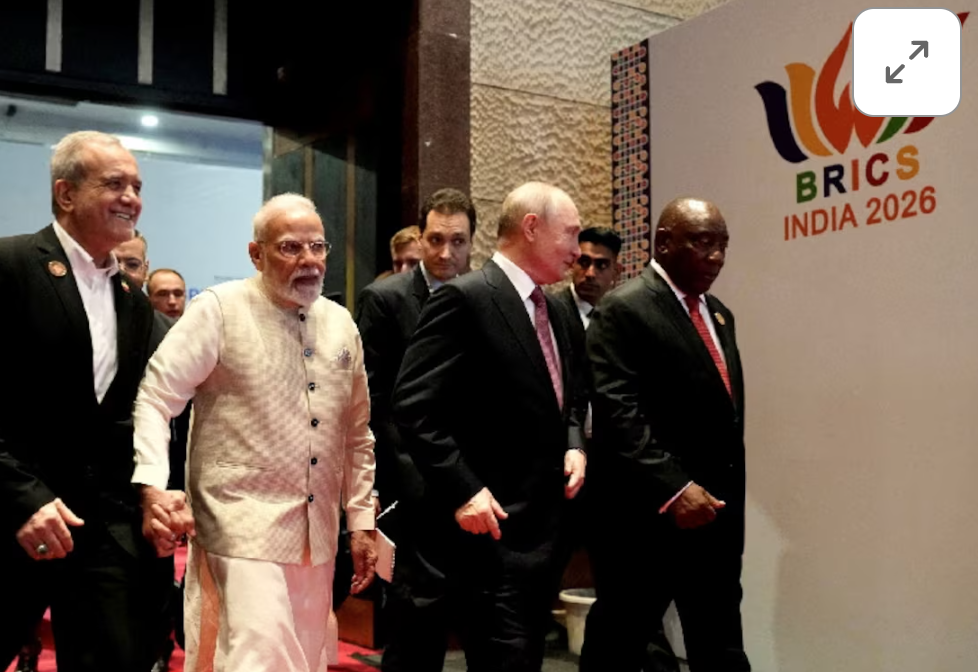
BRICS Summit 2026: BRICS leaders have agreed on a joint declaration at the group’s summit in New Delhi, marking an important diplomatic breakthrough for a bloc that has faced internal disagreements over the Middle East conflict. The agreement comes as tensions between the United States and Iran continue and BRICS members attempt to demonstrate that emerging economies can find common ground on major global issues.
India, which is hosting the summit, played a central role in consultations aimed at bridging differences among members. Prime Minister Narendra Modi used the opening session to call for stronger BRICS cooperation, greater representation for the Global South and urgent reform of the United Nations Security Council.
BRICS Agrees on Joint Declaration Despite Internal Differences
The agreement on a joint declaration is significant because BRICS foreign ministers meeting in New Delhi in May were unable to issue a joint statement. Differences between Iran and the United Arab Emirates, particularly over the Gulf conflict, had prevented consensus.
Four sources familiar with the negotiations said the latest declaration was unlikely to name any particular country. Instead, it was expected to condemn unilateral aggression by any country.
The approach allowed members with differing positions on the Middle East conflict to support common language without directly assigning responsibility to one side.
Leaders were expected to formally approve the document later on Saturday. The Indian government did not immediately comment on the reported agreement.
Why the Joint Declaration Matters for BRICS
The declaration may not immediately change the military or geopolitical situation in the Middle East, but its diplomatic importance is broader.
For BRICS, reaching consensus demonstrates that the group can still produce a common political position despite disagreements among its members. That is particularly important as the bloc seeks a larger role in global decision-making.
The group increasingly presents itself as a platform for emerging economies seeking greater influence over international institutions and global economic rules.
In that context, the ability to negotiate a common declaration is itself a measure of BRICS’ political credibility.
Middle East Conflict Creates a Major Test for BRICS Unity
The summit is taking place against the backdrop of renewed fighting between the United States and Iran. The conflict has already created wider economic and security concerns, particularly around the Gulf and Red Sea shipping routes.
The challenge for BRICS is that the bloc includes countries with different strategic relationships and interests in the region.
Iran and the United Arab Emirates have particularly important differences over the Gulf conflict, making the search for acceptable diplomatic language difficult.
India has attempted to maintain relations with a wide range of countries, including the United States, Russia, Iran, Israel and Gulf Arab states. That gives New Delhi a complicated diplomatic balancing role during the summit.
India’s Diplomatic Balancing Act
Hosting the summit gives India an opportunity to shape the agenda while avoiding language that could unnecessarily deepen divisions among BRICS members.
India has strong economic and strategic relationships with both Western countries and BRICS members. Maintaining this balance is especially important when issues involving sanctions, energy security, trade and military conflicts are being discussed.
The joint declaration therefore represents not just a BRICS achievement but also a diplomatic test for India.
Indian negotiators reportedly conducted sustained consultations to bridge competing positions and build consensus among the members.
Modi Calls for a Stronger Voice for the Global South
Prime Minister Narendra Modi used the summit to argue that developing and emerging countries should have a greater role in shaping international decisions.
He said the Global South is heavily affected by international crises but remains underrepresented in major global decision-making structures.
His argument goes beyond BRICS itself. India has increasingly called for international institutions to reflect the economic and demographic weight of emerging countries.
India Renews Demand for UN Security Council Reform
Modi also reiterated India’s longstanding demand for reform of the United Nations Security Council.
He argued that reform can no longer be delayed and called for a broader representation of emerging powers in global institutions.
For India, permanent membership of an expanded Security Council remains a major diplomatic objective. New Delhi has consistently argued that today’s international institutions do not adequately reflect the world’s current political and economic realities.
Who Attended the BRICS Summit?
The New Delhi summit brought together leaders from several major emerging economies. Among those attending were Russian President Vladimir Putin, Chinese President Xi Jinping, Iranian President Masoud Pezeshkian, South African President Cyril Ramaphosa and Abu Dhabi Crown Prince Sheikh Khaled bin Mohamed bin Zayed Al Nahyan.
The presence of senior leaders from countries with different foreign-policy priorities underlines both the diversity and the complexity of the expanded BRICS grouping.
| BRICS Summit 2026 Factor | Why It Matters |
|---|---|
| Joint declaration | Demonstrates that members can reach consensus despite differences |
| Middle East conflict | Tests the bloc’s ability to maintain a common position |
| India’s role | New Delhi has worked to bridge competing positions |
| Global South representation | India is seeking greater influence for emerging economies |
| UN Security Council reform | India wants global institutions to better reflect today’s power structure |
| Economic cooperation | BRICS aims to expand trade and reduce barriers among members |
BRICS Expansion Has Made Consensus More Difficult
The modern BRICS grouping is considerably broader than its original membership. It now includes Brazil, Russia, India, China, South Africa, Egypt, Ethiopia, Indonesia, Iran and the United Arab Emirates.
The expansion has increased the group’s economic and demographic weight, but it has also introduced more diverse national interests.
Different members have different relationships with the United States, Europe, Russia, China and countries in the Middle East. They also have different priorities concerning energy, trade, sanctions and security.
That makes consensus more difficult than it was when BRICS consisted of a smaller number of countries.
What Is BRICS Trying to Achieve?
BRICS was established in 2009 and has sought to increase the influence of emerging economies in international affairs.
The bloc has criticised aspects of a global system that it sees as disproportionately influenced by Western powers. Its members have called for changes to institutions such as the World Bank, International Monetary Fund and World Trade Organization.
BRICS has also increasingly focused on trade cooperation, investment and reducing barriers between member economies.
Its growing membership gives the group a larger potential economic base, but turning that size into coordinated policy remains one of its biggest challenges.
Xi Jinping Calls for a More Equitable International Order
Chinese President Xi Jinping said BRICS countries should support a more equitable and just international order.
His comments fit into a broader BRICS argument that global institutions should give emerging economies a stronger voice.
However, the group’s internal differences show that a shared criticism of the existing international system does not necessarily mean that members agree on every geopolitical issue.
The joint declaration is therefore important because it demonstrates that members can identify areas of common ground even when their individual strategic interests differ.
BRICS and the Global Economy
BRICS’ influence is not limited to diplomacy. The group represents a significant share of the world’s population and economic activity.
Its members together account for more than 40% of the global population and almost one-quarter of the global economy, according to the information accompanying the summit.
That economic scale gives the bloc potential influence over trade, investment, energy markets and supply chains.
But economic size does not automatically translate into collective power. Members must still overcome differences in regulations, currencies, trade policies, political priorities and bilateral relationships.
Trade Cooperation Is a Key Priority for India
India is pushing BRICS members to expand trade cooperation, reduce barriers and create more business opportunities.
For New Delhi, stronger intra-BRICS trade could help diversify economic relationships and create new opportunities for Indian companies.
Greater cooperation could also become increasingly relevant as global supply chains are reshaped by geopolitical tensions and competition between major powers.
However, deeper trade integration will require practical progress rather than political declarations alone. Differences in tariffs, regulations, payment systems and market access can limit the benefits of increased cooperation.
Can BRICS Become a Stronger Geopolitical Force?
The latest joint declaration provides evidence that BRICS can find common ground, but it does not eliminate the group’s internal contradictions.
The Middle East crisis illustrates the challenge clearly. Members may agree on broad principles such as opposing unilateral aggression, yet still have very different views about specific conflicts and national interests.
For BRICS to become a more influential geopolitical force, it will need to convert its growing membership and economic weight into practical cooperation.
Three Areas to Watch
- Economic cooperation: Whether members can significantly expand trade and investment.
- Institutional reform: Whether BRICS can coordinate demands for changes to global financial and political institutions.
- Diplomatic coordination: Whether the group can maintain consensus when major conflicts divide its members.
Why the New Delhi Summit Is Important for India
For India, the summit offers an opportunity to position New Delhi as a bridge between competing geopolitical blocs.
India’s relationships with the United States, Russia, Iran, Israel and Gulf countries make its diplomatic position unusually complex. That complexity can also become an advantage if India is able to facilitate dialogue among countries that do not always agree.
The successful negotiation of the joint declaration strengthens India’s argument that it can help build consensus among major emerging economies.
What the Joint Declaration Does Not Solve
Despite its significance, the declaration should not be viewed as a solution to the divisions within BRICS.
It does not remove disagreements between Iran and the UAE, nor does it resolve the broader conflict involving the United States and Iran. It also does not automatically create a unified BRICS foreign policy.
Instead, its importance lies in establishing a minimum level of consensus at a particularly difficult moment.
That distinction is crucial when assessing BRICS’ future. The bloc’s ability to issue statements is useful, but its long-term influence will depend on whether members can turn political consensus into economic and institutional cooperation.
BRICS Summit 2026: The Bigger Picture
The New Delhi summit comes at a time when the international system is becoming increasingly fragmented. Trade disputes, sanctions, military conflicts and competition between major powers are reshaping global economic relationships.
In this environment, BRICS is attempting to position itself as a stronger voice for emerging economies.
The joint declaration sends a carefully calibrated message: BRICS members can disagree on individual conflicts while still cooperating around broader principles and demands for greater representation.
For India, the immediate diplomatic achievement is securing consensus. The longer-term challenge will be turning that consensus into measurable progress on trade, investment, institutional reform and global governance.
Bottom Line
BRICS has agreed on a joint declaration at its New Delhi summit despite deep differences among members over the Middle East conflict. The agreement is a diplomatic success for the expanded grouping and reflects India’s efforts to bridge competing positions.
Prime Minister Narendra Modi has used the summit to push for a stronger voice for the Global South, greater BRICS economic cooperation and urgent reform of the UN Security Council. The declaration may not change the immediate geopolitical situation, but it demonstrates that BRICS can still find common ground amid major international tensions.
The real test now is whether the bloc can move beyond declarations and translate its growing economic and demographic weight into practical cooperation and greater influence over global decision-making.
For breaking news and live news updates, like us on Facebook or follow us on Twitter and Instagram. Read more on Latest Business on thefoxdaily.com.



COMMENTS 0