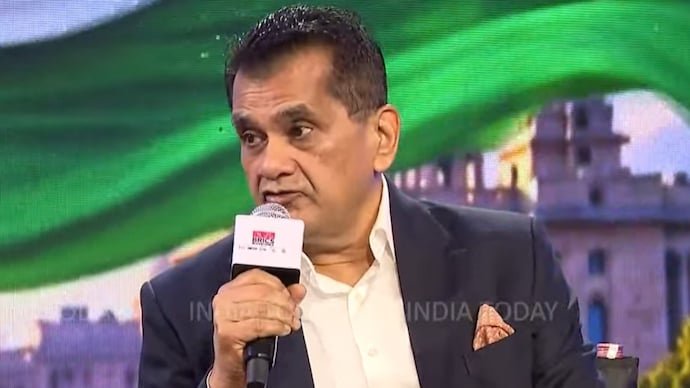
India must approach its BRICS presidency as a mature and pragmatic global player rather than allowing the grouping to acquire an anti-Western image, former G20 Sherpa Amitabh Kant has said. As New Delhi hosts the BRICS Summit, Kant argued that India’s long-term interests require it to engage simultaneously with the United States, Europe and China while using the grouping to advance trade, investment, development and climate priorities.
Kant made the remarks amid an increasingly difficult international Environment marked by conflicts in Europe and the Middle East, supply-chain disruptions, protectionist trade measures and industrial policies designed by major economies to strengthen domestic production.
His warning comes at a strategically important moment for India. The country is trying to balance deepening ties with the United States and Europe with an important economic and diplomatic relationship with China, while also maintaining its partnerships with Russia and other members of the expanded BRICS grouping.
For India, the challenge is not simply to manage disagreements between major powers. It is to ensure that its BRICS leadership supports the country’s development ambitions without narrowing its diplomatic options.
Why Amitabh Kant wants India to avoid an anti-Western BRICS agenda
Kant’s central argument is that India’s BRICS presidency should focus on consensus building rather than confrontation.
He has cautioned against allowing the summit’s outcome document to be interpreted as an anti-Western statement, particularly at a time when India is simultaneously expanding cooperation with Washington and European capitals.
The logic behind the position is straightforward. India’s economic transformation depends on access to Western markets, technology, capital and investment, while its strategic environment requires sustained engagement with China and other emerging powers.
Turning BRICS into an explicitly anti-Western political platform could therefore create unnecessary friction with countries that India needs for its development and security objectives.
At the same time, avoiding an anti-Western posture does not mean abandoning India’s independent positions. New Delhi has repeatedly sought to preserve strategic autonomy by cooperating with different partners on different issues rather than entering rigid geopolitical blocs.
India’s multi-alignment strategy is at the heart of BRICS diplomacy
The phrase “multi-aligned” captures the approach Kant believes India should maintain during its presidency.
India has built relationships across competing geopolitical camps. It works closely with the United States through initiatives such as the Quad and expanding defence and technology cooperation, while remaining deeply engaged with Russia in areas ranging from energy to defence.
China remains India’s most complicated major-power relationship, shaped by economic interdependence alongside unresolved border tensions and strategic competition in the Indo-Pacific.
Europe, meanwhile, has become increasingly important to India’s trade, investment, technology and climate partnerships.
That makes the Indian position different from the idea of choosing one side of a global rivalry. The goal is to maximise India’s strategic and economic room for manoeuvre.
BRICS remains significant despite criticism that it is losing relevance
Kant dismissed the argument that BRICS has become irrelevant, pointing instead to the grouping’s growing economic and geopolitical weight.
The expanded BRICS grouping includes 11 members and represents roughly 40 per cent of global GDP and about a quarter of global trade. Its expansion has widened the forum’s geographical reach and strengthened its importance in discussions involving the Global South.
The group’s economic significance gives India an important platform to influence debates over trade, investment, development financing, energy and international economic Governance.
But the enlargement also makes consensus more difficult. BRICS members have different economic models, political systems, foreign-policy priorities and relationships with the United States and Europe.
India therefore has to perform two roles simultaneously: represent its own national interests and keep a diverse coalition moving toward common ground.
Consensus becomes harder as BRICS expands
Managing an expanded BRICS is fundamentally different from managing a smaller grouping of relatively similar economies.
The interests of China and India do not always align. Gulf countries have their own strategic calculations. Russia’s relationship with the West is fundamentally different from that of many other members. Brazil and South Africa bring their own priorities concerning development, trade and global governance.
The inclusion of countries with competing regional interests makes the task of producing a unanimous political document considerably more complicated.
That is why Kant has placed so much emphasis on consensus building as the hallmark of India’s presidency. India’s diplomatic success will be measured not simply by the positions it advocates, but by whether it can bring countries with sharply different perspectives toward language they can all accept.
Middle East conflict creates an unusual BRICS challenge
One of the biggest complications facing the summit is the ongoing conflict in the Middle East.
The gathering brings together countries that have very different positions and interests in the region. Iran is a BRICS member, while the United Arab Emirates and Saudi Arabia are also part of the expanded grouping and have faced direct security threats related to the conflict.
The simultaneous presence of countries with competing regional interests creates a delicate diplomatic environment for India.
Rather than allowing the summit to become dominated by geopolitical confrontation, Kant has argued that New Delhi should steer discussions toward issues that offer the greatest common ground.
His recommendation is particularly significant because the Middle East crisis has already generated consequences far beyond the region, affecting energy prices, Shipping, inflation and supply chains.
Why India should prioritise trade and investment
Kant believes India’s BRICS agenda should focus strongly on trade, investment and development.
That strategy would allow India to use the summit to address practical economic concerns affecting members and other developing countries rather than turning every discussion into a geopolitical debate between rival power centres.
Trade is especially important because global commerce has been reshaped by tariffs, industrial subsidies, export controls and efforts by governments to reduce dependence on foreign supply chains.
For emerging economies, these policies can increase production costs and restrict access to major markets. A BRICS dialogue focused on resilient supply chains and greater investment could therefore have wider economic value.
India also has an opportunity to use its presidency to encourage cooperation in areas such as digital infrastructure, logistics, Energy Security, manufacturing and technology.
The Global South could benefit from an economic-focused BRICS
Kant’s proposal places the Global South at the centre of India’s BRICS priorities.
Developing countries have been particularly exposed to the economic consequences of wars, high energy prices, disrupted shipping routes, tighter financial conditions and rising protectionism.
A BRICS agenda that concentrates on economic resilience could therefore address problems that affect countries regardless of their ideological or geopolitical preferences.
This is also where India’s leadership could have the greatest practical impact. Instead of attempting to settle disagreements between major powers, India can focus on areas where cooperation produces measurable benefits for developing economies.
Such an approach would allow New Delhi to position BRICS as an economic and developmental platform while avoiding the perception that the group exists primarily to challenge Western countries.
India’s Viksit Bharat target shapes the calculation
Kant linked India’s international strategy directly to the country’s Viksit Bharat ambition of becoming a developed economy by 2047.
Achieving that goal will require large-scale investment, technological upgrading, stronger manufacturing capabilities, greater exports and access to global markets.
Those requirements make diplomatic flexibility a valuable economic asset. India cannot afford to isolate itself from any major centre of capital, technology, trade or strategic influence.
This explains Kant’s emphasis on working with the US, Europe and China at the same time. The relationships may compete with each other in some areas, but India has interests that require engagement with all three.
For India, multi-alignment is therefore not simply a foreign-policy philosophy. It is increasingly linked to economic development.
US scepticism toward BRICS adds another complication
India’s balancing act is also complicated by US President Donald Trump‘s sceptical approach toward BRICS.
Washington has increasingly viewed the grouping through the lens of whether it could eventually reduce Western influence over global trade and finance. Any BRICS document that explicitly criticises the United States or advocates a confrontational alternative to the existing international system could attract stronger American opposition.
That would make India’s wider diplomatic task harder because New Delhi is simultaneously trying to expand strategic cooperation with Washington.
Kant’s warning is therefore less about protecting the image of BRICS and more about protecting India’s strategic flexibility. A confrontational summit could produce headlines, but it could also narrow India’s options after the meeting ends.
India has to balance China without turning BRICS into a battleground
China represents perhaps the most complicated element of India’s BRICS strategy.
Both countries are major Asian economies and key participants in the grouping, but their relationship remains affected by border tensions, strategic competition and concerns about China’s growing influence across the Indo-Pacific.
At the same time, China is too economically significant for India to ignore. Bilateral economic ties, regional trade and supply-chain realities make engagement necessary even when strategic disagreements persist.
India’s objective, therefore, is unlikely to be either confrontation or unconditional accommodation. The practical challenge is to manage competition while finding areas in which both countries can cooperate.
A consensus-oriented BRICS presidency gives India a framework to pursue that approach without making the summit itself an arena for bilateral rivalry.
What India can realistically achieve as BRICS chair
India’s presidency cannot resolve the biggest geopolitical disputes dividing BRICS members. Neither can it fundamentally reshape relations between the United States, China, Russia and Europe through one summit.
Its realistic opportunity lies in building agreements around issues where interests overlap.
These include improving trade links, encouraging investment, strengthening development cooperation, improving supply-chain resilience, supporting climate action and developing practical mechanisms for greater economic cooperation.
India can also use the summit to highlight concerns shared by developing economies, including high borrowing costs, energy insecurity, infrastructure financing gaps and unequal access to advanced technologies.
Success on these issues would provide a more durable legacy than a strongly worded geopolitical declaration.
Why the summit theme matters
India’s BRICS chairship is built around resilience, innovation, cooperation and sustainability. The theme provides a natural framework for the priorities Kant has outlined.
Resilience can address vulnerable supply chains and energy disruptions. Innovation can focus on technology and digital infrastructure. Cooperation can support trade and investment. Sustainability can bring climate finance and clean-energy development into the conversation.
These themes also create a diplomatic advantage because they are less politically divisive than direct discussions about military alliances or geopolitical competition.
By focusing on practical areas of cooperation, India can demonstrate that a multipolar world does not necessarily require an anti-Western or anti-American political agenda.
BRICS expansion brings both opportunity and risk
The expansion of BRICS has increased the group’s influence, but it has also made its internal politics more complicated.
The more countries that join, the more difficult it becomes to reach detailed agreement on sensitive geopolitical issues. At the same time, a larger membership base creates a broader economic market and more opportunities for trade, investment and energy cooperation.
India’s presidency will therefore be judged partly on whether it can convert the numerical expansion of BRICS into practical cooperation.
The challenge is to avoid two extremes: turning BRICS into a loose talking shop with little concrete output, or pushing it too aggressively toward a geopolitical bloc that alienates countries outside the grouping.
Can BRICS strengthen India’s global influence?
The presidency gives India another platform to present itself as a major voice of the developing world without formally positioning itself against the West.
That middle-ground strategy fits New Delhi’s broader diplomatic ambitions. India wants to be recognised as a leading power with influence across multiple groupings, from the G20 and BRICS to the Quad and wider Global South initiatives.
Its ability to maintain relationships across these different forums is itself a source of influence.
A successful BRICS presidency could reinforce India’s reputation as a country capable of bringing competing interests together. A presidency dominated by geopolitical confrontation, on the other hand, could make it harder for New Delhi to maintain its carefully constructed balance.
The bigger issue is India’s place in a fragmented world
Kant’s remarks point to a larger question: how should India navigate a world in which the old global order is becoming more fragmented?
Major economies are increasingly using tariffs, industrial subsidies, export restrictions and technology controls to protect national interests. At the same time, conflicts are disrupting energy markets and trade routes, while institutions created after the Second World War face growing pressure to adapt.
India cannot control these trends. It can, however, decide how much strategic flexibility it maintains while they unfold.
That makes the principle of multi-alignment increasingly practical. India can cooperate with the United States on technology and defence, with Europe on trade and investment, with China on selected economic issues and with BRICS partners on Global South priorities without treating these relationships as mutually exclusive.
What a successful Indian BRICS presidency would look like
A successful summit for India would not necessarily be one that produces the strongest geopolitical declaration. It could instead be one that delivers a credible set of economic and developmental outcomes while keeping the diverse membership united.
That would strengthen India’s standing as a consensus-builder and allow New Delhi to advance its own priorities without becoming trapped in the rivalries of larger powers.
For Kant, that is the essence of acting as a “mature, seasoned player.” India has enough economic and diplomatic weight to shape discussions, but it also has enough interests at stake to understand the cost of choosing confrontation where cooperation remains possible.
India’s BRICS test goes beyond the summit
The real test of India’s BRICS presidency will begin after the leaders leave New Delhi.
Statements and declarations matter, but their value depends on whether they translate into stronger trade, investment, development cooperation, climate action and economic resilience.
India’s ability to deliver such outcomes will determine whether its presidency is remembered primarily for geopolitical rhetoric or for practical diplomacy.
For New Delhi, the strategic objective is clear: use BRICS to expand India’s influence without shrinking its relationships elsewhere. Working with the United States, Europe and China at the same time may be difficult, but it is precisely that balancing act that could allow India to protect its national interests and keep its 2047 development ambitions on track.
For breaking news and live news updates, like us on Facebook or follow us on Twitter and Instagram. Read more on Latest India on thefoxdaily.com.





COMMENTS 0