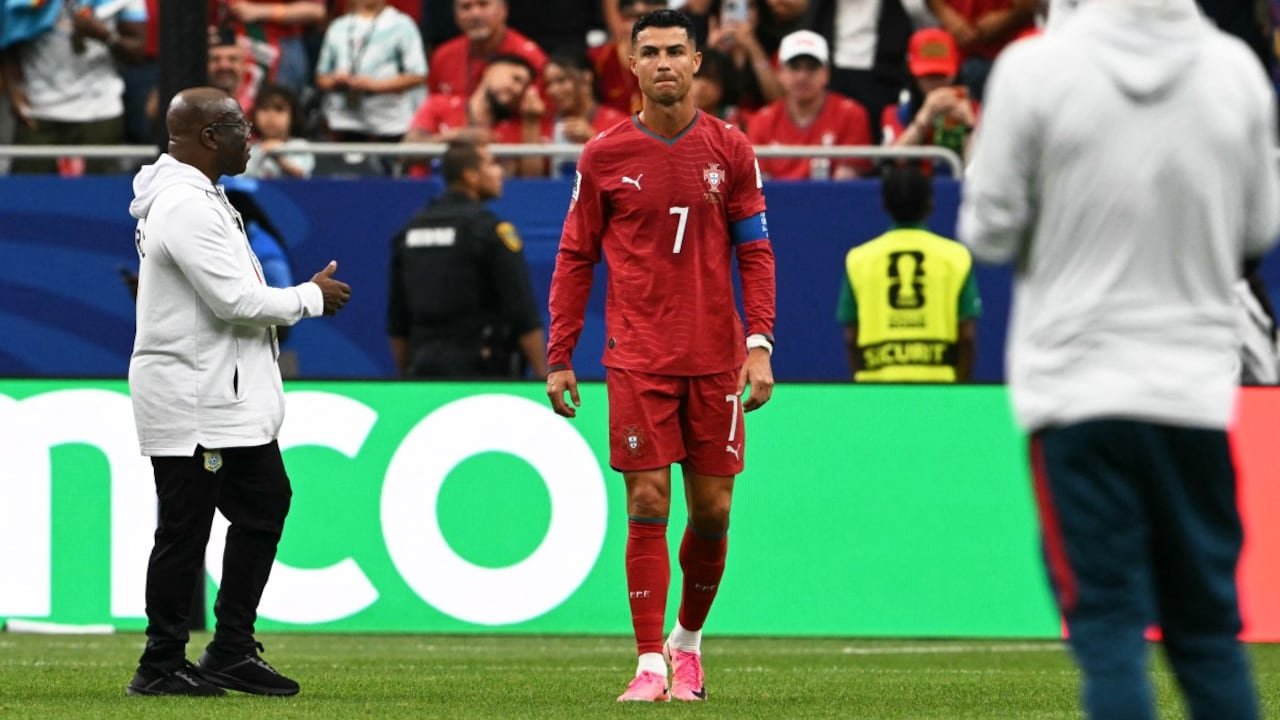
“The team needs to score, not you need to score.”
Those words from Thierry Henry captured the central dilemma surrounding Cristiano Ronaldo after Portugal’s underwhelming 1-1 draw against DR Congo in their opening match of the 2026 FIFA World Cup.
For two decades, Ronaldo built his legacy on relentless ambition, elite physical conditioning, and an unmatched obsession with goals. Time and again, he transformed criticism into motivation and setbacks into triumphs.
But football, perhaps more than any other sport, is unforgiving when it comes to age.
At 41 years and 132 days, Ronaldo became the oldest outfield player to start a FIFA World Cup match. While the milestone underscored his extraordinary longevity, it also highlighted a more uncomfortable reality: Portugal may need to rethink how they use their greatest-ever player.
The concern is not that Ronaldo no longer has value. The concern is whether Portugal’s current system extracts enough value from him to justify building their attack around him.
Portugal Dominated Possession but Lacked Purpose
For the opening 20 minutes, Portugal appeared to be in complete control.
Joao Neves headed Portugal into an early lead, and Roberto Martinez’s side monopolised possession with ease. Featuring midfield technicians like Bruno Fernandes, Vitinha, and Bernardo Silva, Portugal completed hundreds of passes while limiting DR Congo’s time on the ball.
However, possession alone rarely wins World Cup matches.
Despite enjoying overwhelming control, Portugal struggled to convert territory into meaningful opportunities. Their passing sequences often ended in harmless areas, with few line-breaking passes or dangerous runs behind the defence.
The result was a surprisingly sterile attacking display.
| Key Match Statistics | Portugal | DR Congo |
|---|---|---|
| Goals | 1 | 1 |
| Total Shots | 7 | 8 |
| Shots on Target | 1 | 2 |
| Expected Goals (xG) | 0.64 | 0.82 |
| Passes Completed | 783 | 249 |
The statistics tell a striking story. Portugal completed more than three times as many passes as their opponents, yet DR Congo created the better opportunities.
That disparity points to a larger issue than individual underperformance—it suggests a structural problem.
The Evolution of Cristiano Ronaldo’s Game
Ronaldo’s transformation over the years has been remarkable.
Early in his career, he terrorised defenders as a dynamic winger capable of beating opponents with pace, power, and dribbling ability. He could carry attacks single-handedly, create chances for teammates, and influence every phase of play.
Today, his role is fundamentally different.
Ronaldo operates almost exclusively inside the penalty area, relying on movement, positioning, and finishing instincts rather than explosive athleticism.
Against DR Congo, that evolution exposed its limitations.
He finished the match with just 25 touches and failed to register a single shot on target.
For most strikers, those numbers would be disappointing. For a player regarded as one of football’s greatest goalscorers, they are alarming.
Modern football increasingly demands forwards who contribute to build-up play, press aggressively, and create space for teammates. Ronaldo’s current profile offers less flexibility in those areas.
The Numbers Behind Ronaldo’s International Decline
Football’s biggest stars are ultimately judged by their output, and recent numbers paint a difficult picture.
Ronaldo has now gone 10 consecutive matches across the FIFA World Cup and UEFA European Championship without scoring.
Portugal have also struggled offensively when heavily dependent on their captain.
In the team’s last four major tournament matches, Ronaldo has played 396 out of a possible 420 minutes, yet Portugal have scored only once.
Interestingly, Portugal’s goals-per-game average improves significantly when Ronaldo is not on the pitch.
While statistics never tell the complete story, they raise valid questions about whether Portugal’s attack has become too predictable.
Too often, the team’s final actions appear designed to find Ronaldo rather than identify the best available option.
Why the Lionel Messi Comparison Matters
Comparisons between Ronaldo and Lionel Messi have defined an era, and the opening week of the 2026 World Cup reignited that debate.
Messi’s hat-trick for Argentina demonstrated how he has successfully adapted his game to the realities of aging.
Instead of remaining fixed in advanced positions, Messi now operates deeper, influencing matches through passing, vision, and spatial awareness.
His role allows younger, quicker teammates to attack space while he orchestrates play.
Portugal’s setup asks Ronaldo to do the opposite.
As a central striker, his primary responsibility remains scoring goals. When those goals do not arrive, his influence over the game diminishes considerably.
The comparison is not about determining which player is greater. It highlights two very different approaches to aging in elite football.
Is Portugal’s System Limiting Its Creative Talent?
Portugal possess one of the most technically gifted midfields in international football.
Bruno Fernandes excels at risk-taking passes. Bernardo Silva thrives in tight spaces. Vitinha dictates tempo and progression.
Yet against DR Congo, these strengths rarely translated into genuine chances.
Part of the issue may be tactical.
When a team prioritises feeding one player, even a player of Ronaldo’s stature, it can unintentionally reduce attacking unpredictability.
Defenders know where the danger is likely to come from, making it easier to organise and defend.
Portugal looked constrained by their own structure, circulating possession comfortably without generating enough movement around the penalty area.
Should Roberto Martinez Consider a Difficult Decision?
Few coaches willingly bench a player of Ronaldo’s stature.
However, tournament football often rewards difficult decisions over emotional ones.
Fernando Santos faced similar criticism when he left Ronaldo out of key matches during the 2022 World Cup.
Four years later, the same conversation has returned.
Using Ronaldo as an impact substitute could offer several advantages. Fresh legs against tired defenders would maximise his finishing ability while reducing the physical demands placed on him.
It would also allow Portugal’s midfield to play with greater fluidity during the early stages of matches.
That approach carries risks, particularly given Ronaldo’s status within Portuguese football, but it may provide the balance the team currently lacks.
The Burden of History Could Define Portugal’s Tournament
Roberto Martinez defended his decision to keep Ronaldo on the pitch, arguing that removing the greatest goalscorer in football history when a team needs a goal makes little sense.
On paper, that logic is understandable.
In reality, it reflects Portugal’s biggest challenge.
They are balancing the legacy of an icon with the practical demands of winning football matches in 2026.
Ronaldo remains a leader, a symbol, and one of the sport’s most influential figures.
But World Cups are won by teams willing to evolve.
Portugal must decide whether loyalty to their past can coexist with the tactical flexibility required for future success.
Conclusion
Cristiano Ronaldo’s legacy is secure regardless of what happens at the 2026 FIFA World Cup.
However, football’s biggest tournaments have little interest in past achievements.
Portugal’s draw against DR Congo exposed a team struggling to adapt to the realities of an aging superstar. Ronaldo’s experience and goalscoring instincts remain valuable, but the team can no longer rely solely on his reputation to solve complex tactical problems.
The challenge facing Roberto Martinez is not whether to trust Ronaldo—it is how to use him in a way that elevates the entire team.
Because Thierry Henry’s message remains the most important lesson from Portugal’s opening match: the objective is not for Cristiano Ronaldo to score.
The objective is for Portugal to win.
For breaking news and live news updates, like us on Facebook or follow us on Twitter and Instagram. Read more on Latest Sports on thefoxdaily.com.






COMMENTS 0